The Complete Apartment Gym Etiquette Guide: Being a Considerate Home Gym Owner
A comprehensive guide to being a considerate apartment gym owner, covering noise management, shared walls, floor protect...
Complete guide to soundproofing your apartment gym. Learn about flooring, wall treatments, equipment choices, and layout strategies to keep neighbors happy.
FTC Disclosure: SnugGym.com participates in the Amazon Associates Program. We earn commissions from purchases made through our links at no cost to you. Our reviews are independently researched and not influenced by affiliate partnerships.
Apartment gym noise is the single most common reason home fitness setups get abandoned. Not because the equipment fails — but because a neighbor complaint forces a choice between working out and maintaining your lease. Soundproofing your gym space isn't about eliminating all noise (impossible without structural changes). It's about reducing noise to levels that don't trigger complaints — typically below the threshold that penetrates walls and floors during normal daytime hours.
Airborne transmission: Sound traveling through air, through walls, under doors, and through HVAC vents. Addressed by sealing gaps and adding mass to surfaces.
Impact transmission: Vibration from dropped weights, jumping, and footfalls traveling through the floor structure. Addressed by decoupling and absorption at the impact point.
Flanking transmission: Sound traveling around walls through connected structures — floor joists, ductwork, and shared walls. The hardest path to address in rentals.
| Source | Estimated dB Level | Transmission Risk |
|---|---|---|
| Normal conversation | 60 dB | Low |
| Treadmill running | 65-75 dB | Moderate-High |
| Jumping rope | 70-80 dB | High |
| Dumbbell drop (bare floor) | 80-95 dB | Very High |
| Barbell drop (bare floor) | 90-100+ dB | Extreme |
| Deadlift on platform | 40-50 dB | Low |
| Rowing machine | 50-60 dB | Low-Moderate |
| Resistance band exercises | 20-30 dB | None |
The floor is where most gym noise originates and where soundproofing delivers the greatest return on investment.
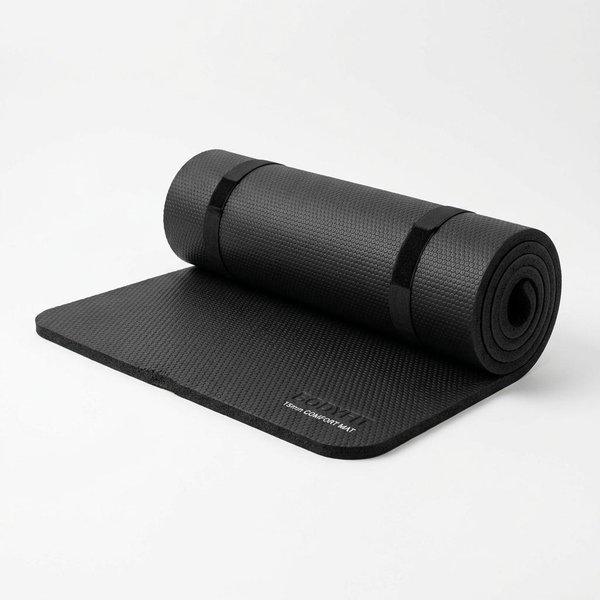
Start with the largest, highest-quality mat you can fit. This is your primary impact noise defense.
Top recommendation: Titan Fitness Equipment Mat
| Specification | Detail |
|---|---|
| Material | High-density PVC |
| Thickness | 3/8" to 1/2" |
| Size Options | 4'×6' to 8'×10' |
| Price | $40-120 |
Our analysis: The Titan mat provides a continuous, dense barrier between equipment and subfloor. The PVC material is more durable than EVA foam tiles and doesn't compress under heavy loads, maintaining its acoustic properties over time.
For any area where weights contact the floor, add 3/4" horse stall mats over the base mat.
Tractor Supply 4'×6' Stall Mat
For Olympic lifts or any exercise involving dropped implements, build a dedicated platform:
See our DIY Soundproof Platform Guide for detailed construction steps.
Mass-loaded curtains and moving blankets hung on the gym-facing walls absorb reflected sound within your space. This doesn't stop transmission to adjacent units but reduces the overall noise level in your room.
Best option: NICETOWN Soundproof Curtains
Foam acoustic panels absorb mid-to-high frequencies (clanking weights, machine noise). They do NOT block sound transmission through walls — they only reduce echo within your space.
Recommended placement:
For serious soundproofing, U-shaped rubber channels ("U-boats") decouple the floor from the subfloor. These are installed under plywood subflooring and are typically used in commercial recording studios. They require significant construction and are impractical for most rentals.
Gym noise escapes primarily through gaps around doors. Sealing these is the cheapest and most effective airborne noise reduction step.
Install a draft-blocking door sweep to seal the gap under your gym room door.
Suptikes Door Draft Stopper
Apply foam or rubber weatherstripping around the door frame to seal the perimeter.
| Gap Location | Solution | Cost |
|---|---|---|
| Under door | Door sweep | $10-15 |
| Door jamb sides | Foam weatherstripping | $5-8 |
| Door top | Foam strip | $3-5 |
| HVAC vents | Magnetic vent covers | $10-15 |
| Electrical outlets | Foam outlet gaskets | $5 |
The quietest gym is one with quiet equipment. Strategic equipment choices reduce noise at the source.
| Equipment | Noise Level | Best For |
|---|---|---|
| Magnetic rowing machine | 50-60 dB | Full-body cardio, minimal noise |
| Under-desk elliptical | 25-35 dB | Active recovery, desk work |
| Recumbent bike (magnetic) | 45-55 dB | Low-impact steady state |
| Stepper (hydraulic) | 40-50 dB | Compact cardio |
| Jump rope | 70-80 dB | Avoid in apartments |
| Treadmill | 65-75 dB | Use with extreme caution |
See our Best Quiet Cardio Equipment section for detailed reviews.
| Exercise Modification | Noise Impact | Recommendation |
|---|---|---|
| Dumbbell → selectorized | Eliminates plate clanking | Highly recommended |
| Deadlift → controlled eccentric | Eliminates floor impact | Highly recommended |
| Plyometrics → low-impact alternatives | Reduces impact by 70%+ | Recommended |
| Plate-loaded machines → selectorized | Quieter weight changes | Moderate impact |
| Free weights → resistance bands | Near-silent | Excellent for apartments |
Even the best soundproofing has limits. Combine physical improvements with behavioral strategies.
| Time Window | Noise Tolerance | Recommendation |
|---|---|---|
| 6 AM - 8 AM | Very Low | Cardio, stretching, bands only |
| 8 AM - 10 AM | Low | Light strength work, no drops |
| 10 AM - 6 PM | Moderate | Normal workouts acceptable |
| 6 PM - 9 PM | Low-Moderate | Normal strength, limit drops |
| 9 PM - 11 PM | Very Low | Stretching, mobility only |
| 11 PM - 6 AM | Zero | No gym use (consider building rules) |
If possible, introduce yourself to neighbors below and beside your gym space. A brief conversation establishing mutual respect often prevents the formal complaint process even if occasional noise occurs.
| Tier | Components | Total Cost | Noise Reduction |
|---|---|---|---|
| Essential ($50-100) | Door sweep + weatherstripping, basic floor mat | $50-100 | 20-30% |
| Standard ($150-300) | Above + stall mats, curtains, equipment selection | $150-300 | 40-55% |
| Advanced ($400-700) | Above + soundproof platform, acoustic panels, upgraded flooring | $400-700 | 60-75% |
| Maximum ($800-1500) | Above + mass-loaded vinyl, Green Glue, professional materials | $800-1500 | 75-85% |
How much does soundproofing cost for a typical apartment gym?
For most apartment gym builders, $150-300 in soundproofing materials (floor mats, door seals, curtains) provides meaningful noise reduction. This investment protects your security deposit and neighbor relationships while enabling unrestricted training.
Can I completely soundproof a room without construction?
No. True sound isolation requires decoupled walls, mass-loaded construction, and sealed openings — all impossible without structural modifications. However, you can reduce gym noise by 60-75% with the strategies in this guide, which is sufficient to prevent complaints in most buildings.
What if my downstairs neighbor complains anyway?
First, listen — they may be hearing something you don't (flanking through ducts, for example). Add additional flooring mass. If complaints continue, consider shifting to quieter exercises (bands, controlled eccentrics) or working out during agreed-upon hours.
Is cork flooring good for gym soundproofing?
Cork underlayment provides moderate sound absorption but isn't sufficient as a primary gym floor. It's best used as an additional layer beneath rubber mats or stall mats, where it adds decoupling. Cork alone compresses too much under heavy weights.