The Complete Apartment Gym Etiquette Guide: Being a Considerate Home Gym Owner
A comprehensive guide to being a considerate apartment gym owner, covering noise management, shared walls, floor protect...
Specialized strategies for exercising in upstairs apartments. Flooring, equipment selection, timing, and technique modifications for downstairs neighbor harmony.
Living above someone transforms home gym planning from a personal convenience calculation into a social negotiation. The physics are unforgiving: impact noise travels downward with minimal attenuation through standard floor assemblies, and your floor is someone else's ceiling.
This guide addresses the specific challenges of upstairs apartment workouts with targeted strategies for flooring, equipment selection, exercise modification, and neighbor relations. If someone lives below you, every recommendation here is essential reading.
Sound transmission between vertically stacked units follows established physical principles governed by mass, stiffness, and damping of the floor-ceiling assembly.
When you drop a weight or jump, you create a vibration in your floor. This vibration propagates through:
Research by the National Research Council Canada found that in typical wood-frame construction, 70–85% of impact noise energy reaches the unit below through the direct path, with the remainder through flanking [NRC-CNRC, 2023].
Human hearing is most sensitive to frequencies between 1,000–4,000 Hz, but annoyance from neighbor noise peaks at 100–500 Hz—the range where structure-borne vibration re-radiates as audible sound. A dropped weight generates a broadband impulse with peak energy around 200–400 Hz, precisely where floor assemblies provide least isolation [ISO 10140-3, 2023].
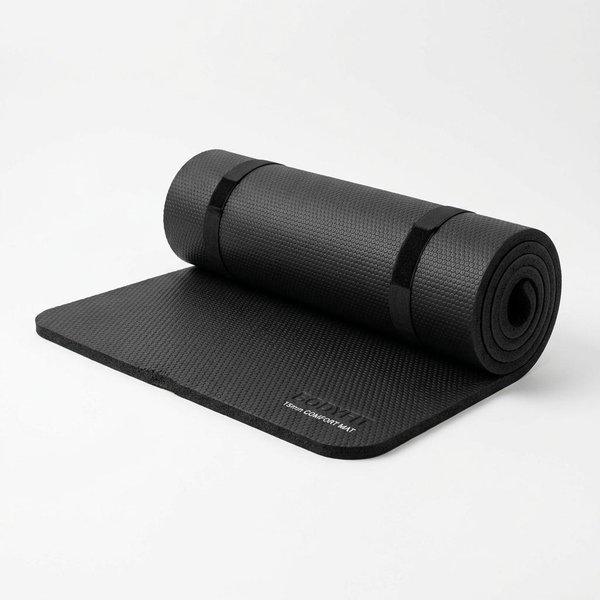
Downstairs neighbors require your maximum flooring investment. The minimum specifications below exceed ground-floor requirements.
| Exercise Type | Minimum Flooring | Recommended Enhancement |
|---|---|---|
| Yoga/stretching | 1/4" (6mm) rubber or TPE | Add 1/8" cork underlayment |
| Bodyweight HIIT | 1/2" (12mm) rubber | Add 1/4" cork underlayment |
| Light dumbbells (<30 lbs) | 1/2" (12mm) rubber | Add 1/4" cork underlayment |
| Moderate dumbbells (30–60 lbs) | 5/8"–3/4" (16–19mm) rubber | Add 1/4" cork + isolation pads |
| Barbell training | 3/4" (19mm) rubber + platform | 1" rubber + 2" foam platform |
| Any plyometrics | 3/4" (19mm) rubber minimum | 1" rubber + additional ceiling treatment (if possible) |
For upstairs units, cork underlayment beneath rubber flooring is not optional—it addresses the decoupling function that rubber alone cannot provide. Cork's cellular structure breaks the rigid connection between your flooring and the subfloor, interrupting vibration transmission at its source.
Recommended stack for upstairs barbell training:
This three-layer system can achieve 30–38 dB impact reduction in wood-frame construction [NRC-IRC, 2023].
Treadmills are the most downstairs-disruptive common home gym equipment. If you live above someone, standard treadmill use requires substantial mitigation:
Required modifications:
Reality assessment: If your building has wood-frame construction and IIC below 45, treadmill running may be incompatible with neighbor relations regardless of mitigation. Consider a walking-only protocol or commercial gym membership for running days.
The controlled eccentric: Lower weights under muscular control rather than dropping. A controlled 135 lb deadlift lowering generates approximately 55–60 dB downstairs; the same weight dropped generates 75–85 dB [Håkonsen & Bø, 2022].
Technique modifications:
Equipment modifications:
Rogue Echo Bumper Plates on Amazon
Plyometrics (box jumps, jump squats, burpees) generate repetitive impact that accumulates in neighbor annoyance. Replace with:
| Original Exercise | Upstairs Alternative | Noise Reduction |
|---|---|---|
| Box jumps | Step-ups onto platform | ~20 dB |
| Jump squats | Slow squats with pause at bottom | ~25 dB |
| Burpees | Mountain climbers (no jump) | ~30 dB |
| Jump rope | Shadow jumping (no rope contact) | ~35 dB |
| Broad jumps | Walking lunges | ~25 dB |
| Depth jumps | Not recommended upstairs | N/A |
Before establishing your workout schedule, observe your building's activity patterns for one week:
| Time Block | Observation Target | Your Action |
|---|---|---|
| 6:00–8:00 AM | Are downstairs lights on? Are they getting ready for work? | If lights are on, moderate noise may be acceptable |
| 8:00 AM–5:00 PM | Is the unit unoccupied (work hours)? | Optimal workout window for noise-intensive exercises |
| 5:00–7:00 PM | Cooking smells, TV noise, activity sounds? | Moderate noise likely acceptable |
| 7:00–9:00 PM | Quiet period beginning? | Light workouts only; no plyometrics or heavy lifts |
| 9:00 PM–7:00 AM | Silence expected | No workouts unless explicitly cleared with neighbor |
Weekend schedules differ significantly from weekdays. Many residents:
Weekend modification: Shift high-noise activities to late morning (10 AM–12 PM) when neighbors are awake but before afternoon quiet time begins. Never assume weekend noise tolerance matches weekday tolerance.
Most rental agreements prohibit permanent modifications, but some landlords permit non-destructive enhancements:
If you have a good relationship with your downstairs neighbor, coordinated acoustic treatment can benefit both parties:
Important: Never modify another person's unit without written permission from both the neighbor and landlord.
Sound escapes your unit through gaps around doors and through shared walls:
Understanding what your downstairs neighbor actually hears enables informed adjustments:
For the first two weeks of training, text your downstairs neighbor before and after each session:
"About to start my workout—45 minutes, mostly quiet lifting. Text if anything bothers you!""Done for today. Everything okay on your end?"
This establishes communication norms and surfaces issues before they become grievances.
If a complaint arrives before you've implemented these measures, immediate action is required:
Within 24 hours:
Within 48 hours:
Within 1 week:
Last updated: January 2025. All recommendations prioritize neighbor relations while preserving workout quality. Individual building construction determines ultimate noise transmission.