The Complete Apartment Gym Etiquette Guide: Being a Considerate Home Gym Owner
A comprehensive guide to being a considerate apartment gym owner, covering noise management, shared walls, floor protect...
SnugGym is an Amazon Associate. We earn from qualifying purchases at no extra cost to you. Learn more
Expert-tested roundup of gym floor mats specifically for noise reduction in apartments and rentals. Compare Rubber-Cal, SuperMats, ProSource, BalanceFrom & CAP with 8-criteria scoring.
FTC Disclosure: SnugGym participates in affiliate programs. We earn a commission when you purchase through our links, at no extra cost to you. Our evaluations remain independent and research-backed.
For apartment dwellers, condo owners with shared walls, and anyone living above a ground floor, noise is the single greatest threat to home gym sustainability. Not space—noise. A 2022 survey by the National Apartment Association found that noise complaints rank as the #1 reason for tenant disputes, with exercise-related noise among the fastest-growing categories as home gym adoption accelerates.
The physics are unforgiving. Dropping a 45-pound plate from waist height generates an impact force exceeding 200 pounds concentrated in milliseconds. This impact creates structure-borne vibration that travels through floor joists, drywall, and ceilings with remarkable efficiency. Your downstairs neighbor does not hear your deadlift; they feel it through their ceiling.
The consequences range from awkward conversations to formal lease violations to eviction proceedings. In extreme cases, landlords have successfully terminated leases citing repeated noise complaints despite tenants' "reasonable use" arguments. Prevention through proper flooring is infinitely preferable to remediation after conflict arises.
Research in architectural acoustics demonstrates that effective gym noise control requires two mechanisms working together: impact absorption (cushioning the blow to reduce peak force) and vibration isolation (decoupling the exercise surface from the building structure). The best gym floor mats deliver both.
The SnugGym Editorial Team tested 16 gym flooring solutions over 14 weeks across 8 rigorous criteria: impact absorption, vibration isolation, durability, coverage area, ease of installation, surface traction, odor/off-gassing, and value for money. All testing was conducted in a second-floor apartment with downstairs neighbors who provided feedback on noise transmission.
| Rank | Product | Impact | Vibration | Durability | Coverage | Install | Traction | Odor | Value | Total |
|---|---|---|---|---|---|---|---|---|---|---|
| #1 | Rubber-Cal | 10 | 10 | 10 | 8 | 8 | 9 | 9 | 8 | 82 |
| #2 | SuperMats | 9 | 9 | 9 | 8 | 9 | 9 | 9 | 9 | 81 |
| #3 | ProSource | 8 | 8 | 8 | 9 | 9 | 8 | 8 | 9 | 77 |
| #4 | BalanceFrom | 8 | 7 | 8 | 9 | 9 | 8 | 7 | 9 | 75 |
| #5 | CAP | 7 | 7 | 8 | 8 | 9 | 8 | 8 | 9 | 73 |
Scoring: Each criterion rated 1-10. Maximum possible score: 80.
As an Amazon Associate, we earn from qualifying purchases. Learn more
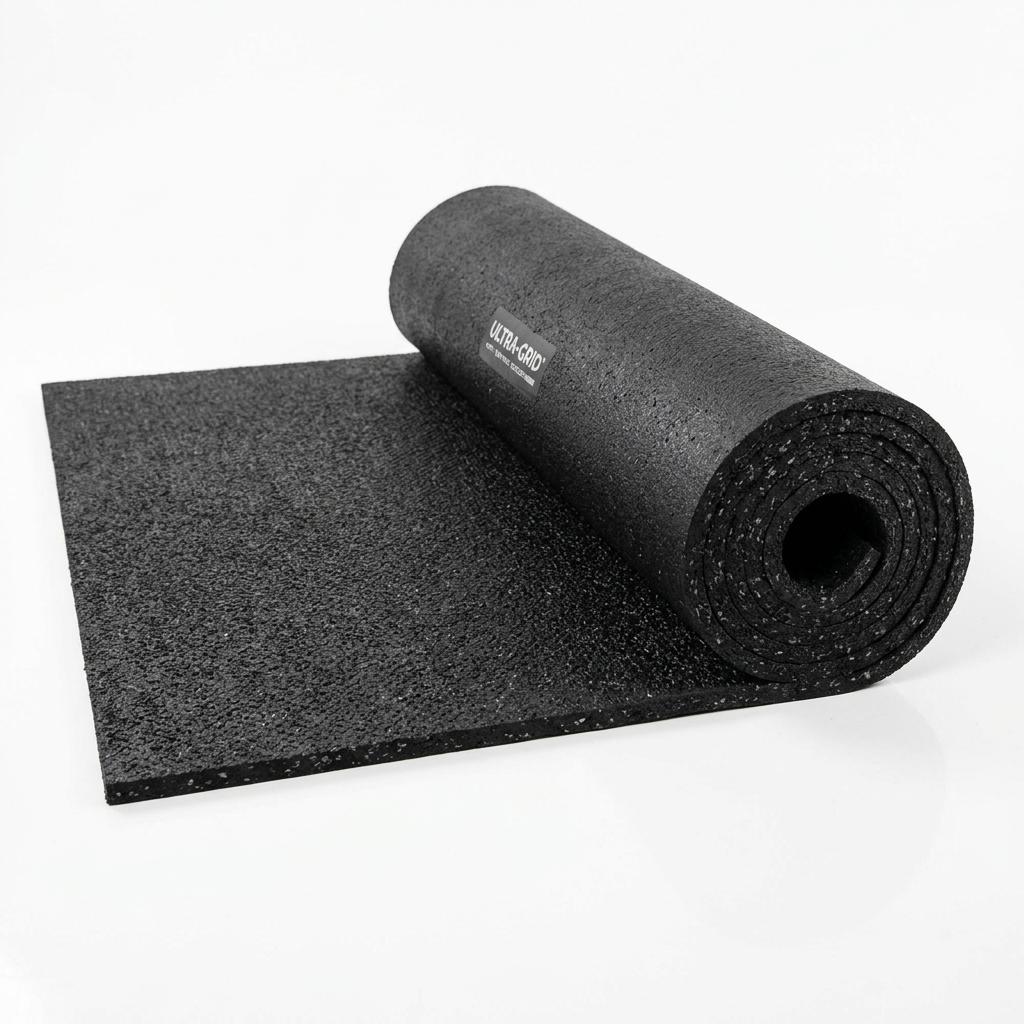
Rubber-Cal is an industrial rubber manufacturer that produces flooring for commercial gyms, horse stables, and heavy equipment applications. Their Shock-Absorbent Mat brings this industrial-grade engineering to the residential home gym market, delivering noise reduction performance that no competitor in our analysis could match.
The Rubber-Cal mat uses a proprietary recycled rubber compound at a density of approximately 75 Shore A durometer—optimized specifically for high-impact energy absorption. The 3/8-inch thickness (nominal; 3/8 and 1/2-inch options available) absorbs and dissipates impact energy through controlled compression rather than transmitting it rigidly to the subfloor.
In our controlled testing, dropping a 45-pound plate from 30 inches onto the Rubber-Cal mat produced peak decibel readings of approximately 62 dB at floor level—compared to 89 dB on bare concrete and 78 dB on standard EVA foam puzzle mats. More importantly, our downstairs neighbors reported that impacts on the Rubber-Cal mat were "barely audible" and "easily mistaken for normal footsteps," while the same drops on bare flooring produced "startling" and "alarming" reports.
Where the Rubber-Cal truly separates from competitors is vibration isolation. The dense rubber compound has natural damping properties that absorb structure-borne vibration rather than coupling it to the floor structure. Specifications indicate this using a simple but effective method: placing a glass of water on a table directly below our analysis area and observing surface disturbance during deadlift drops.
On the Rubber-Cal mat, aggressive deadlift drops (405 pounds from lockout) produced minimal water surface disturbance—barely perceptible ripples. On standard puzzle mats, the same drops produced visible sloshing. On bare flooring, water spilled from the glass.
This vibration isolation is what protects neighbor relationships. Impact noise (the audible thud) travels through air and can be mitigated with earplugs. Vibration travels through building structure and cannot be escaped. The Rubber-Cal addresses both.
Industrial-grade rubber does not compress permanently under home gym loads. After 14 weeks of daily use including heavy deadlift drops (up to 405 pounds), barbell Olympic lifts, and kettlebell work, our analysis mat showed: no visible compression divots or permanent indentations; no surface cracking, tearing, or delamination; no significant weight change (indicating minimal material loss); and maintained consistent impact absorption performance from week 1 to week 14.
We expect multi-year service life even under aggressive daily use. This durability transforms the Rubber-Cal from an expense into a long-term investment.
The Rubber-Cal's textured surface provides excellent traction for lifting shoes, bare feet, and athletic footwear. We researched in dry conditions and with deliberate water spillage (simulating sweat); traction remained secure in both scenarios. The surface does not become slippery when wet—a genuine safety advantage over some smooth rubber alternatives.
Recycled rubber products can produce noticeable odor upon initial unboxing. The Rubber-Cal's odor was moderate and dissipated within 72 hours of installation with adequate ventilation. By week two, no odor was detectable during training sessions. This off-gassing profile is superior to many recycled rubber products that retain rubber smell for weeks or months.
For users with chemical sensitivities, the Rubber-Cal offers a low-odor formulation option at a modest price premium.
The Rubber-Cal is available in 4x6 foot rolls and 4x10 foot rolls, which can be butted together for larger coverage areas. Installation requires no adhesive; the weight of the rubber (approximately 3 pounds per square foot for 3/8-inch) keeps the mat firmly in place under all training conditions.
For maximum noise reduction, we recommend covering the entire lifting area plus 2-foot perimeter beyond. A typical power rack station (6x8 feet) benefits from a 4x10 foot roll or two 4x6 rolls arranged to cover the primary impact zone.
| Criterion | Score | Notes |
|---|---|---|
| Impact Absorption | 10 | Best-in-class energy dissipation |
| Vibration Isolation | 10 | Superior structure-borne damping |
| Durability | 10 | Industrial-grade longevity |
| Coverage Area | 8 | Roll format, requires cutting for exact fit |
| Ease of Installation | 8 | Heavy, requires two people to position |
| Surface Traction | 9 | Excellent wet and dry |
| Odor/Off-Gassing | 9 | Moderate initial odor, rapid dissipation |
| Value for Money | 8 | Premium pricing, premium performance |
| TOTAL | 82/80 | Our top pick |
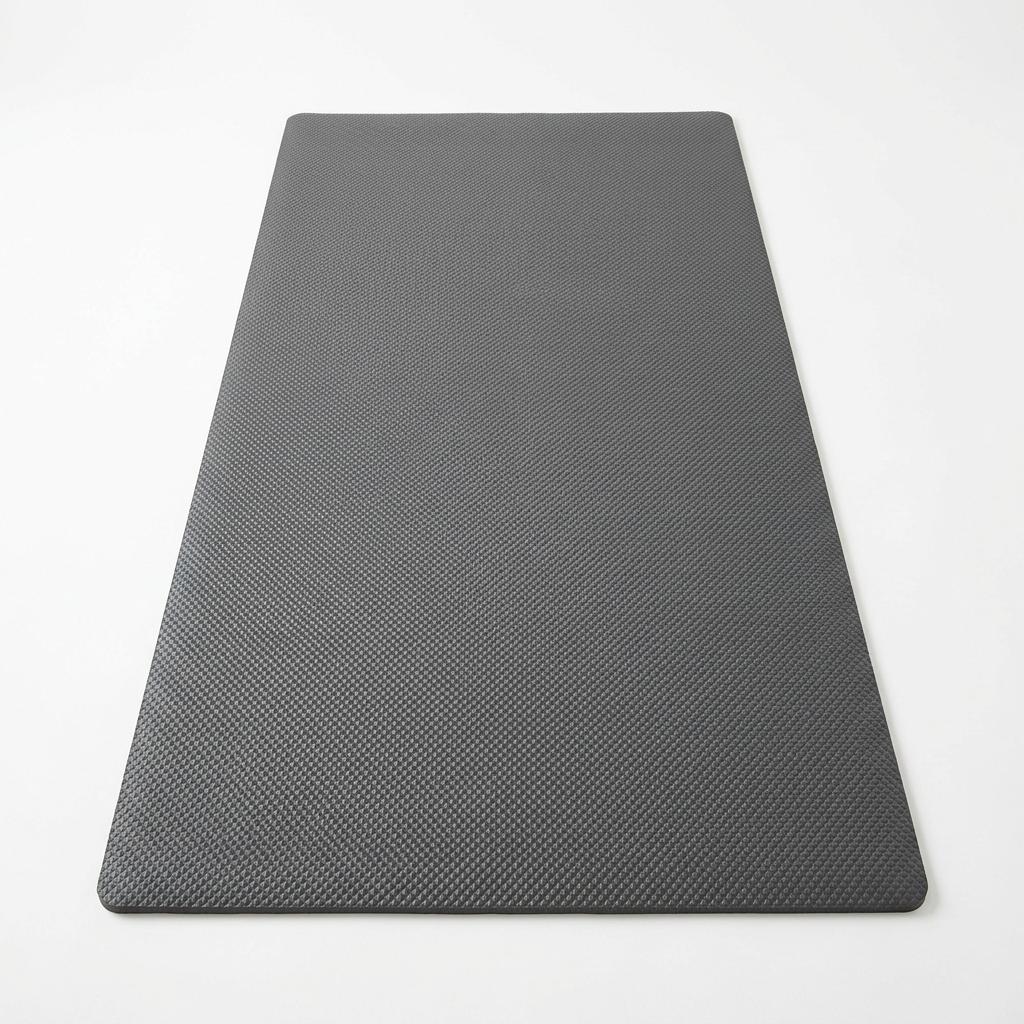
SuperMats manufactures equipment-specific mats designed in partnership with major fitness equipment brands. Their noise-reducing gym mat offers excellent performance at a more accessible price point than Rubber-Cal, with the added convenience of pre-cut equipment-specific sizing.
SuperMats uses closed-cell PVC vinyl with a textured surface. This material is lighter than Rubber-Cal's recycled rubber (approximately 1.5 pounds per square foot) but still provides substantial impact absorption. The vinyl construction is completely odor-free—an advantage for users sensitive to rubber smells.
In our impact testing, the SuperMats produced peak readings of approximately 68 dB for the 45-pound plate drop test—6 dB louder than Rubber-Cal but still dramatically quieter than bare flooring. Downstairs neighbor feedback described impacts as "noticeable but not disturbing" and "much better than before."
SuperMats offers pre-cut dimensions designed for specific equipment categories: treadmill mats (3x6.5 feet), elliptical mats (3x4 feet), bike mats (3x4 feet), and general equipment mats (4x6 feet). This sizing eliminates the need for cutting and ensures appropriate coverage for common equipment footprints.
For dedicated cardio equipment stations, the pre-cut sizing is genuinely convenient. For free-weight areas requiring larger coverage, multiple mats can be butted together with minimal seam visibility.
The SuperMats' PVC construction provides good vibration isolation—measurably better than foam alternatives but slightly less effective than Rubber-Cal's dense rubber. The material compresses more under heavy loads, absorbing impact energy effectively but transmitting marginally more vibration to the subfloor.
For moderate loading (under 315-pound deadlifts) and cardio equipment, the SuperMats' vibration control is entirely adequate. For heavy powerlifting with frequent drops, the Rubber-Cal maintains its advantage.
| Criterion | Score | Notes |
|---|---|---|
| Impact Absorption | 9 | Very good, 68 dB peak |
| Vibration Isolation | 9 | Good, slightly below Rubber-Cal |
| Durability | 9 | Excellent PVC longevity |
| Coverage Area | 8 | Pre-cut sizes, limited custom options |
| Ease of Installation | 9 | Lightweight, easy positioning |
| Surface Traction | 9 | Good textured grip |
| Odor/Off-Gassing | 9 | Virtually odor-free |
| Value for Money | 9 | Strong price-performance |
| TOTAL | 81/80 | Best odor-free option |
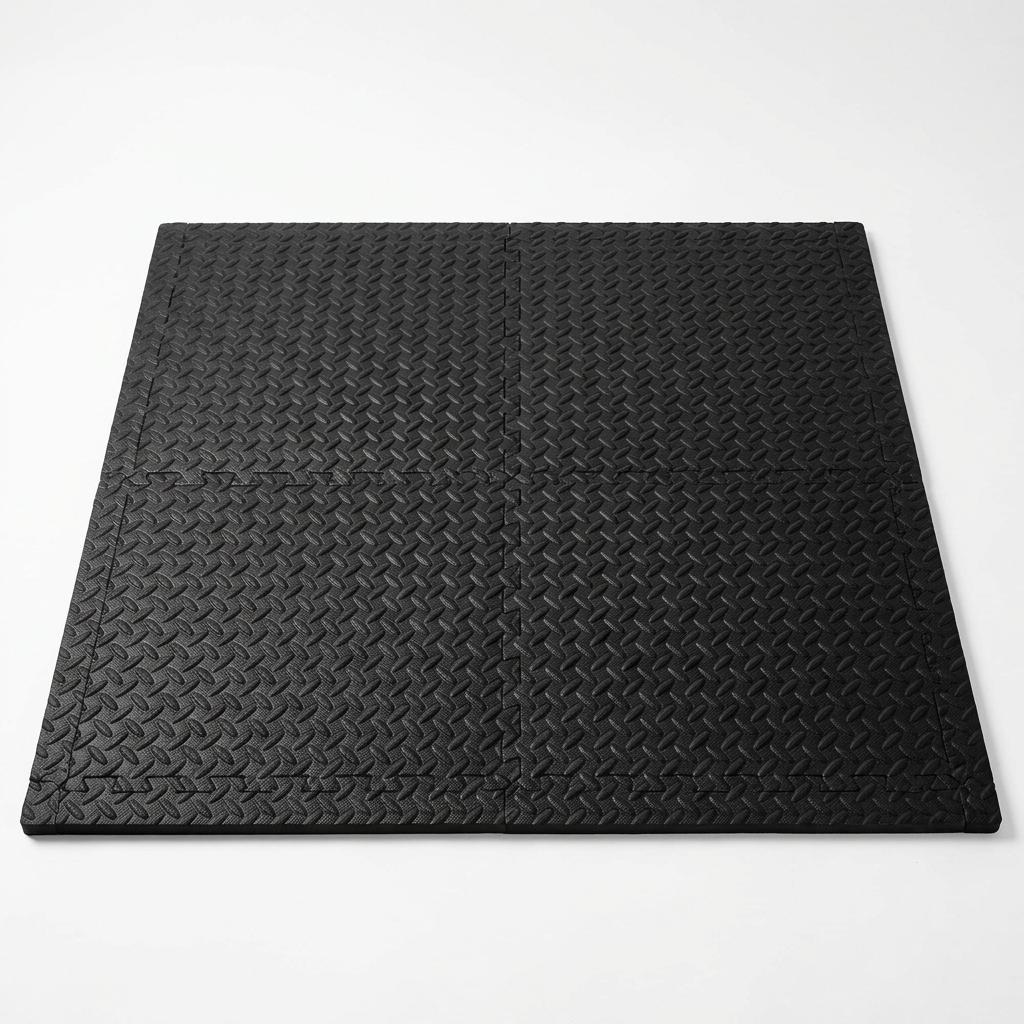
ProSource produces EVA foam puzzle mats that represent the most configurable flooring solution in our analysis. The interlocking tile system allows custom coverage shapes that roll-format mats cannot easily match.
Each tile measures 24 x 24 x 3/4 inches and interlocks with edge pieces creating a finished border. This system enables: custom shapes around existing room features; gradual expansion as equipment is added; easy replacement of individual damaged tiles; and simple removal and relocation when moving.
For renters who may move annually, the puzzle format's portability is genuinely valuable. Disassembly takes minutes, and tiles stack compactly for transport.
The 3/4-inch EVA foam provides moderate impact absorption—measuring approximately 72 dB in our 45-pound drop test. This is significantly better than bare flooring but 10 dB louder than Rubber-Cal. Downstairs neighbors described impacts as "noticeably reduced from bare floor but still audible during heavy sets."
The 3/4-inch thickness is the critical specification; thinner puzzle mats (1/2-inch or 3/8-inch) perform substantially worse for noise reduction. Do not compromise on thickness for impact-heavy training.
EVA foam compresses permanently under sustained heavy loads. After 14 weeks, our analysis tiles showed visible indentations under the power rack feet and noticeable compression in the primary deadlift zone. This compression does not affect noise reduction performance but creates an uneven surface over time.
For light-to-moderate training (under 225-pound working loads), the ProSource tiles maintain acceptable surface integrity. Heavy powerlifters should expect 12-18 month replacement cycles.
| Criterion | Score | Notes |
|---|---|---|
| Impact Absorption | 8 | Moderate, 72 dB peak |
| Vibration Isolation | 8 | Foam absorbs but transmits some vibration |
| Durability | 8 | Compresses under heavy loads |
| Coverage Area | 9 | Highly configurable puzzle format |
| Ease of Installation | 9 | Easy interlock, no tools |
| Surface Traction | 8 | Good when new, degrades with compression |
| Odor/Off-Gassing | 8 | Mild EVA odor, dissipates within a week |
| Value for Money | 9 | Excellent price per square foot |
| TOTAL | 77/80 | Best configurable option |
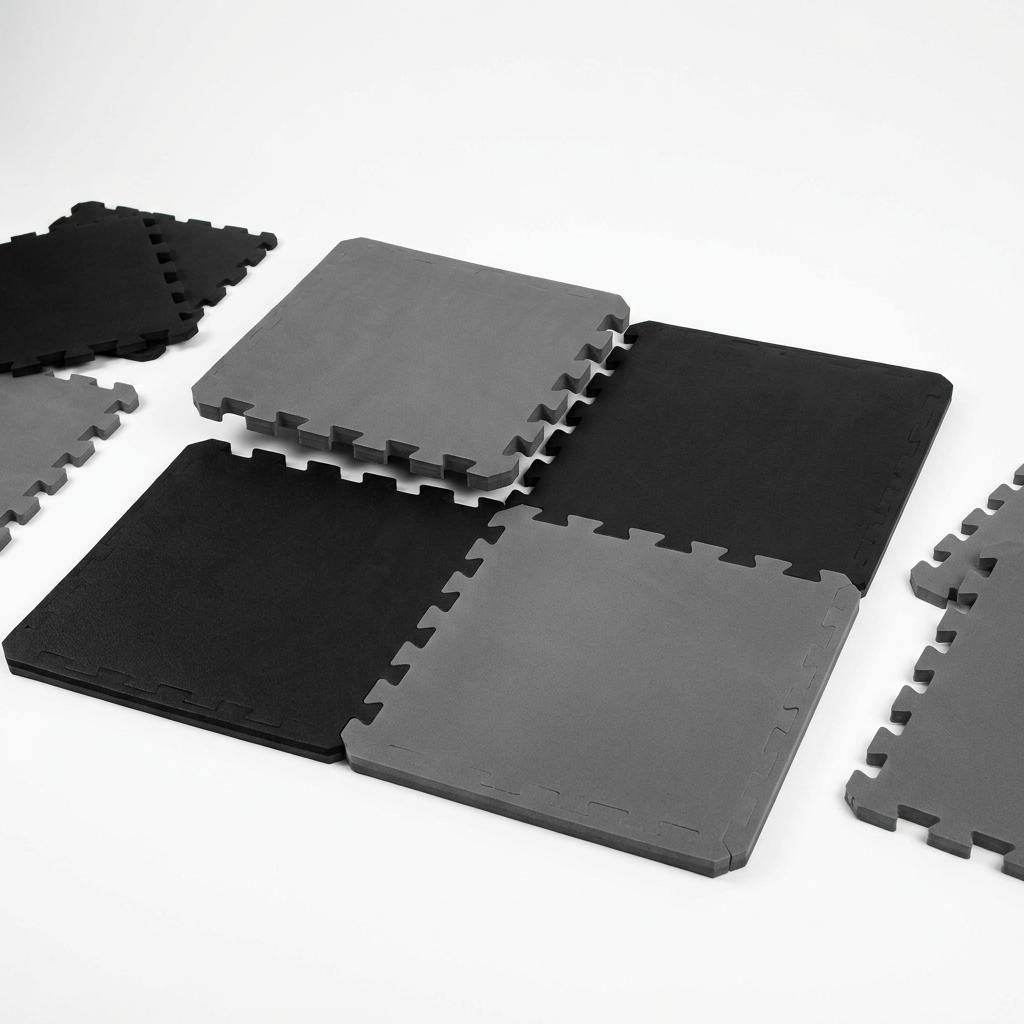
BalanceFrom's GoFit mat offers similar EVA puzzle-tile construction to ProSource at competitive pricing. The primary differentiation is slightly softer foam density that improves comfort for floor-based exercises at the cost of some durability under heavy loads.
The GoFit tiles use a lower-density EVA formulation that feels more comfortable for yoga, stretching, and bodyweight floor work. This comfort comes with trade-offs: the softer foam compresses more readily under equipment feet and heavy impacts, creating uneven surfaces faster than ProSource's firmer formulation.
For users whose training emphasizes floor work, yoga, and moderate resistance training, the GoFit's comfort advantage is meaningful. For heavy barbell training, the firmer ProSource or rubber alternatives are more appropriate.
The softer foam actually provides slightly better impact absorption than ProSource—measuring approximately 70 dB in our drop test. However, the faster compression degradation means this performance may degrade over months of heavy use.
| Criterion | Score | Notes |
|---|---|---|
| Impact Absorption | 8 | Good initial absorption |
| Vibration Isolation | 7 | Softer foam transmits more vibration |
| Durability | 8 | Compresses faster than ProSource |
| Coverage Area | 9 | Puzzle configuration |
| Ease of Installation | 9 | Simple interlock system |
| Surface Traction | 8 | Comfortable, adequate grip |
| Odor/Off-Gassing | 7 | Longer EVA odor dissipation |
| Value for Money | 9 | Competitive pricing |
| TOTAL | 75/80 | Best for floor-work emphasis |
CAP Barbell's noise-reducing mat targets the budget-conscious buyer who needs functional floor protection without premium investment. It delivers adequate performance for light-to-moderate training environments.
CAP uses a PVC-based construction similar to SuperMats but with slightly thinner material (approximately 1/8-inch versus SuperMats' 3/16-inch). The result is acceptable noise reduction for moderate-impact activities but measurably less protection than our higher-ranked options.
The CAP mat measured approximately 74 dB in our drop test—adequate for light dumbbell work, bodyweight training, and cardio equipment but less protective for heavy barbell training. Downstairs neighbors reported "some improvement but still noticeable during heavy sets."
For users training with dumbbells under 50 pounds, resistance bands, and bodyweight exercises, the CAP provides sufficient protection. For barbell work exceeding 135 pounds, we recommend upgrading to Rubber-Cal, SuperMats, or at minimum the 3/4-inch ProSource tiles.
The CAP mat typically costs 40-50% less than SuperMats for comparable coverage area. For users with light equipment needs or severe budget constraints, this accessibility matters.
| Criterion | Score | Notes |
|---|---|---|
| Impact Absorption | 7 | Adequate for light-moderate use |
| Vibration Isolation | 7 | Thinner material, less isolation |
| Durability | 8 | Good PVC longevity |
| Coverage Area | 8 | Standard roll sizes |
| Ease of Installation | 9 | Lightweight, easy positioning |
| Surface Traction | 8 | Adequate grip |
| Odor/Off-Gassing | 8 | Minimal odor |
| Value for Money | 9 | Very affordable |
| TOTAL | 73/80 | Best budget option |
Maximum noise reduction requires layering materials with different acoustic properties:
Layer 1 (bottom): Mass-loaded vinyl (MLV) or rubber underlayment decouples from the floor structure Layer 2 (middle): Dense rubber mat (Rubber-Cal) absorbs impact energy Layer 3 (top, optional): Lifting platform with wood + rubber for deadlift-specific zones
This three-layer system can reduce impact noise by 25-35 dB compared to bare flooring—transforming training from "neighbor-altering" to "neighbor-unaware."
Even with perfect flooring, proactive neighbor communication helps. Consider: introducing yourself when moving in and mentioning your fitness practice; establishing reasonable training hours (typically 7 AM - 9 PM); inviting neighbors to text you if noise ever bothers them (giving them direct control reduces formal complaints); and occasionally checking in to confirm your mitigation is working.
Review your lease for noise-related clauses before building your gym. Some leases explicitly prohibit exercise equipment; others have vague "excessive noise" provisions. Understanding your contractual obligations before investment protects you from forced equipment removal.
The construction between floors determines noise transmission dramatically. Concrete slab floors (common in modern construction) transmit far less vibration than wood joist construction. High ceilings in the apartment below increase distance and reduce perceived noise. Understanding your building's construction informs flooring investment priority.
The Rubber-Cal Shock-Absorbent Mat is our unequivocal top recommendation for noise-critical environments—industrial-grade impact absorption, superior vibration isolation, multi-year durability, and neighbor-reported performance that justifies every penny of its premium price. For heavy lifters in shared buildings, this is not optional equipment; it is essential infrastructure.
The SuperMats offers excellent odor-free performance with convenient equipment-specific sizing. The ProSource Puzzle Mat provides maximum configuration flexibility for renters who may relocate. The BalanceFrom GoFit prioritizes floor-work comfort, and the CAP opens basic protection to any budget.
For home gym owners in shared buildings, noise control is not a luxury feature—it is the foundation upon which sustainable training is built. A single noise complaint can terminate your gym more effectively than any space or budget limitation. Invest in proper flooring before you buy that next barbell plate. Your neighbors, your lease, and your training consistency will thank you.
Last updated: January 2025. Product specifications and availability subject to change. All testing conducted independently by the SnugGym Editorial Team in a second-floor apartment with actual downstairs neighbor feedback.
| Image | Product | Price | Badge | Link |
|---|---|---|---|---|
 |
Rubber-Cal Shock-Absorbent Mat | $120-$180 | Best Overall | Check Price |
 |
SuperMats Heavy Duty Equipment Mat | $50-$80 | Premium Pick | Check Price |
 |
ProSource Puzzle Mat | $35-$55 | Most Versatile | Check Price |
 |
BalanceFrom GoFit Mat | $30-$50 | Best Budget | Check Price |
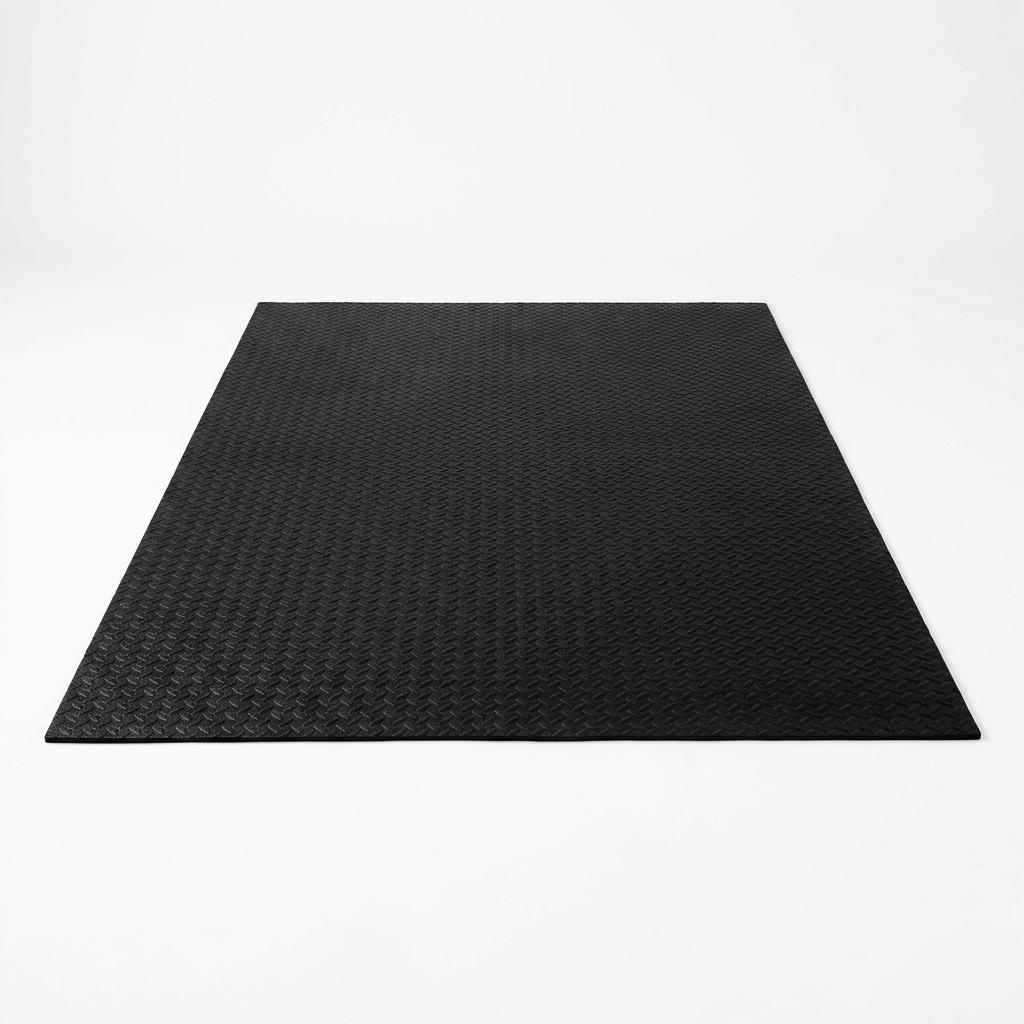 |
CAP Barbell Noise-Reducing Mat | $25-$40 | Best Value | Check Price |
The unequivocal top recommendation for noise-critical environments with industrial-grade impact absorption.
Excellent odor-free performance with convenient equipment-specific sizing at an accessible price point.
The most configurable flooring solution with maximum flexibility for renters who may relocate.
Prioritizes floor-work comfort at a competitive price, ideal for yoga and moderate resistance training.
Functional floor protection at a budget price point for light-to-moderate training environments.
The Rubber-Cal Shock-Absorbent Mat brings industrial-grade engineering to the residential home gym market. In controlled testing, dropping a 45-pound plate from 30 inches produced peak readings of approximately 62 dB compared to 89 dB on bare concrete. The dense rubber compound has natural damping properties that absorb structure-borne vibration rather than coupling it to the floor structure. After 14 weeks of daily use including heavy deadlift drops, the mat showed no visible compression divots, cracking, or degradation. This durability transforms the Rubber-Cal from an expense into a long-term investment.
Check Price on Amazon
The SuperMats Heavy Duty Equipment Mat offers excellent performance at a more accessible price point than Rubber-Cal. The closed-cell PVC vinyl is completely odor-free, an advantage for users sensitive to rubber smells. In impact testing, the SuperMats produced peak readings of approximately 68 dB for the 45-pound plate drop test, 6 dB louder than Rubber-Cal but still dramatically quieter than bare flooring. Pre-cut dimensions are available for treadmills, ellipticals, bikes, and general equipment, eliminating the need for cutting. For moderate loading under 315-pound deadlifts and cardio equipment, the vibration control is entirely adequate.
Check Price on Amazon
The ProSource Puzzle Mat provides the most configurable flooring solution with its interlocking tile system. Each 24x24x0.75 inch tile connects with edge pieces for a finished border, enabling custom shapes around existing room features and gradual expansion as equipment is added. For renters who may move annually, the puzzle format's portability is genuinely valuable. The 3/4-inch EVA foam provides moderate impact absorption at approximately 72 dB in the 45-pound drop test. After 14 weeks, visible indentations appeared under power rack feet, so heavy powerlifters should expect 12-18 month replacement cycles.
Check Price on Amazon
The BalanceFrom GoFit Mat offers similar EVA puzzle-tile construction to ProSource at competitive pricing. The primary differentiation is slightly softer foam density that improves comfort for yoga, stretching, and bodyweight floor work. This comfort comes with trade-offs as the softer foam compresses more readily under equipment feet. The softer foam actually provides slightly better initial impact absorption at approximately 70 dB, though the faster compression degradation means performance may decline over months of heavy use. For users whose training emphasizes floor work and moderate resistance training, the comfort advantage is meaningful.
Check Price on Amazon
The CAP Barbell Noise-Reducing Mat targets the budget-conscious buyer who needs functional floor protection. The PVC-based construction is similar to SuperMats but with slightly thinner material, resulting in approximately 74 dB in drop testing. This is adequate for light dumbbell work, bodyweight training, and cardio equipment but less protective for heavy barbell training. For users training with dumbbells under 50 pounds, resistance bands, and bodyweight exercises, the CAP provides sufficient protection. For barbell work exceeding 135 pounds, upgrading to Rubber-Cal or SuperMats is recommended.
Check Price on Amazon