Apartment Home Gym Essentials Checklist: Start Here
The complete checklist for building an apartment-friendly home gym. Essential equipment, noise solutions, and space-savi...
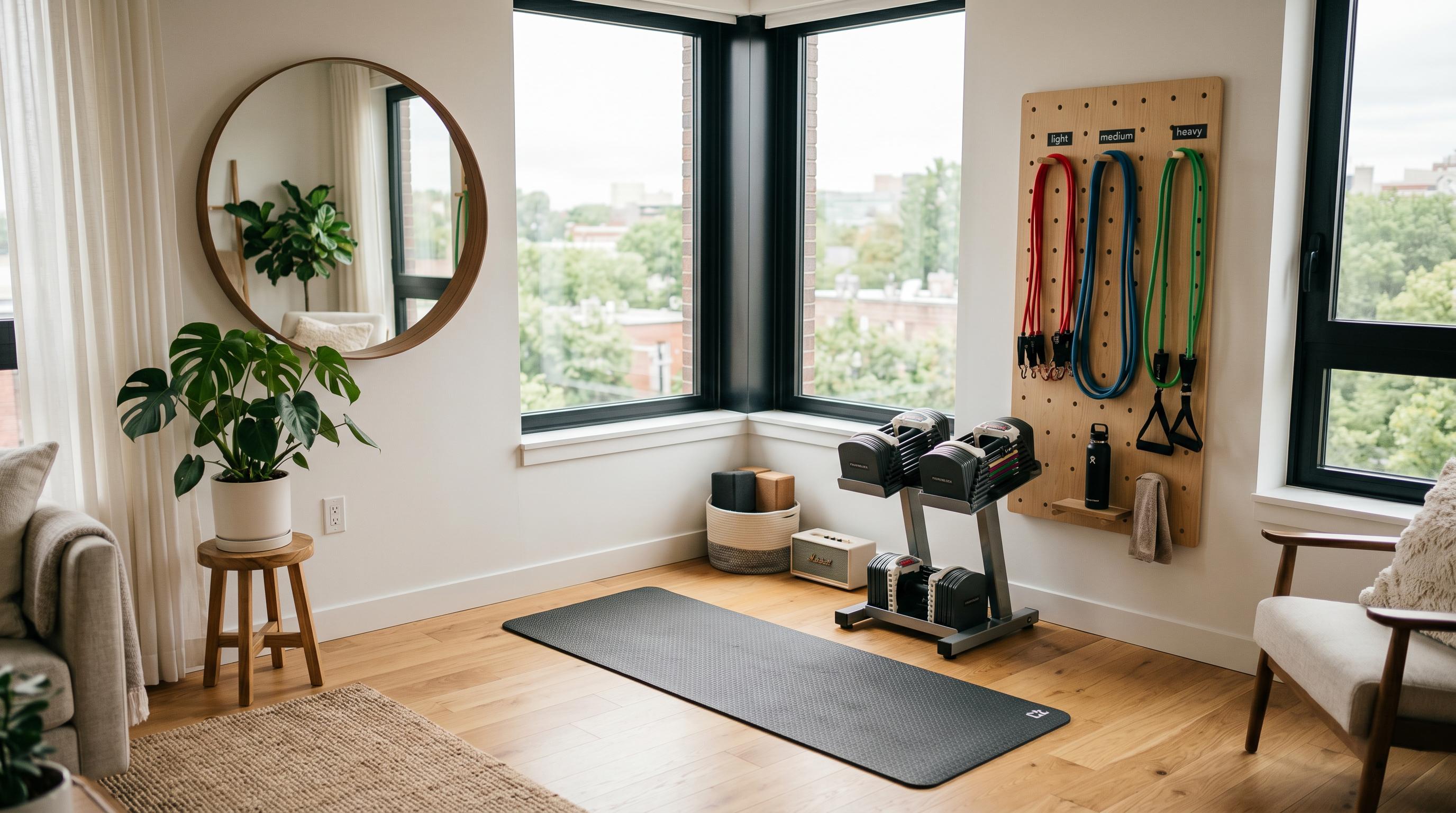
A research-backed framework for planning your home gym budget, from $50 starter setups to $1,000+ complete gyms. Includes cost-per-use analysis and priority-based purchasing.
The average American spends $58 per month on a gym membership—that is nearly $700 per year, every year, forever. A well-planned home gym can pay for itself in 6–18 months while saving commute time and eliminating excuses. But without a budget framework, it is easy to overspend on flashy equipment you rarely use while neglecting the basics that drive results.
This guide provides a research-backed method for budgeting your home gym purchase, regardless of your total available funds. We will cover cost-per-use analysis, priority-based purchasing, and realistic price ranges for equipment that actually delivers results.
According to IHRSA (International Health, Racquet & Sportsclub Association), 50% of gym members quit within 6 months, yet many continue paying dues due to cancellation friction. A home gym eliminates this waste.
Consider the 5-year cost comparison:
| Gym Type | Monthly Cost | 5-Year Total | Time Spent Commuting |
|---|---|---|---|
| Budget commercial gym | $30 | $1,800 | ~260 hours |
| Mid-tier gym | $60 | $3,600 | ~260 hours |
| Premium/boutique | $150 | $9,000 | ~260 hours |
| Home gym (one-time) | $0 | $300–$2,000 | 0 hours |
Even a premium $2,000 home gym breaks even against a mid-tier commercial gym in under 3 years. Against a boutique studio, it pays for itself in 13 months.
But the real value is not just financial. A 2019 study in Preventive Medicine Reports found that home exercisers were 32% more consistent than gym members, largely due to reduced friction (no commute, no crowds, no time constraints).
We recommend thinking in three budget tiers. Each tier builds on the previous one, so you can start small and upgrade without waste.
Goal: Establish a consistent exercise habit with minimal investment.
What the research says: A 2020 meta-analysis in Sports Medicine confirmed that resistance bands produce strength gains comparable to conventional weights for beginners and intermediate trainees. You do not need heavy iron to start.
| Priority | Equipment | Est. Cost | Why First? |
|---|---|---|---|
| 1 | Resistance band set | $25–$40 | Full-body strength, zero space, travel-friendly |
| 2 | Yoga mat | $20–$40 | Floor work, joint protection, grip |
| 3 | Jump rope | $10–$20 | Cardio, coordination, $0 operating cost |
Total: $55–$100
Browse resistance band sets on Amazon | Shop yoga mats | Find jump ropes
Goal: Add progressive overload for muscle and strength development.
What the research says: Free weights consistently outperform machines for muscle activation according to EMG studies. A 2014 Journal of Strength and Conditioning Research study showed that free-weight squats activated 43% more muscle mass than smith machine squats.
| Priority | Equipment | Est. Cost | Upgrade From |
|---|---|---|---|
| 1 | Adjustable dumbbells (pair) | $100–$350 | Resistance bands for upper body |
| 2 | Adjustable workout bench | $80–$200 | Floor-only exercises |
| 3 | Pull-up bar (doorway) | $25–$50 | Band pulldowns |
| 4 | Additional weight plates | $50–$100 | Heavier progressive overload |
Total: $255–$700 (cumulative with Tier 1)
Shop adjustable dumbbells | Browse adjustable benches | Find pull-up bars
Goal: Eliminate all equipment limitations for any training style.
| Priority | Equipment | Est. Cost | Capability Added |
|---|---|---|---|
| 1 | Olympic barbell + plates | $300–$600 | Heavy compound lifts |
| 2 | Squat rack or half rack | $250–$700 | Safe solo barbell training |
| 3 | Rubber flooring (sq ft) | $1.50–$4/sq ft | Floor protection, noise reduction |
| 4 | Cardio equipment (optional) | $200–$800 | Weather-independent conditioning |
| 5 | Storage rack/organization | $50–$150 | Safety, longevity, aesthetics |
Total: $800–$2,200+ (cumulative)
Browse Olympic barbell sets | Shop squat racks | Find rubber gym flooring
When deciding between equipment options, calculate the cost-per-use over a realistic timeframe:
Cost Per Use = Purchase Price ÷ Estimated Uses (3 years)
Example: A $300 adjustable dumbbell pair used 3× per week for 3 years:
$300 ÷ 468 uses = $0.64 per use
Compare that to a $40 ab roller used 10 times total: $4.00 per use.
The "cheaper" ab roller is actually 6× more expensive per use. This math helps you avoid novelty equipment that seems affordable but delivers poor value.
| Equipment | Price | 3-Year Uses | Cost/Use |
|---|---|---|---|
| Adjustable dumbbells | $300 | 468 | $0.64 |
| Resistance band set | $35 | 312 | $0.11 |
| Yoga mat | $30 | 468 | $0.06 |
| Pull-up bar | $35 | 312 | $0.11 |
| Adjustable bench | $150 | 312 | $0.48 |
| Equipment | Price | 3-Year Uses | Cost/Use |
|---|---|---|---|
| Ab roller | $40 | 10 | $4.00 |
| Electric muscle stimulator | $150 | 20 | $7.50 |
| Vibration plate | $200 | 15 | $13.33 |
| Fancy balance trainer | $120 | 12 | $10.00 |
Rule of thumb: If you cannot envision using a piece of equipment at least 100 times in three years, it probably is not worth buying.
Twenty percent of equipment delivers eighty percent of results. Buy in this exact order:
These items have the highest exercise variety per dollar and square foot:
Add these once you have trained consistently for 6–8 weeks:
Only purchase after Phase 1 and 2 are integrated into your routine:
Your equipment purchase is not the only expense. Budget for these often-overlooked costs:
| Hidden Cost | Typical Range | Notes |
|---|---|---|
| Rubber gym flooring | $50–$300 | Essential for heavy lifting and noise control |
| Mirrors | $50–$200 | Critical for form feedback |
| Storage/organization | $30–$150 | Keeps equipment accessible and safe |
| Replacement parts | $10–$50/year | Cables, bands, grips wear out |
| Additional weight | $50–$200 | As you get stronger |
| Lighting upgrade | $20–$100 | Dim spaces reduce workout quality |
| Ventilation/fan | $20–$60 | Airflow affects performance and comfort |
If budget is tight, consider these strategies:
The "Gym Cancellation" Method Cancel your commercial gym membership and redirect 3 months of dues ($150–$450) into your home gym fund. This creates immediate capital without affecting your cash flow.
The Monthly Build-Out Allocate $50–$100 per month to equipment purchases. In 6 months, you will have a $300–$600 setup that far exceeds most starter gyms.
The "Sell to Upgrade" Cycle Buy used equipment, sell when upgrading. Facebook Marketplace and Craigslist typically resell fitness equipment at 60–70% of retail if kept in good condition. Your net cost is the depreciation gap, not the full purchase price.
Seasonal Sales Calendar
| Item | Cost | Rationale |
|---|---|---|
| Resistance band set | $35 | Full-body circuits |
| Yoga mat | $30 | HIIT floor work |
| Jump rope | $15 | High-calorie-burn cardio |
| Foam roller | $20 | Recovery, mobility |
| Fan | $25 | Climate control for intensity |
| Total | $125 |
| Item | Cost | Rationale |
|---|---|---|
| Adjustable dumbbells (50 lb max) | $280 | Progressive overload to intermediate level |
| Adjustable bench | $130 | Chest, shoulder, arm exercises |
| Pull-up bar | $30 | Back width and strength |
| Resistance bands (light) | $25 | Warm-up, prehab, isolation work |
| Total | $465 |
| Item | Cost | Rationale |
|---|---|---|
| Olympic barbell + 300 lb plates | $450 | Heavy compound lifts |
| Squat stand (compact) | $280 | Safe solo training |
| Adjustable bench | $130 | Variation and support exercises |
| Rubber flooring (24 sq ft) | $80 | Floor and equipment protection |
| Collars | $20 | Safety |
| Total | $960 |
| Equipment | Why Quality Matters | Warning Signs of Cheap |
|---|---|---|
| Squat rack | Holds weight over your body | Wobbly, thin gauge steel, no safety pins |
| Bench | Supports your entire body weight plus weights | Squeaky, thin padding, narrow base |
| Barbells | Rotating sleeves prevent wrist injury | Fixed sleeves, poor knurling, bend easily |
| Equipment | Why Cheap Works Fine | Budget Option |
|---|---|---|
| Resistance bands | Simple rubber construction | $15–$25 sets perform like $50+ brands |
| Jump ropes | Cord + handles | $10 rope works as well as $50 |
| Yoga mats | PVC or TPE material | $20–$30 mats last years |
| Storage | Metal or plastic shelving | DIY solutions work fine |
Create a simple spreadsheet with these columns:
| Date | Item | Cost | Expected Uses/Year | Cost/Use | Priority Score (1–10) |
|---|
Review quarterly. If an item's cost-per-use is climbing (meaning you are not using it), sell it and redirect funds to higher-value equipment.
Budgeting for a home gym is not about spending as little as possible—it is about spending optimally to support your specific goals. The $35 resistance band set that gets used 300 times destroys the $2,000 treadmill that becomes a clothes hanger.
Start with Tier 1. Train consistently for two months. Then use the cost-per-use method to guide every subsequent purchase. Your wallet—and your physique—will thank you.
For ultra-budget setups, see our home gym under $50 guide and home gym under $150 guide.