Apartment Home Gym Essentials Checklist: Start Here
The complete checklist for building an apartment-friendly home gym. Essential equipment, noise solutions, and space-savi...
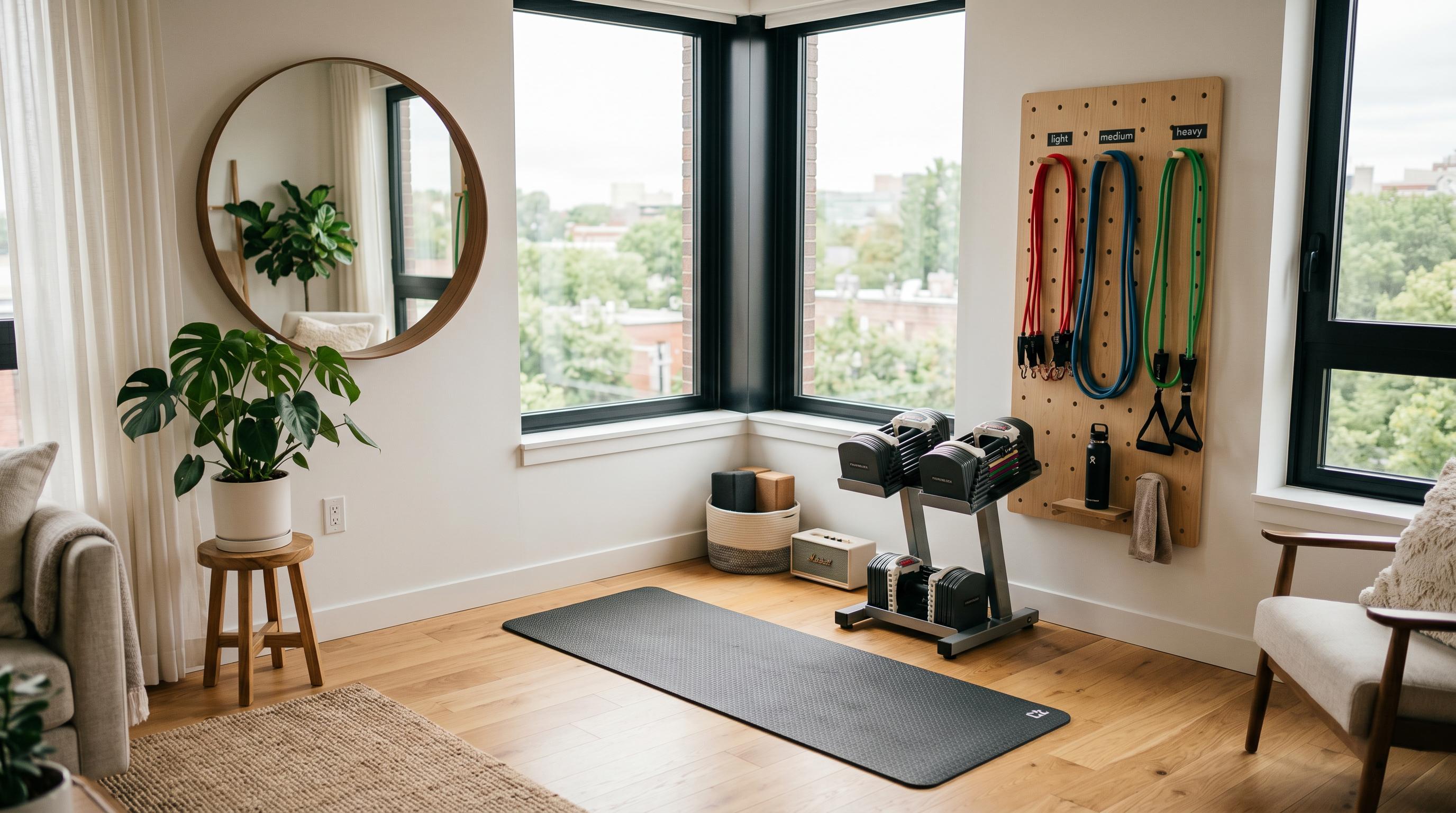
AMRAP workouts challenge you to complete as many rounds as possible in a set time. Ideal for compact home gyms with minimal equipment.
AMRAP stands for "As Many Rounds (or Reps) As Possible." It is a workout structure in which you perform a prescribed circuit of exercises continuously for a set amount of time, aiming to complete as many full rounds as you can before the timer runs out. It is one of the most space-efficient and equipment-minimal training formats available, making it a natural fit for apartment home gyms.
Unlike traditional strength training with fixed sets and rest periods, AMRAP is time-capped and self-paced. You work at your own intensity level, making it universally scalable regardless of fitness experience.
The structure of an AMRAP workout is simple but effective:
This format eliminates rest-based decision-making. The clock dictates the session, and your only job is to keep moving.
Research published in the Journal of Strength and Conditioning Research (2017) found that high-density circuit training---similar in structure to AMRAP---significantly improves aerobic and anaerobic work capacity in trained individuals. By training at sustained intensity, your body adapts to handle more physical output in less time.
AMRAP workouts build psychological resilience. There are no scheduled rests, so you must learn to push through discomfort and manage pacing. This mental skill transfers to other areas of training and daily life.
A well-designed 10-minute AMRAP can produce cardiovascular and muscular fatigue comparable to much longer steady-state sessions. A 2018 meta-analysis in Sports Medicine confirmed that short, high-intensity circuit training yields meaningful fitness gains when performed consistently.
Because AMRAP prioritizes movement density over heavy load, you can achieve excellent results with just a pair of dumbbells, a kettlebell, or even bodyweight alone. This makes it ideal for small apartments where equipment storage is limited.
No equipment needed. Clear a space roughly 6 x 4 feet and begin.
| Exercise | Reps |
|---|---|
| Air Squats | 10 |
| Push-Ups | 8 |
| Alternating Reverse Lunges | 10 (5 per leg) |
| Mountain Climbers | 16 (8 per side) |
Goal: Complete as many rounds as possible in 10 minutes. Rest only when necessary.
Scaling: Beginners can reduce reps by 30--40% or substitute incline push-ups and reverse lunges held to a chair.
This intermediate circuit requires one pair of moderate-weight dumbbells (storage footprint: under 2 sq ft).
| Exercise | Reps |
|---|---|
| Goblet Squats | 12 |
| Dumbbell Push Press | 10 |
| Renegade Rows | 10 (5 per side) |
| Dumbbell Romanian Deadlifts | 12 |
| Plank Shoulder Taps | 14 (7 per side) |
Goal: Maximize rounds in 20 minutes. Use a weight that allows unbroken sets in the first two rounds.
Notes: The push press and shoulder taps produce very little floor impact, making this circuit especially neighbor-friendly for upstairs apartments.
Tracking is essential for AMRAP progression. Record the following after every session:
Over time, you should see one or more of the following: more rounds in the same time, the same rounds with heavier weight, or fewer rest breaks. If none of these improve after three attempts at the same workout, it is time to adjust variables---reduce rest, increase weight, or extend the time cap.
AMRAP is inherently scalable, but beginners should follow these guidelines:
AMRAP is one of the most effective training formats for compact home gyms. It requires minimal equipment, fits in tight spaces, and adapts to any fitness level. Whether you have 10 minutes and no gear or 20 minutes and a single pair of dumbbells, an AMRAP workout delivers measurable conditioning and strength benefits in a time-efficient, neighbor-friendly package. Start with short durations, track your rounds, and increase the challenge incrementally.