Apartment Home Gym Essentials Checklist: Start Here
The complete checklist for building an apartment-friendly home gym. Essential equipment, noise solutions, and space-savi...
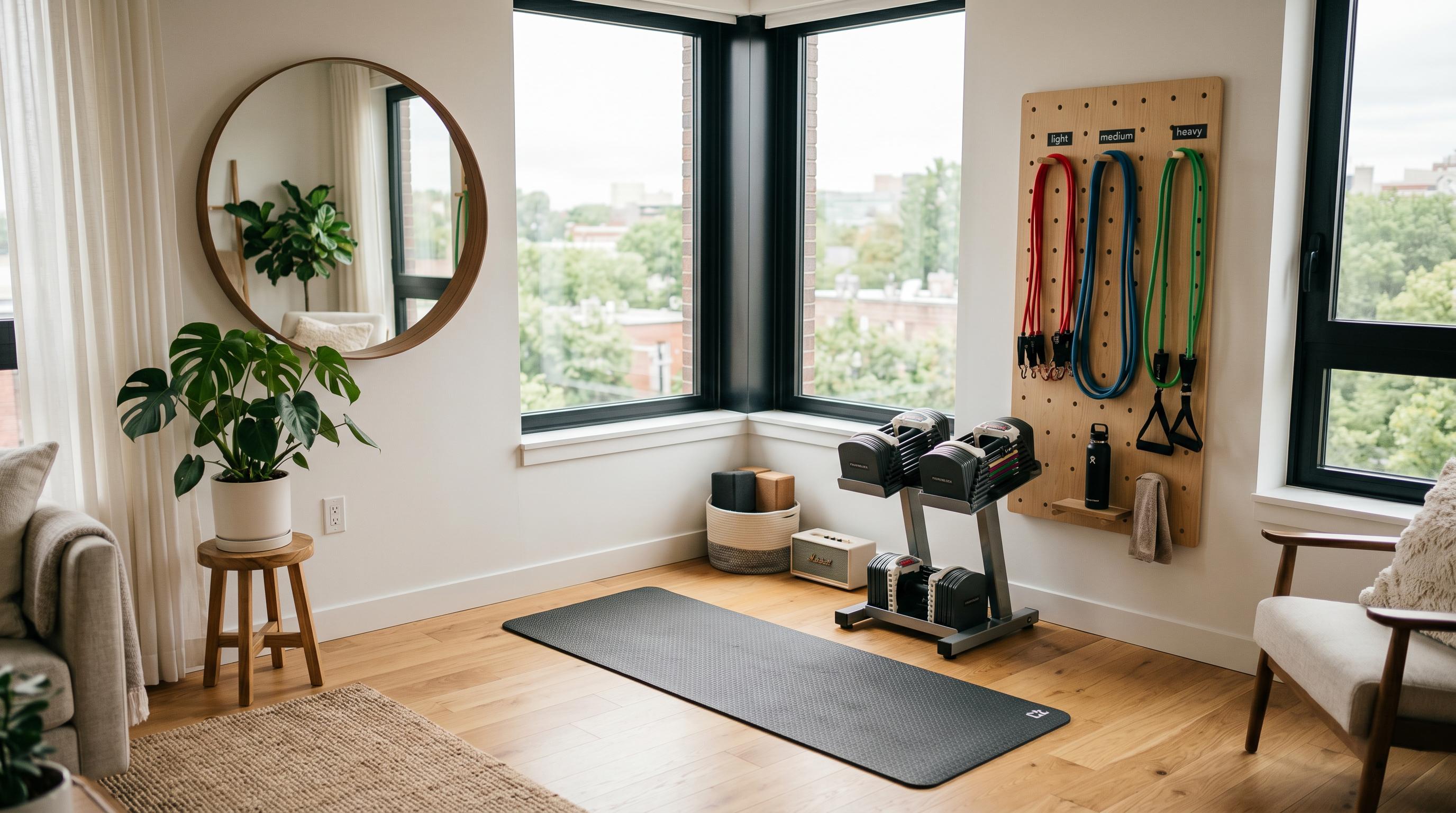
Practical noise reduction strategies for apartment home gyms. From equipment mats to workout timing, keep your fitness routine neighbor-friendly.
Noise is the single biggest challenge facing apartment home gym owners. Unlike house dwellers, you share floors, walls, and ceilings with neighbors who have every right to quiet enjoyment of their home. A dropped dumbbell or early-morning jump squat can escalate quickly into a formal complaint---or worse, a lease violation.
The good news: you do not need a professional soundproofed studio to work out quietly. A combination of smart equipment choices, flooring solutions, spatial positioning, and workout timing can reduce gym noise by 50--70% according to acoustic engineering estimates.
This guide covers every practical noise-reduction strategy available to renters.
Most apartment leases include quiet-hours clauses and noise ordinances. Fitness-related noise---dropping weights, treadmill thumping, jumping---is a leading cause of neighbor disputes in multi-unit buildings. Once a complaint is logged with property management, your gym may be at risk.
Repeated noise complaints can result in written warnings, fines, or lease termination depending on your agreement. It is far easier to prevent noise issues than to resolve them after a complaint has been filed.
Noise concerns create mental stress. If you are constantly worried about how loud your deadlifts sound, you will not train with full focus. A quieter gym is a more enjoyable gym.
The equipment you choose determines your baseline noise level before any soundproofing.
| Type | Noise Level | Best for Apartments |
|---|---|---|
| Magnetic resistance bike | Very Low (40--50 dB) | Yes---near-silent operation |
| Belt-drive bike | Low (45--55 dB) | Yes---smooth, minimal friction |
| Chain-drive bike | Moderate (55--65 dB) | No---audible clanking |
| Fan/air bike | High (60--75 dB) | No---whirring carries through walls |
| Treadmill (cushioned deck) | Moderate (55--70 dB) | Marginal---footfall noise unavoidable |
| Rowing machine (magnetic) | Low (45--55 dB) | Yes---water/magnetic models are quietest |
Rule of thumb: Magnetic resistance mechanisms generate virtually no contact noise. Belt-drive systems are smoother and quieter than chain-drive. Avoid fan bikes unless you are on the ground floor with no shared walls.
Flooring is the most effective noise-reduction investment you can make. Target coverage: the entire workout area plus a 2-foot buffer on all sides.
| Material | Thickness | Cost (per sq ft) | Effectiveness |
|---|---|---|---|
| Horse-stall rubber mats | 3/4 in | $2.50--$3.50 | Excellent---dense, heavy, absorbs impact |
| EVA foam puzzle mats | 3/8 -- 1/2 in | $1.00--$2.00 | Good---lightweight, easy to install/remove |
| Rubber gym flooring rolls | 3/8 in | $3.00--$5.00 | Excellent---seamless coverage, professional finish |
| Carpet underlayment (dense rubber) | 1/4 -- 3/8 in | $1.50--$2.50 | Moderate---adds cushioning under existing carpet |
Layer EVA foam mats (top layer, comfortable, easy to clean) over horse-stall rubber mats (bottom layer, dense, absorbs vibration). This dual-layer approach dramatically reduces both impact noise and structure-borne vibration. When you move, both layers can be rolled up and taken with you.
Avoid: Thin yoga mats as your only flooring. They provide minimal impact protection and essentially no sound dampening for dropped weights.
Where you place your gym within your apartment matters as much as what you put on the floor.
Identify which walls, floors, and ceilings are shared with neighbors. Place your workout area:
Placing equipment in a corner where two walls meet can help contain noise within your unit rather than letting it radiate outward. It also maximizes open floor space for the rest of your apartment.
Bookshelves, sofas, and wardrobes placed against shared walls act as informal sound barriers. Position these between your gym area and the neighbor's unit when possible.
Beyond flooring, individual equipment can be isolated to prevent vibration transfer.
| Item | Solution | Cost |
|---|---|---|
| Dumbbell storage rack | Rubber feet pads or cork under each corner | $5--$10 |
| Bench feet | Isolate with 1-inch rubber furniture cups | $8--$15 |
| Pull-up bar (doorway) | Ensure tight fit; add felt pads on contact points | $3--$5 |
| Treadmill | Anti-vibration isolation pads underneath | $15--$30 |
| Jump rope area | Extra-thick rubber mat or dedicated jump platform | $30--$60 |
Pro tip: Felt furniture pads on the underside of a plyo box or bench prevent the scraping sound of shifting equipment during workouts.
Strategic scheduling eliminates half your noise risk before you touch a weight.
Most leases specify quiet hours from 10 PM to 7 AM on weekdays and often extended on weekends. Treat these as hard limits. Schedule high-impact work (plyometrics, drop sets) outside these windows entirely.
| Time Window | Noise Tolerance | Recommended Workout Type |
|---|---|---|
| 7:00--9:00 AM | Moderate | Low-impact strength, yoga, stretching |
| 9:00 AM--12:00 PM | High | Any workout---optimal window |
| 12:00--2:00 PM | Moderate-High | Strength, cardio, HIIT acceptable |
| 2:00--6:00 PM | High | Any workout---second-best window |
| 6:00--9:00 PM | Moderate | Low-to-moderate impact preferred |
| 9:00 PM--7:00 AM | Low/Very Low | Yoga, stretching, meditation only |
Communication tip: If you have a predictable schedule, briefly inform your immediate neighbors of your workout times. Transparency prevents misunderstandings.
These upgrades are reversible and lease-friendly.
Foam acoustic panels absorb airborne sound within your room. They reduce echo and prevent sound from bouncing toward shared walls. Place panels on the wall behind and beside your main workout area. Use removable mounting strips to avoid wall damage.
Cost: $20--$40 for a 12-pack of 1-foot panels.
Apply foam weatherstripping around the perimeter of your workout room's door. This seals the gap and reduces sound transmission to hallways and adjacent units.
Cost: $5--$10 per door.
Thick curtains or moving blankets hung on shared walls add mass that blocks sound transmission. This is an imperfect but cheap and reversible barrier.
Cost: $15--$40 depending on size.
A white noise machine placed near a shared wall can mask moderate workout sounds. It will not cover dropped weights, but it can obscure the sound of a bike trainer or rowing session.
Cost: $20--$50.
The following table gives approximate sound levels at floor level from 3 feet away. For context: normal conversation is ~60 dB; a vacuum cleaner is ~70 dB.
| Exercise | Approximate dB | Risk Level | Mitigation Required |
|---|---|---|---|
| Yoga / Stretching | 20--30 dB | None | None |
| Resistance band work | 30--40 dB | Very Low | None |
| Bodyweight squats | 40--50 dB | Low | Basic mat |
| Dumbbell curls (controlled) | 45--55 dB | Low | Basic mat |
| Kettlebell swings (rubber bell) | 50--60 dB | Moderate | Thick rubber mat |
| Goblet squats (dumbbell to floor) | 55--65 dB | Moderate | 3/4" rubber flooring |
| Jump rope | 60--70 dB | High | Thick mat + ground floor preferred |
| Deadlifts (dumbbells to floor) | 65--75 dB | High | Controlled eccentric; do not drop |
| Plyometrics (box jumps) | 70--80 dB | Very High | Ground floor only; maximum padding |
Use this checklist before your first workout and review monthly:
Apartment gym noise is a solvable problem. Start with the highest-impact changes: choose quiet equipment, invest in thick rubber flooring, and schedule high-impact work during daytime hours. Layer on isolation pads, acoustic treatments, and weatherstripping as needed. The goal is not zero sound---that is impossible---but noise levels low enough that your neighbors never feel compelled to complain. A considerate gym is a sustainable gym.
SnugGym.com participates in the Amazon Services LLC Associates Program. Some links on this page may be affiliate links, meaning we may earn a small commission at no additional cost to you.