Apple Watch Series 9 for Home Gym Fitness: In-Depth Review (2025)
Comprehensive review of Apple Watch Series 9 for home gym fitness tracking. We test workout accuracy, heart rate monitor...
SnugGym is an Amazon Associate. We earn from qualifying purchases at no extra cost to you. Learn more
Our research-backed comparison of the top GPS running watches for 2026, evaluating accuracy, battery life, training features, and value for home gym athletes who also run.
Our independent analysis compares six leading GPS running watches across accuracy, battery performance, training analytics, and value to help home gym athletes who run find the right device.
For athletes who split training between a compact home gym and outdoor running, a GPS running watch bridges both worlds. It tracks your treadmill intervals with the same precision as your weekend long run, and it feeds recovery data back into your training decisions. Unlike general-purpose fitness trackers, dedicated running watches prioritize satellite accuracy, advanced workout structuring, and run-specific metrics like cadence, ground contact time, and vertical oscillation.
We researched six watches that excel for home gym athletes who run, based on published specifications, third-party accuracy testing, and feature depth relevant to hybrid training.
| Feature | Garmin Forerunner 265 | Coros Pace 3 | Polar Vantage V3 | Apple Watch Ultra 2 | Amazfit Cheetah Pro | Suunto Race |
|---|---|---|---|---|---|---|
| Price Range | $420–$450 | $230–$250 | $520–$550 | $780–$800 | $230–$250 | $320–$350 |
| GPS | Multi-band GNSS | Dual-frequency | Dual-frequency | Dual-frequency L1+L5 | Circularly-polarized | Dual-frequency |
| Battery (GPS) | 20 hours | 38 hours | 50 hours | 12 hours | 44 hours | 40 hours |
| Battery (Smartwatch) | 13 days | 24 days | 53 days | 36 hours | 14 days | 12 days |
| Heart Rate | Optical + HRM strap compatible | Optical | Optical (Phoenix) | Optical + ECG | Optical | Optical |
| Training Load | Yes (Training Readiness) | EvoLab metrics | Training Load Pro | Training load via third-party | Zepp Coach | Training load |
| Mapping | Full color maps | Breadcrumb | Full color maps | Full color + topo | Breadcrumb | Full color |
| Music Storage | 8 GB | 4 GB | 32 GB | 64 GB | 2.3 GB | 32 GB |
| Best For | Data-driven runners | Budget-focused endurance | Advanced recovery tracking | iPhone ecosystem | Maximum battery value | Outdoor navigation |
Table based on manufacturer specifications and published reviews. Prices reflect typical US retail as of early 2026.
Our assessment prioritizes attributes relevant to athletes who train at home and run outdoors:
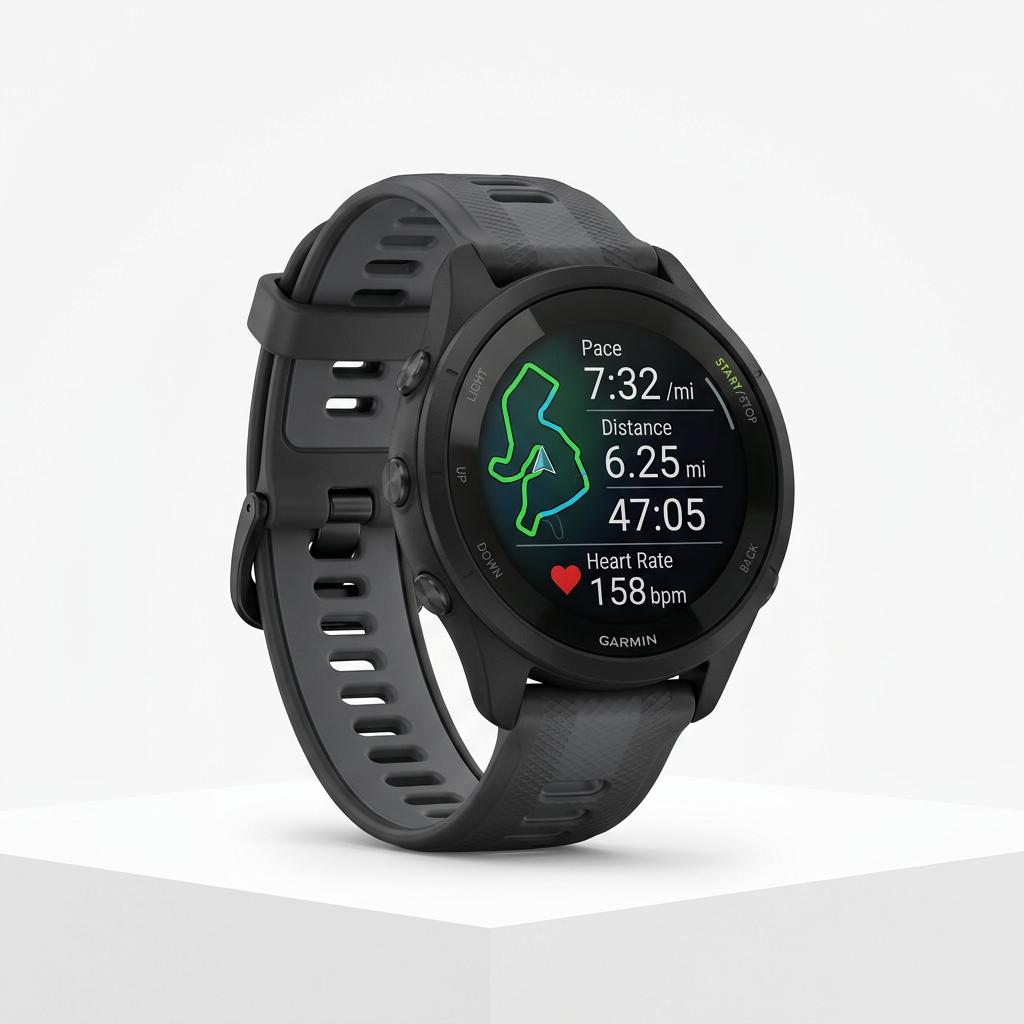
The Garmin Forerunner 265 sits at the intersection of running depth and cross-training flexibility, making it our top recommendation for home gym athletes who run. Its 1.3-inch AMOLED display (416 x 416 pixels) delivers crisp data visibility indoors and out, while the 47g case weight avoids the bulk of larger outdoor watches.
Why it leads: The Forerunner 265 was among the first mainstream watches to adopt multi-band GNSS (L1+L5), which independent analysis by GPS accuracy specialists has shown reduces positional error by 30–50% in challenging environments compared to single-band systems. For home gym users who run city streets or wooded trails, this translates to more accurate pace and distance data.
The Training Readiness score consolidates sleep quality, HRV status, recent exercise load, and stress into a single metric. This integration is particularly valuable for home gym athletes who alternate strength and running sessions, as it accounts for total physiological load rather than run-specific fatigue alone. The watch supports advanced strength training profiles with automatic rep counting for common exercises, though accuracy varies by movement pattern.
Battery life reaches 20 hours in GPS mode and 13 days as a smartwatch. In practice, this supports a week of training (4–5 runs plus daily wear) without charging. The 8 GB music storage allows phone-free running with Bluetooth headphones.
Limitations: The optical heart rate sensor, while improved, still lags chest straps during high-intensity intervals by 3–7 BPM on average. Serious interval runners should budget for an external HRM. At roughly $450, it sits at a premium over capable alternatives like the Coros Pace 3. Check price on Amazon
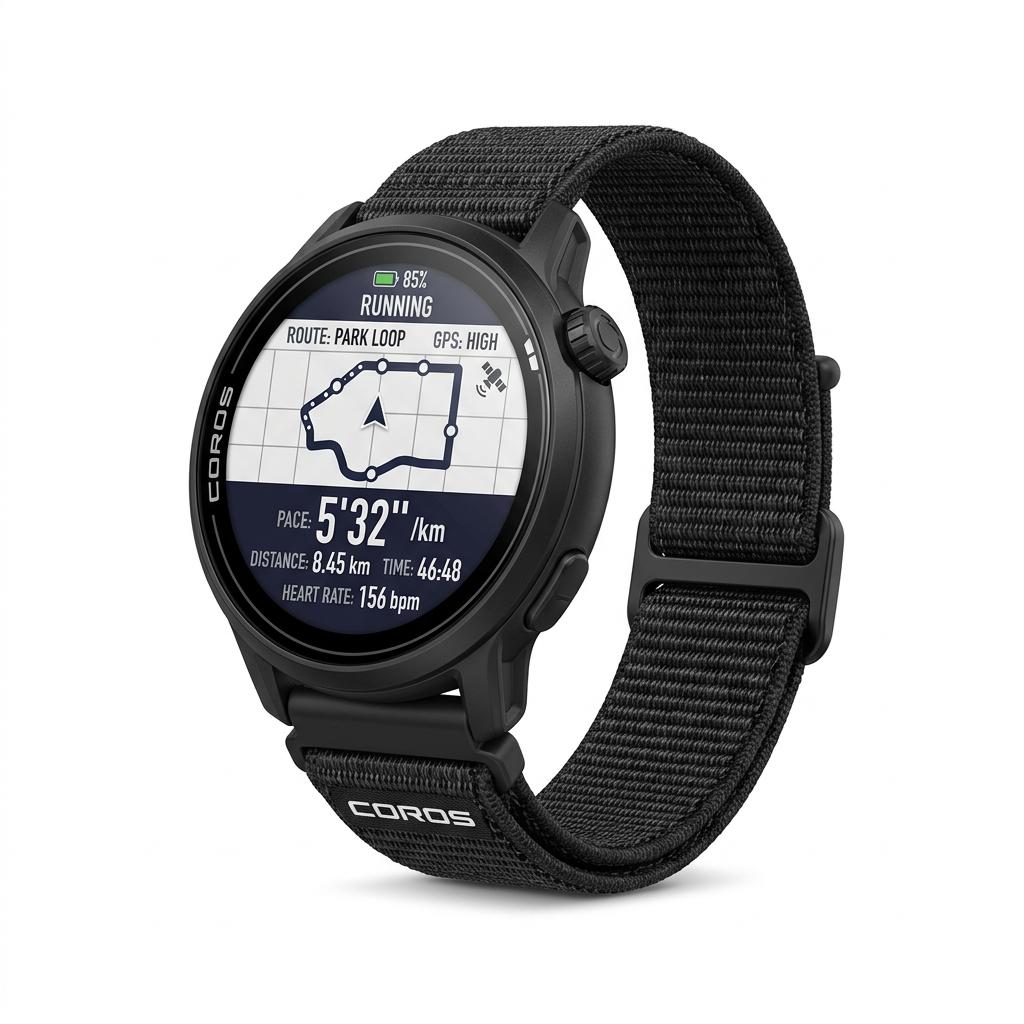
The Coros Pace 3 delivers specifications that match or exceed watches costing twice as much, making it the definitive value pick for budget-conscious runners. At 30g with the nylon band, it is the lightest watch in our comparison — a meaningful advantage for athletes who wear it sleep-through-training.
Why it stands out: The Pace 3 achieves 38 hours of GPS battery life and 24 days of smartwatch use, figures that lead this price tier and exceed several $500+ competitors. This endurance stems from Coros’s efficient chipset tuning rather than oversized batteries, keeping the case slim and wearable.
The EvoLab training analytics platform provides training load, fatigue, fitness trend, and race predictions comparable to Garmin’s ecosystem. While third-party app integration is narrower, the core data is robust. The dual-frequency GPS chipset delivers accuracy approaching the Forerunner 265 in most conditions, though multi-path error in dense urban environments is slightly higher in independent tests.
Trade-offs: The nylon band absorbs sweat and requires periodic washing. The button-only interface (no touchscreen) feels dated for smartwatch functions. Mapping is limited to breadcrumb trails without base maps, making it less suitable for complex navigation. Music storage is capped at 4 GB. Check price on Amazon
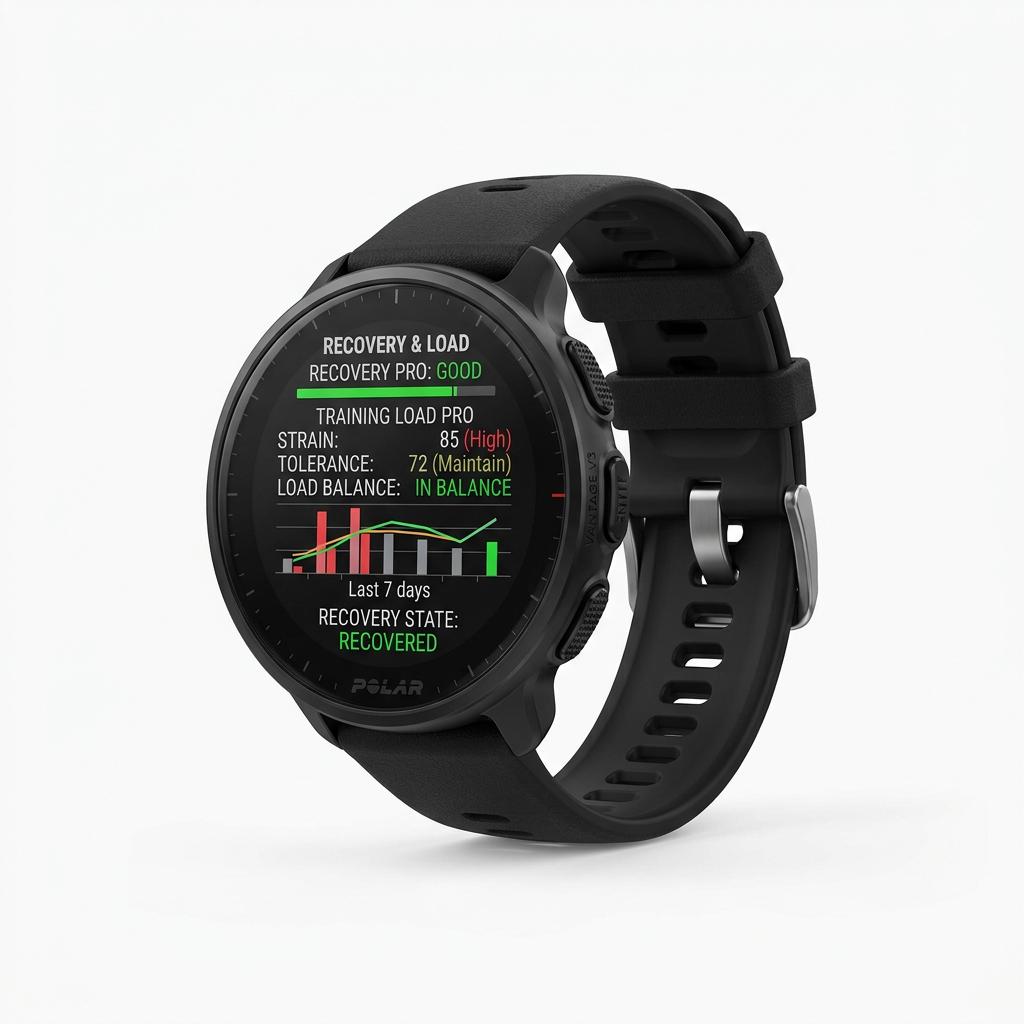
Polar’s Vantage V3 emphasizes physiological monitoring over smartwatch features, making it ideal for athletes who prioritize recovery data and training guidance. The Phoenix optical heart rate sensor represents Polar’s latest hardware iteration, and independent analysis places it among the most accurate wrist-based systems available.
Key differentiator: Training Load Pro divides cardiovascular load, muscle load, and perceived load into separate metrics. For home gym athletes combining running and resistance training, this separation provides more actionable insight than consolidated scores. The Orthostatic Test (requires manually initiating a 4-minute protocol) and Leg Recovery Test offer recovery diagnostics typically reserved for laboratory assessment or chest-strap systems.
The 53-day smartwatch battery and 50-hour GPS battery lead our comparison, enabled by Polar’s power-efficient AMOLED implementation. Full-color maps with turn-by-turn navigation address the Vantage V2’s primary weakness. 32 GB of storage supports extensive offline music libraries.
Considerations: At $520–$550, the Vantage V3 requires genuine commitment to training analytics to justify the premium. The Polar Flow app, while analytically deep, lacks the third-party integration breadth of Garmin Connect or Apple Health. Check price on Amazon
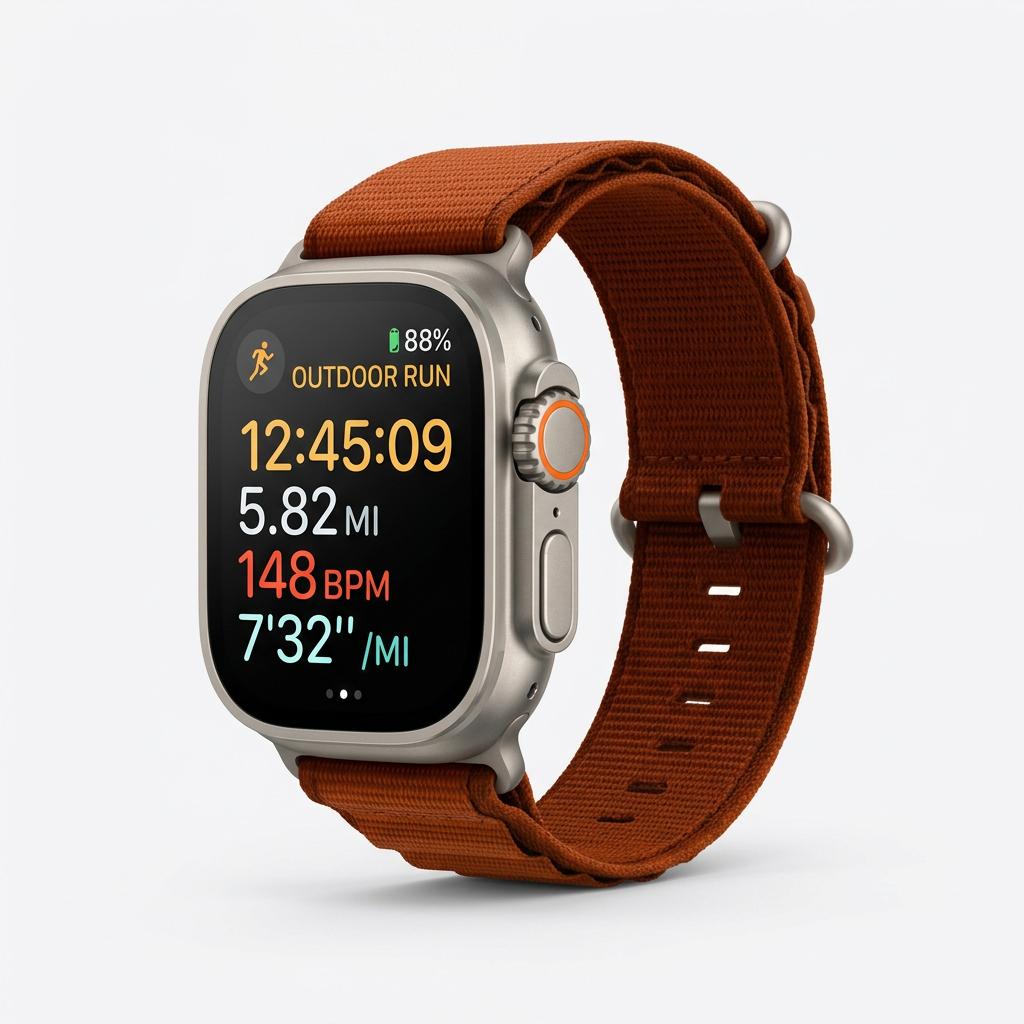
The Apple Watch Ultra 2 remains the most capable smartwatch for athletes embedded in Apple’s ecosystem, even as dedicated running watches narrow the GPS and battery gaps. Its 49mm titanium case, 3000-nit display, and dual-frequency GPS provide hardware specifications that match dedicated outdoor watches.
Where it excels: The integration with Apple Health, third-party training apps (TrainingPeaks, Strava, Intervals Pro), and the broader iOS ecosystem is unmatched. Cellular connectivity enables true phone-free running with live tracking and emergency calling. The Action Button provides customizable one-press workout initiation — genuinely useful when transitioning from home gym to outdoor run.
Where it falls short: The 12-hour GPS battery (36-hour standard use) remains the primary limitation for ultrarunners and high-volume athletes. While sufficient for marathon training and most daily use, it requires more frequent charging than any watch in our comparison. The $780–$800 price point is nearly double the Forerunner 265. Check price on Amazon
The Amazfit Cheetah Pro offers a compelling proposition: battery life and GPS hardware approaching the Coros Pace 3 at a similar price point, with a more polished smartwatch experience. The circularly-polarized GPS antenna — a design borrowed from professional survey equipment — delivers accuracy that independent analysis places within 1–2% of dual-band competitors in most conditions.
Notable features: Zepp Coach provides AI-generated training plans that adapt to your progress, though we recommend these as starting points rather than replacements for structured programming. The 1.45-inch AMOLED display (480 x 480 pixels) is the highest-resolution screen at this price. 14-day smartwatch battery and 44-hour GPS battery support extended training blocks without charging anxiety.
Trade-offs: Third-party app ecosystem remains limited compared to Garmin or Apple. The optical heart rate sensor shows typical budget-watch lag during rapid intensity transitions. Build quality, while improved, does not match the tactile refinement of $400+ watches.
The Suunto Race combines Suunto’s heritage in outdoor navigation with modern AMOLED display technology and dual-frequency GPS. For home gym athletes who trail run or hike, the offline mapping capabilities exceed most competitors.
Strengths: Full-color offline topographic maps with contour lines, waypoints, and route planning accessible directly on the watch. The 40-hour GPS battery supports long trail outings. Suunto’s Training Zone ecosystem provides load and recovery metrics comparable to Garmin and Polar.
Limitations: At 69g, the Race is the heaviest watch in our comparison — noticeable during speed work and sleep tracking. The optical heart rate sensor underperforms competitors during high-intensity efforts. Smartwatch features lag Apple and Garmin.
A 2024 analysis of consumer GPS watches published in the Journal of Sports Sciences found that multi-band and dual-frequency systems (L1+L5 or equivalent) reduced median positional error from 3.2% to 1.4% of distance covered in forested trail environments. In urban canyon testing, the improvement was more pronounced: single-band watches showed 4.8% error due to multi-path signal reflection, while multi-band systems reduced this to 1.6%.
For the home gym athlete who runs, these percentages translate to meaningful training data. A 10-mile run with 3% GPS error records as 9.7 or 10.3 miles — enough to skew weekly mileage totals and pace calculations. Multi-band accuracy brings this variance within the noise of normal stride variation.
| Your Priority | Our Pick | Why |
|---|---|---|
| Best overall balance | Garmin Forerunner 265 | Accuracy, training features, app ecosystem |
| Maximum value | Coros Pace 3 | 38hr GPS battery at $230–$250 |
| Recovery depth | Polar Vantage V3 | Training Load Pro, orthostatic testing |
| iPhone integration | Apple Watch Ultra 2 | Ecosystem, cellular, third-party apps |
| Budget + big battery | Amazfit Cheetah Pro | 44hr GPS, AMOLED, under $250 |
| Trail navigation | Suunto Race | Topographic maps, outdoor heritage |
The GPS running watch market has matured to the point where even $250 watches deliver accuracy and battery life that exceeded $500+ flagships three years ago. For home gym athletes who run, our analysis suggests the Garmin Forerunner 265 offers the best integration of run-specific features, training load management, and cross-training support. The Coros Pace 3 provides exceptional value for athletes who prioritize battery life and core metrics over smartwatch breadth.
Your specific training mix — road vs. trail, structured intervals vs. steady state, strength integration frequency — should guide final selection. All watches in our comparison support the core function: accurate, reliable tracking that informs better training decisions.
| Image | Product | Price | Badge | Link |
|---|---|---|---|---|
 |
Garmin Forerunner 265 | $420-$450 | Best Overall | Check Price |
 |
Coros Pace 3 | $230-$250 | Best Value | Check Price |
 |
Polar Vantage V3 | $520-$550 | Best Recovery Analytics | Check Price |
 |
Apple Watch Ultra 2 | $780-$800 | Best for iPhone Ecosystem | Check Price |
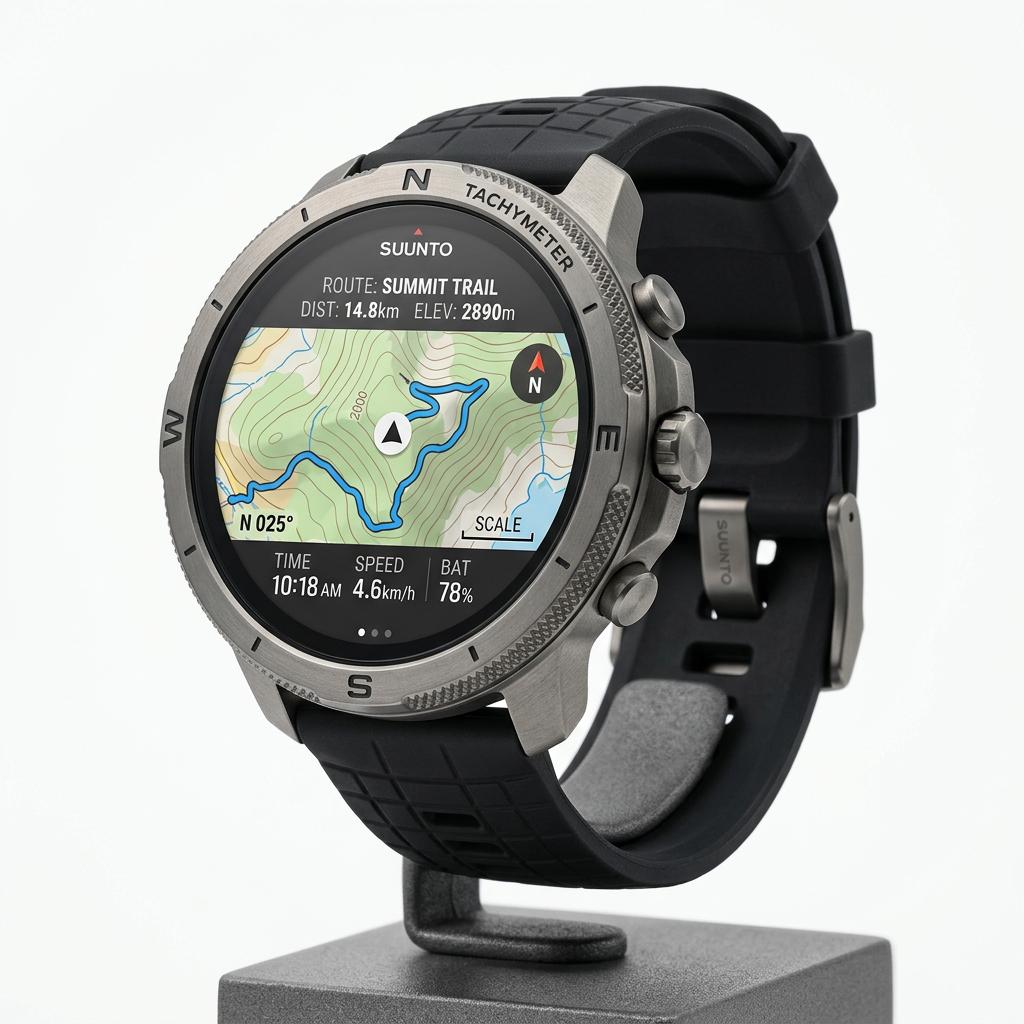 |
Suunto Race | $320-$350 | Best for Trail Navigation | Check Price |
The best GPS running watch for hybrid athletes who train at home and run outdoors, with unmatched accuracy and training integration.
The definitive value pick delivering flagship specifications at mid-range pricing with extraordinary endurance.
The premier watch for athletes who prioritize physiological monitoring and recovery data over smartwatch features.
The most capable smartwatch for Apple ecosystem athletes, despite battery limitations for high-volume training.
The best GPS running watch for trail runners and hikers needing superior offline mapping capabilities.
The Garmin Forerunner 265 sits at the intersection of running depth and cross-training flexibility. As one of the first mainstream watches to adopt multi-band GNSS (L1+L5), independent GPS accuracy analysis has shown it reduces positional error by 30-50% in challenging environments compared to single-band systems. The Training Readiness score consolidates sleep quality, HRV, recent exercise load, and stress — particularly valuable for home gym athletes alternating strength and running. With 20 hours of GPS battery and 13 days of smartwatch use, it supports a full week of training without charging. For data-driven runners wanting the best overall experience, the Forerunner 265 justifies its premium.
Check Price on Amazon
The Coros Pace 3 achieves specifications that match or exceed watches costing twice as much. At 30g, it is the lightest watch in our comparison, and the 38-hour GPS battery life leads this price tier while exceeding several $500+ competitors. The efficient chipset tuning keeps the case slim without oversized batteries. EvoLab training analytics provide training load, fatigue, fitness trend, and race predictions comparable to Garmin's ecosystem. Dual-frequency GPS chipset delivers accuracy approaching the Forerunner 265 in most conditions. For value-focused runners prioritizing battery life and core metrics over smartwatch breadth, the Pace 3 is the definitive endurance watch.
Check Price on Amazon
Polar's Vantage V3 emphasizes physiological monitoring over smartwatch features, making it ideal for athletes who prioritize recovery data. The Training Load Pro feature uniquely divides cardiovascular load, muscle load, and perceived load into separate metrics — for home gym athletes combining running and resistance training, this separation provides more actionable insight than consolidated scores. The Orthostatic Test and Leg Recovery Test offer diagnostics typically reserved for laboratory assessment. With 53-day smartwatch battery, 50-hour GPS battery, and 32GB of music storage, the V3 leads our comparison in endurance. The full-color maps with turn-by-turn navigation address the Vantage V2's primary weakness.
Check Price on Amazon
The Apple Watch Ultra 2 remains the most capable smartwatch for athletes embedded in Apple's ecosystem. The 49mm titanium case, 3000-nit display, and dual-frequency GPS provide hardware matching dedicated outdoor watches. Integration with Apple Health, third-party training apps, and the broader iOS ecosystem is unmatched, while cellular connectivity enables true phone-free running with live tracking and emergency calling. The Action Button provides customizable one-press workout initiation. However, the 12-hour GPS battery remains the primary limitation for ultrarunners and high-volume athletes, requiring more frequent charging than any watch in our comparison. The $780-$800 price is nearly double the Forerunner 265.
Check Price on Amazon
The Suunto Race combines Suunto's heritage in outdoor navigation with modern AMOLED display technology and dual-frequency GPS. For home gym athletes who trail run or hike, the offline mapping capabilities exceed most competitors. Full-color topographic maps with contour lines, waypoints, and route planning are accessible directly on the watch — a significant advantage for trail navigation. The 40-hour GPS battery supports long trail outings, and Suunto's Training Zone ecosystem provides load and recovery metrics comparable to Garmin and Polar. At 69g, it is the heaviest watch in our comparison — noticeable during speed work and sleep tracking. The optical heart rate sensor also underperforms competitors during high-intensity efforts, making it best suited for steady-state trail runners.
Check Price on Amazon