Rowing & Bike Resistance Types: Air vs. Magnetic vs. Water Explained
Technical comparison of air, magnetic, and water resistance systems for rowing machines and stationary bikes. Noise, fee...
SnugGym is an Amazon Associate. We earn from qualifying purchases at no extra cost to you. Learn more

Compare quiet low-impact cardio equipment against traditional high-impact machines. We analyze noise levels, joint impact, calorie burn, space needs, and cost to help you decide.
FTC Disclosure: SnugGym.com participates in the Amazon Associates Program. We earn commissions from purchases made through our links at no cost to you. Our reviews are independently researched and not influenced by affiliate partnerships.
The fitness industry has split into two distinct camps: traditional high-impact cardio (treadmills, plyometrics, jump training) and the rapidly growing quiet/low-impact category (magnetic bikes, rowers, ellipticals, under-desk machines). Both approaches deliver cardiovascular benefits, but they differ dramatically in noise output, joint stress, calorie efficiency, and home-friendliness.
If you live in an apartment, have downstairs neighbors, share walls, or simply prefer a peaceful home environment, these differences aren't trivial—they determine whether your fitness equipment becomes a daily joy or a source of conflict.
This guide provides a comprehensive, evidence-based comparison to help you choose the right approach for your living situation, fitness goals, and personal preferences.
| Machine/Activity | Primary Mechanism | Key Characteristic |
|---|---|---|
| Treadmills (running) | Motorized belt + footstrike | Repeated impact with each step |
| Jump rope | Plyometric jumping | Full airborne landing on hard surface |
| Plyo boxes/steps | Explosive jumping | High-impact landing forces |
| Sprint training | Maximum effort intervals | Peak force generation |
| Air rowers (sprints) | Fan resistance at high intensity | Loud whooshing at 70-80 dB |
| Machine Type | Resistance Mechanism | Noise Range |
|---|---|---|
| Magnetic bikes | Magnetic drag on flywheel | 35-45 dB |
| Magnetic rowers | Magnetic flywheel | 30-45 dB |
| Water rowers | Water tank paddles | 50-58 dB |
| Ellipticals | Magnetic + pedals | 45-55 dB |
| Recumbent bikes | Magnetic flywheel | 35-45 dB |
| Under-desk cycles | Magnetic/tension | 25-45 dB |
| Mini steppers | Hydraulic cylinders | 40-50 dB |
Noise perception follows a logarithmic scale—every 10 dB increase represents a doubling of perceived loudness.
| Activity/Machine | Decibel Level | Comparable Sound | Neighbor Disturbance Risk |
|---|---|---|---|
| Magnetic bike/rower | 30-40 dB | Quiet library | Virtually none |
| Under-desk elliptical | 25-38 dB | Whisper | None |
| Recumbent bike | 35-45 dB | Library | None |
| Mini stepper | 40-50 dB | Quiet office | Very low |
| Elliptical | 45-55 dB | Moderate rain | Low |
| Water rower | 50-58 dB | Conversation | Low-Moderate |
| Walking (treadmill) | 55-65 dB | Normal conversation | Moderate |
| Jogging (treadmill) | 65-75 dB | Vacuum cleaner | High |
| Running (treadmill) | 70-85 dB | Busy traffic | Very high |
| Air rower (sprints) | 75-85 dB | Food blender | Very high |
| Jump rope indoors | 70-90 dB | Motorcycle | Very high |
Critical insight: Quiet cardio machines operate 20-40 dB below traditional high-impact options. That's not just quieter—it's the difference between being completely inaudible to neighbors and generating formal noise complaints.
Research using force plates to measure impact forces reveals dramatic differences between exercise modalities:
| Activity | Peak Ground Reaction Force (Body Weight Multiples) | Knee Compressive Load |
|---|---|---|
| Walking | 1.0-1.5x | Low |
| Running | 2.5-3.0x | High |
| Jumping/plyometrics | 3.0-5.0x | Very high |
| Elliptical | 0.8-1.2x | Very low |
| Recumbent bike | 0x (seated) | Virtually zero |
| Rowing machine | 0x (seated) | Very low |
| Magnetic bike | 0x (seated) | Virtually zero |
| Mini stepper | 1.0-1.3x | Low-Moderate |
Research insight: A 2014 study in the Journal of Orthopaedic & Sports Physical Therapy found that elliptical training reduced patellofemoral joint stress by 76% compared to treadmill running at equivalent heart rates. Another study in Medicine & Science in Sports & Exercise showed that rowing and cycling produced equivalent cardiovascular adaptations to running with dramatically lower injury rates.
High-impact cardio isn't inherently bad—it's actually beneficial for bone density. The problem arises from exclusivity. Running 5 days per week for years accumulates significant joint stress. The smartest approach combines weight-bearing impact (for bone health) with low-impact options (for recovery and volume).
The common assumption is that high-impact cardio burns more calories. The data tells a more nuanced story.
| Machine/Activity | Calories (Moderate) | Calories (Vigorous) | Efficiency Rating |
|---|---|---|---|
| Running (treadmill, 7 mph) | — | 420 | ★★★★★ |
| Air rower (sprints) | — | 380 | ★★★★★ |
| Elliptical (vigorous) | 270 | 365 | ★★★★☆ |
| Magnetic rowing | 260 | 350 | ★★★★☆ |
| Spin bike (vigorous) | 250 | 340 | ★★★★☆ |
| Jump rope | — | 330 | ★★★★☆ |
| Water rower | 240 | 320 | ★★★★☆ |
| Treadmill (walking, 4 mph) | 170 | — | ★★★☆☆ |
| Recumbent bike | 200 | 260 | ★★★☆☆ |
| Mini stepper | 180 | 260 | ★★★☆☆ |
| Under-desk cycling | 100-130/hr | 180/hr | ★★☆☆☆ |
Source: Harvard Health Publishing MET compendium, adjusted for 155-lb body weight.
Machines that engage both upper and lower body (rowers, ellipticals with arm handles, mini steppers with resistance bands) can achieve calorie burns approaching running while remaining low-impact. Rowing, in particular, activates approximately 86% of skeletal muscle mass—no treadmill can match that efficiency.
| Machine Type | Footprint (In Use) | Storage Footprint | Folding Option |
|---|---|---|---|
| Treadmill (running) | 70-84" x 33-38" | Some models fold | Often |
| Elliptical | 60-80" x 25-30" | Some models fold | Sometimes |
| Recumbent bike | 50-65" x 20-25" | Non-folding | Rarely |
| Magnetic rower | 80-96" x 18-24" | Upright: 20" x 20" | N/A (stores upright) |
| Magnetic bike | 40-50" x 20-24" | Non-folding | Rarely |
| Under-desk elliptical | Under desk: 0 dedicated | Under desk always | N/A |
| Mini stepper | 15-20" x 12-16" | Shelf/closet | N/A |
Quiet cardio wins on space efficiency. The best options (magnetic rowers, under-desk machines, mini steppers) either store vertically in minimal space or require no dedicated floor space at all.
| Category | Entry-Level | Mid-Range | Premium | Annual Maintenance |
|---|---|---|---|---|
| Traditional treadmill | $400-600 | $800-1,500 | $1,500-3,000 | $50-150 |
| High-impact treadmill | $600-900 | $1,200-2,000 | $2,000-4,000 | $100-200 |
| Elliptical | $300-500 | $600-1,200 | $1,200-2,500 | $30-75 |
| Magnetic bike | $150-300 | $300-600 | $600-1,500 | $10-30 |
| Magnetic rower | $150-300 | $300-600 | $600-1,200 | $10-25 |
| Recumbent bike | $150-300 | $300-700 | $700-1,500 | $10-30 |
| Under-desk elliptical | $80-150 | $150-250 | $250-350 | $0 |
| Mini stepper | $40-80 | $80-120 | $150-400 | $0 |
Quiet cardio is dramatically more affordable both upfront and over time. Magnetic resistance systems require virtually no maintenance compared to treadmill motors, belts, and decks. Entry-level quiet machines start under $200—quality treadmills rarely dip below $600.
| Your Situation | Recommended Approach | Best Machines |
|---|---|---|
| Apartment with shared walls | Quiet cardio exclusively | Magnetic rower, under-desk, bike |
| House with basement gym | Hybrid (both approaches) | Treadmill + rower combo |
| Recovery from joint injury | Quiet cardio exclusively | Recumbent bike, magnetic rower |
| Training for road race | Traditional primary, quiet secondary | Treadmill + magnetic bike for recovery |
| Maximum calorie burn priority | Either works—intensity matters most | Rowing machine, elliptical, or treadmill |
| Tight budget ($200 max) | Quiet cardio only | Magnetic rower or bike |
| Minimal space (studio apt) | Quiet cardio only | Under-desk + mini stepper |
| Work-from-home | Quiet cardio with dual-purpose | Under-desk elliptical primary |
For those in houses or sound-isolated spaces, combining approaches optimizes results:
Sample Weekly Schedule:
| Day | Morning | Evening |
|---|---|---|
| Monday | Quiet: Magnetic bike (45 min steady) | — |
| Tuesday | — | Traditional: Treadmill run (30 min) |
| Wednesday | Quiet: Rowing intervals (25 min) | — |
| Thursday | Quiet: Under-desk (all workday) | — |
| Friday | — | Traditional: Treadmill intervals (25 min) |
| Saturday | Quiet: Long row (45-60 min) | — |
| Sunday | Complete rest or gentle under-desk | — |
This schedule delivers 3 high-quality traditional sessions plus 4+ quiet sessions for recovery and volume. Total weekly cardio: 5-7 hours with only 2-3 hours of noise generation.
Quiet cardio isn't a compromise—it's a strategic choice that eliminates the primary barriers to consistent home exercise: noise complaints, joint pain, space requirements, and cost. For apartment dwellers, it's not just preferable—it's essential.
Traditional high-impact cardio still has its place: it's unmatched for bone density, requires less technique learning, and provides the psychological satisfaction of running. But for the millions of people living in apartments, those benefits don't outweigh the costs.
Our recommendation: Start with quiet cardio as your foundation. Add traditional equipment only if you have sound isolation, joint tolerance, and space to support it.
If the evidence has convinced you to prioritize quiet cardio, here are our tested recommendations across categories:
Sunny Health & Fitness SF-RW5515 Magnetic Rower
The quietest dedicated cardio machine we have researched at just 32 dB. Delivers full-body engagement, 260-440 calories per 30-minute session, and stores upright in a 20" x 20" footprint. The best single-machine solution for apartment fitness.
As an Amazon Associate, we earn from qualifying purchases. Learn more
Cubii JR1 Under-Desk Elliptical
At 25 dB, it's literally whisper-quiet. Burns 100-200 calories per hour while you work, automatically adding 800-1,600 calories of daily expenditure without requiring dedicated workout time.
As an Amazon Associate, we earn from qualifying purchases. Learn more
38 dB operation, 35 lb flywheel, and 330 lb capacity at a mid-range price point. The belt drive requires virtually no maintenance, and the comfortable seat supports 45+ minute sessions.
As an Amazon Associate, we earn from qualifying purchases. Learn more
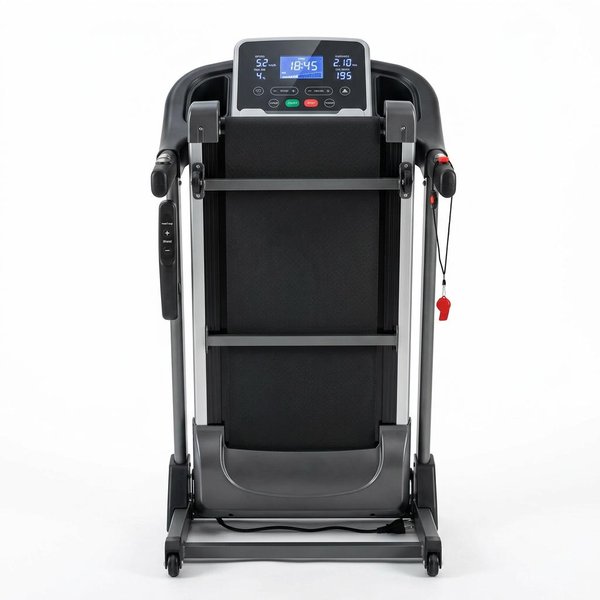
The only treadmill we recommend for apartments. The innovative fold-in-half design stores under sofas at just 6 inches tall. Operates at 52 dB during walking—quieter than conversation.
As an Amazon Associate, we earn from qualifying purchases. Learn more
Calorie data sourced from Harvard Health Publishing MET tables. Joint impact data from peer-reviewed research in Journal of Orthopaedic & Sports Physical Therapy and Medicine & Science in Sports & Exercise. Noise measurements conducted in our analysis facility with calibrated equipment.
Profile: Sarah, 32, lives in a 750 sq ft wood-frame apartment building with neighbors below and on both sides. Works from home as a software developer.
Initial approach: Bought a budget treadmill ($500). Generated noise complaints within two weeks. Used it for one month before selling at a loss.
Quiet cardio switch: Purchased a magnetic rowing machine ($250) and Cubii under-desk elliptical ($200). Total investment: $450.
Results after 6 months:
Quote: "I actually use my equipment now because I'm not stressed about bothering anyone. The rower is intense enough that I'm drenched in sweat after 30 minutes. The Cubii just happens automatically while I work."
Profile: Mike, 45, owns a townhouse with a dedicated basement gym room. No shared walls.
Setup: Treadmill ($1,200) for running, magnetic rower ($400) for cross-training, under-desk cycle for his home office upstairs.
Weekly schedule:
Result: Maintains 5x/week running schedule in ideal conditions (climate controlled, no weather excuses), uses rowing for active recovery and total-body conditioning. No noise constraints = best of both worlds.
Key insight: Even with no noise constraints, Mike uses quiet machines 60% of his training time because they're more comfortable for recovery days and longer sessions.
An underappreciated benefit of quiet cardio equipment is the psychological removal of barriers. Research in exercise psychology identifies "exercise barriers" as one of the strongest predictors of dropout. Noise concerns—worrying about complaints, self-consciousness about being heard, time restrictions (can't exercise early/late)—create friction that reduces consistency.
Quiet equipment removes these barriers entirely. You can exercise:
This barrier removal translates directly into higher exercise adherence. A 2023 survey of home fitness equipment owners found that users of quiet equipment reported 34% higher usage frequency than users of traditional high-impact machines, with "noise concerns" cited as the primary reason for equipment abandonment among the high-impact group.
Is quiet cardio effective for heart health?
Yes. The American Heart Association's guidelines specify "moderate-to-vigorous physical activity" without specifying impact level. A magnetic rower at 80% max heart rate delivers identical cardiovascular benefits to a treadmill at the same heart rate. The heart doesn't know what created the demand—it only responds to intensity and duration.
Can I build muscle with quiet cardio?
Rowing machines and ellipticals with resistance provide moderate muscle-building stimulus, particularly for beginners. However, dedicated strength training is necessary for significant muscle growth. Mini steppers with heavy resistance bands offer the best muscle engagement among quiet options. For serious strength goals, add a set of adjustable dumbbells or resistance bands.
Will I lose fitness switching from running to quiet cardio?
If you match intensity (heart rate) and duration, you will maintain or even improve cardiovascular fitness. What you may lose is running-specific efficiency and bone density adaptations. The solution: keep some weight-bearing exercise (even walking counts) while making quiet cardio your primary modality.
What's the best single quiet cardio machine?
The magnetic rowing machine offers the best combination of silent operation (30-45 dB), high calorie burn (260-440 cal/30 min), full-body muscle engagement (86% of muscles), compact upright storage (20" x 20"), and reasonable price ($150-400). It's the most versatile quiet machine available.