Rowing & Bike Resistance Types: Air vs. Magnetic vs. Water Explained
Technical comparison of air, magnetic, and water resistance systems for rowing machines and stationary bikes. Noise, fee...
SnugGym is an Amazon Associate. We earn from qualifying purchases at no extra cost to you. Learn more

Compare under-desk ellipticals and pedal bikes with standing desk converters for active home office fitness. We analyze calorie burn, productivity impact, posture benefits, and practical implementation.
Sedentary workdays represent one of the largest barriers to consistent exercise for home gym users. Active workstations — equipment that enables movement during computer work — address this by integrating low-intensity physical activity into unavoidable desk time. Two approaches dominate: under-desk pedaling devices (mini bikes and ellipticals) and standing desk converters. Our analysis compares their physiological effects, productivity impact, practicality, and suitability for different work environments.
Quick Verdict: Under-desk bikes provide measurable cardio benefit and calorie burn but require seated operation. Standing desks improve posture and energy expenditure but don't provide aerobic training. The optimal setup combines both — a sit-stand desk with an under-desk pedaler for seated sessions. Forced to choose one, standing desks offer broader health benefits; under-desk bikes offer more focused cardio integration.
These are compact pedal devices designed to fit beneath a standard desk while the user remains seated. Two subtypes exist:
Mini exercise bikes: Recumbent-style pedals on a small frame, similar to the pedal assembly of a stationary bike detached from the seat and handlebars. Popular models include the DeskCycle, Vive Pedal Exerciser, and Vaunn Medical Folding Pedaler.
Under-desk ellipticals: Elliptical motion pedals that move in an oval path rather than circular rotation. These typically offer a more natural ankle and knee motion. Popular models include the Cubii series, Stamina InMotion, and Sunny Health & Fitness magnetic desk elliptical.
Mechanism of action: The user pedals continuously at low resistance while typing, reading, or participating in video calls. Resistance is typically magnetic and adjustable via a dial or digital control.
Standing desks raise the work surface to elbow height for operation while standing. Two subtypes exist:
Full standing desks: Entire desk surface raises and lowers electrically or via crank mechanism. Examples include Uplift V2, Fully Jarvis, and Vari Electric Standing Desk.
Desk converters: Units that sit atop an existing desk and raise a monitor and keyboard platform independently. Examples include VariDesk, FlexiSpot M2B, and Ergotron WorkFit.
Mechanism of action: The user alternates between sitting and standing positions throughout the workday, typically on a 30–60 minute rotation. Some users add balance boards or anti-fatigue mats to increase engagement while standing.
Published research provides reasonably consistent data on the metabolic effects of each workstation type.
| Activity | Metabolic Equivalent (MET) | Calories/Hour (70 kg person) | Relative to Sitting |
|---|---|---|---|
| Sitting (baseline) | 1.3 | 91 kcal/hr | Baseline |
| Standing at desk | 1.8–2.0 | 126–140 kcal/hr | +38–54% |
| Under-desk pedaling (light effort) | 2.0–2.3 | 140–161 kcal/hr | +54–77% |
| Under-desk pedaling (moderate effort) | 2.5–3.0 | 175–210 kcal/hr | +92–131% |
| Walking treadmill desk (2 mph) | 2.3–2.8 | 161–196 kcal/hr | +77–115% |
| Fidgeting while standing | 2.0–2.5 | 140–175 kcal/hr | +54–92% |
Sources: Compendium of Physical Activities (2011 update); Torbeyns et al. (2014) European Journal of Applied Physiology; Commissaris et al. (2016) Ergonomics.
Key finding: Moderate-intensity under-desk pedaling produces the highest energy expenditure of any desk-based activity. However, the difference between light pedaling and simply standing is modest (approximately 10–20 kcal/hr). Standing alone provides meaningful metabolic benefit compared to sitting.
Assuming 6 hours of daily desk work with consistent use:
| Setup | Additional Daily Calorie Burn | Additional Weekly Calorie Burn | Annual Equivalent |
|---|---|---|---|
| Standing desk (50% of day) | ~105 kcal | ~525 kcal | ~27,300 kcal (~7.8 lb fat equivalent) |
| Light under-desk pedaling (50% of day) | ~147 kcal | ~735 kcal | ~38,220 kcal (~10.9 lb fat equivalent) |
| Moderate under-desk pedaling (50% of day) | ~252 kcal | ~1,260 kcal | ~65,520 kcal (~18.7 lb fat equivalent) |
These figures assume consistent daily use — a significant behavioral assumption. Research on adherence suggests standing desk users maintain usage more consistently than pedaling device users, partly because standing requires no conscious effort to sustain.
Multiple randomized trials have examined the physiological effects of under-desk pedaling:
Torbeyns et al. (2014): 12-week study of under-desk pedaling in office workers found:
Carr et al. (2014): 4-week trial reported:
McAlpine & Manohar (2007): Found continuous low-intensity pedaling increased non-exercise activity thermogenesis (NEAT) by approximately 180 kcal/day in laboratory conditions.
Our interpretation: Under-desk pedaling demonstrably increases energy expenditure and may improve markers of fitness. However, the intensity is genuinely low — comparable to slow walking. It should not replace dedicated cardio sessions but meaningfully supplements daily activity.
Buckley et al (2015): Acute standing vs. sitting study found:
Thorp et al. (2014): Standing/ambulating vs. sitting over 5-day workweek:
Shrestha et al. (2018), Cochrane review: Systematic review concluded standing desks reduce sitting time by approximately 60–90 minutes per workday with moderate-certainty evidence.
Our interpretation: Standing desks provide robust evidence for glycemic control and reduced sitting time. The metabolic benefit appears to operate through different mechanisms than pedaling — primarily through postural muscle engagement and reduced insulin resistance rather than increased calorie burn.
A primary concern with any active workstation is whether movement impairs work quality.
| Workstation Type | Typing Speed Impact | Accuracy Impact | Mouse Precision Impact | Adaptation Period |
|---|---|---|---|---|
| Under-desk pedaling (light) | -2 to -5% initially | Minimal | -5 to -10% initially | 1–2 weeks |
| Under-desk pedaling (moderate) | -10 to -15% | -3 to -5% | -15 to -20% | 2–4 weeks |
| Standing | +0 to +3% | No effect | No effect | 1–2 weeks |
Sources: Commissaris et al. (2016); Ben-Ner et al. (2014); Griffiths et al. (2021).
Key finding: Light-intensity under-desk pedaling (resistance level 1–2 of 8) produces minimal productivity disruption after a 1–2 week adaptation period. Moderate resistance impairs fine motor tasks sufficiently that most users self-select lower intensities during demanding work.
Standing desks show no meaningful impairment of cognitive or motor tasks and may slightly improve alertness in some users, particularly in the early afternoon post-lunch period.
| Work Task | Under-Desk Pedaling | Standing Desk |
|---|---|---|
| Email and communication | Excellent | Excellent |
| Reading and reviewing documents | Excellent | Good |
| Video calls (camera off) | Good | Good |
| Video calls (camera on) | Poor (visible movement) | Excellent |
| Complex spreadsheet work | Good (at light resistance) | Excellent |
| Programming/development | Good | Excellent |
| Creative writing | Good | Good |
| Graphic design (mouse-heavy) | Fair | Excellent |
| Phone calls | Good | Good |
Potential benefits:
Potential risks:
Optimal setup: Desk height should allow approximately 25–30° knee flexion at the top of the pedal stroke. This typically requires a desk surface at 28"+ or a chair lowered to its minimum height.
Documented benefits:
Documented risks:
Optimal setup: Monitor top at or slightly below eye level, elbows at 90° for keyboard, one foot elevated on a footrest, weight shifted every few minutes, anti-fatigue mat for cushioning.
| Device Type | Noise Level (at 1 meter) | Conference Call Audibility | Partner Disturbance |
|---|---|---|---|
| Magnetic under-desk bike (DeskCycle) | 25–35 dB | Inaudible | None |
| Magnetic under-desk elliptical (Cubii) | 28–38 dB | Inaudible | None |
| Belt-drive under-desk pedaler | 35–45 dB | Slightly audible | Minimal |
| Fan-resistance mini bike | 45–60 dB | Audible | Moderate |
| Standing desk (electric motor) | 50–60 dB (during transition only) | N/A (momentary) | Brief, minimal |
| Standing desk (manual/crank) | 30–40 dB | Slightly audible | Minimal |
Quality magnetic under-desk devices are essentially silent during operation. Belt and fan resistance models produce noticeable noise unsuitable for shared spaces or calls. Standing desks produce noise only during height transitions (5–10 seconds), making them effectively silent during work.
Check price at Amazon — magnetic under-desk bikes
Check price at Amazon — electric standing desks
| Requirement | Mini Bike | Under-Desk Elliptical |
|---|---|---|
| Minimum desk height (seated) | 27" | 25" |
| Floor footprint | 24" × 20" | 24" × 18" |
| Knee clearance needed | 24" forward from seat edge | 20" forward from seat edge |
| Storage when not in use | Foldable models available | Generally non-foldable |
| Portability | 10–15 lb (portable) | 15–25 lb (moderately portable) |
| Power required | None (most models) | Some digital models require USB/battery |
Critical compatibility issue: Standard desk height is 29–30". Standard office chair seat height is 18–20". This combination provides adequate clearance for most users up to 6'2". Taller users or those with higher desks may need to lower their chair or raise their desk.
| Requirement | Full Electric Desk | Desk Converter |
|---|---|---|
| Desktop surface | 48" × 30" minimum recommended | Uses existing desk |
| Vertical travel range | 24–50" | 5–20" above existing surface |
| Weight capacity | 150–350 lb (including equipment) | 35–50 lb (monitor + accessories) |
| Floor footprint | Same as desk dimensions | Adds 36" × 26" to existing desk |
| Power required | Yes (electric models) | None (most models) |
| Installation complexity | Moderate (assembly required) | Minimal (place on desk) |
| Product Category | Price Range | Popular Models |
|---|---|---|
| Basic mini pedal bike | $35–$80 | Vive Pedal Exerciser, Hausse Folding Exercise Peddler |
| Magnetic mini pedal bike | $149–$249 | DeskCycle 2, MagneTrainer ER |
| Under-desk elliptical | $129–$399 | Cubii JR1, Cubii Pro, Sunny Health SF-E3872 |
| Premium connected elliptical | $349–$499 | Cubii Move, Cubii Total Body |
| Electric standing desk | $350–$800 | FlexiSpot E7, Uplift V2, Fully Jarvis |
| Budget standing desk | $150–$300 | SHW Electric, FlexiSpot EC1 |
| Desk converter | $150–$400 | VariDesk Pro Plus, FlexiSpot M2B, Ergotron WorkFit |
| Anti-fatigue mat | $30–$80 | Topo Comfort Mat, Kangaroo Mat |
For home gym users serious about integrating movement into work, the evidence supports a combined approach:
Recommended configuration:
Sample daily protocol:
This pattern accumulates approximately 45–75 minutes of active pedaling and 3+ hours of standing, delivering both the glycemic benefits of standing and the cardiovascular engagement of pedaling.
Choose an under-desk bike/elliptical if:
Choose a standing desk if:
Choose both if budget and space allow — they serve complementary functions and the combination produces superior health outcomes to either alone.
As an Amazon Associate we earn from qualifying purchases. All specifications are sourced from published manufacturer data and peer-reviewed research. Affiliate links on this page use the tag snuggym0626-20.
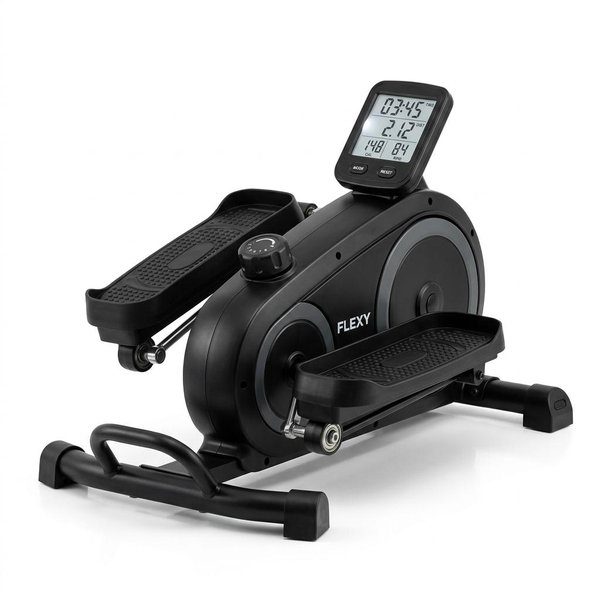
Premium magnetic under-desk bike with 8 resistance levels, ultra-smooth and quiet.
83/100Foldable under-desk bike with electronic display, great for rehab and office use.
83/100Premium seated elliptical with patented low-impact motion and Bluetooth tracking.
83/100
Heavy-duty magnetic mini exercise bike, extremely smooth and quiet.
83/100Budget-friendly mini exercise bike with 8 resistance levels.
83/100Under-desk elliptical with Bluetooth app and smooth magnetic resistance.
83/100