Amazon Basics vs Yes4All Fitness Equipment: Budget Gear Comparison
Comprehensive comparison of Amazon Basics vs Yes4All fitness equipment covering dumbbells, kettlebells, resistance bands...
Learn how to calculate and compare price per pound for gym equipment. Research-backed guide to evaluating fitness gear value with snuggym0626-20 affiliate links.
Last updated: June 26, 2025 | Budget Builds Series
"Price per pound" is the most widely used metric for evaluating the economic value of weight-based fitness equipment. Whether you're purchasing dumbbells, kettlebells, weight plates, or selectorized weight stacks, understanding how to calculate and contextualize this figure prevents overpayment and enables meaningful comparison across brands, materials, and product categories.
This guide defines the metric, provides benchmark values for every major equipment category, identifies when price per pound is misleading, and explains the durability and materials factors that explain seemingly irrational price variations.
Price per pound is calculated as:
Price Per Pound = Total Purchase Price ÷ Total Weight Purchased
You purchase a 200-pound rubber-coated Olympic plate set for $280:
$280 ÷ 200 lbs = $1.40 per pound
The same set includes a 45-pound Olympic barbell priced at $120 when sold separately:
($280 + $120) ÷ (200 + 45) lbs = $400 ÷ 245 lbs = $1.63 per pound
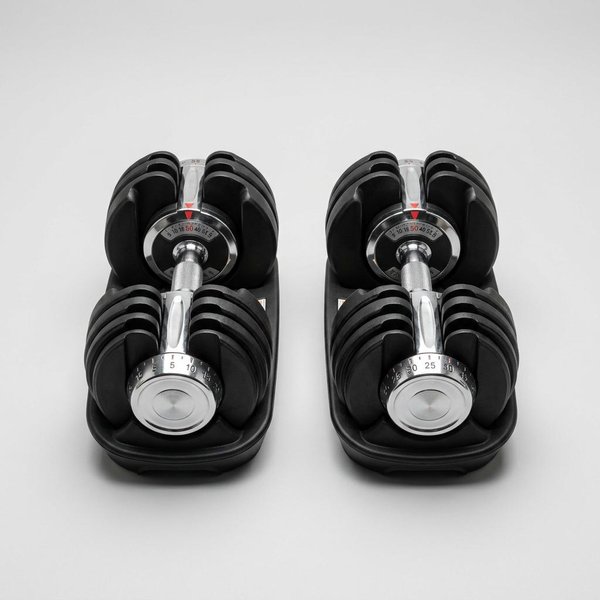
A pair of Bowflex SelectTech 552 dumbbells costs $429 and replaces 15 sets of fixed dumbbells totaling 525 pounds (sum of all individual dumbbell weights from 5 to 52.5 lbs per hand, two hands):
$429 ÷ 525 lbs = $0.82 per pound of weight range covered
This is the metric that makes adjustable dumbbells economically superior — the effective price per pound of exercise capacity is dramatically lower than purchasing equivalent fixed dumbbells.
The following benchmarks reflect market conditions as of 2025 for new equipment sold through major retailers. Used market prices typically run 40–70% of these values.
| Type | Price Per Pound | Notes |
|---|---|---|
| Cast iron (basic, painted) | $0.80–$1.20 | Lowest cost; rusts if not maintained |
| Cast iron (machined, calibrated) | $1.50–$2.50 | Competition-grade accuracy; expensive |
| Rubber-coated iron | $1.20–$1.80 | Floor protection; quieter than bare iron |
| Grip plates (holes for handling) | $1.00–$1.50 | Easier to carry; slight premium |
Top value pick: The papababe Bumper Plate Set delivers rubber-coated bumpers at approximately $1.30 per pound including the barbell — exceptional value for the drop-safe construction.
| Type | Price Per Pound | Notes |
|---|---|---|
| Crumb rubber (recycled, low odor) | $1.00–$1.50 | Softer bounce; wider thickness |
| Virgin rubber (dense, consistent) | $1.50–$2.00 | Harder bounce; competition standard |
| Competition calibrated | $2.50–$4.00 | IWF-spec weight tolerance; color-coded |
Bumper plates cost more per pound than iron but protect floors, reduce noise, and enable Olympic lifting movements. For home gyms on second floors or with noise-sensitive neighbors, the premium is functionally mandatory.
| Type | Price Per Pound (Pair) | Notes |
|---|---|---|
| Hex rubber-coated | $1.00–$1.50 | Most common; durable; doesn't roll |
| Urethane-coated | $1.50–$2.50 | Most durable; commercial gym standard |
| Cast iron (classic) | $0.80–$1.20 | Aesthetic appeal; rust risk |
| Neoprene-coated | $1.00–$1.50 | Comfortable grip; color-coded; light weights only |
Value insight: Fixed dumbbells become cost-prohibitive for complete sets. A full 5–50 lb set in 5-pound increments (10 pairs) at $1.20/lb costs $660 and requires a storage rack. This is why adjustable dumbbells dominate home gym recommendations despite higher single-purchase cost.
| Model | Price | Weight Range | Price Per Pound |
|---|---|---|---|
| Amazon Basics Spin-Lock | $69 | 38 lbs | $1.82 |
| ATIVAFIT Dial System | $299 | 71.5 lbs | $4.18 |
| Bowflex SelectTech 552 | $429 | 52.5 lbs | $8.17 |
| Bowflex SelectTech 1090 | $799 | 90 lbs | $8.88 |
The apparently high price per pound of adjustable systems is misleading — these products include complex mechanical adjustment systems, storage trays, and the engineering to nest multiple weights in one footprint. The relevant comparison is against the cost of purchasing all equivalent fixed dumbbells plus a storage rack.
| Type | Price Per Pound | Notes |
|---|---|---|
| Cast iron (basic) | $1.00–$1.50 | Standard; durable; varies by weight |
| Cast iron (powder-coated) | $1.20–$1.80 | Better grip; corrosion resistance |
| Competition (uniform size) | $2.00–$3.00 | Same dimensions at all weights; color-coded |
| Vinyl-coated | $1.00–$1.50 | Floor protection; color-coded |
Kettlebell pricing is notably weight-dependent. Heavier kettlebells (40+ lbs) typically have lower per-pound costs than lighter ones (10–20 lbs) due to fixed manufacturing and shipping costs being distributed across more material.
Top value pick: The Yes4All Solid Cast Iron Kettlebell consistently delivers cast iron kettlebells at $1.10–$1.40 per pound across the full weight range.
Storage equipment doesn't contribute training weight but is essential for organization and safety. Typical price ranges:
| Type | Price Range | Capacity | Cost Per Pound Stored |
|---|---|---|---|
| A-frame dumbbell rack | $80–$150 | 300–500 lbs | $0.20–$0.50/lb stored |
| Horizontal plate tree | $60–$120 | 300–500 lbs | $0.20–$0.40/lb stored |
| Vertical dumbbell rack | $100–$200 | 400–600 lbs | $0.25–$0.50/lb stored |
| Wall-mounted plate storage | $40–$80 | 200–400 lbs | $0.20–$0.40/lb stored |
Two iron plates both priced at $1.20 per pound may differ substantially:
The apparent price parity conceals meaningful quality differences. Weight tolerance matters for balanced barbell loading — uneven plates create torque that stresses wrists, elbows, and shoulders during heavy lifts.
Some equipment commands higher price per pound due to functional features:
Bowflex dumbbells command approximately 2x the price per pound of ATIVAFIT for equivalent weight ranges. The premium purchases:
Whether this premium is justified depends on your budget flexibility and how much you value the micro-increment feature for upper-body progressive overload.
Price per pound captures only the acquisition cost. The true economic analysis includes:
Maintenance costs:
Replacement costs:
Resale value:
Storage costs (imputed):
Scenario: Building a home gym in a 600 sq ft one-bedroom apartment. Budget: $400. Need: Strength training capability from beginner to intermediate levels.
Option A: Fixed Dumbbell Pairs
Option B: Adjustable Dumbbells
Outcome: Option B provides 4x the weight variety at 10% lower total cost and one-third the floor space. The effective price per pound calculation reveals Option B's superior value despite the higher single-item price.
Why do lighter weights cost more per pound?
Manufacturing, packaging, and shipping costs have a significant fixed component. A 5-pound dumbbell and a 50-pound dumbbell require similar packaging, handling labor, and shipping logistics. The fixed costs distribute across fewer pounds for lighter weights, inflating per-pound pricing.
Is it better to buy used equipment for lower price per pound?
Often yes, with caveats. Used iron plates and fixed dumbbells at $0.50–$0.80 per pound represent excellent value if the equipment isn't cracked, severely rusted, or inaccurately weighed. Avoid used adjustable dumbbells — the internal mechanism condition is difficult to verify and replacement parts are rarely available.
Does price per pound apply to cardio equipment?
Not directly. Cardio machines (treadmills, bikes, rowers) are priced by features, electronics, and build quality rather than weight. A useful parallel metric is price per expected year of service life — e.g., a $600 treadmill lasting 7 years costs $86/year.
Price per pound is an indispensable starting point for equipment evaluation, but it's not the endpoint. The complete analysis incorporates material quality, functional features, warranty coverage, space efficiency, maintenance requirements, and resale value. A higher price per pound is frequently justified by durability, safety features, or space savings that compound over years of ownership.
For most home gym builders, the key insight is that adjustable systems — despite higher nominal price per pound — deliver superior value through space savings and weight range coverage. When evaluating any purchase, calculate the effective price per pound of exercise capacity, not merely the price per pound of metal.
Disclosure: This article contains affiliate links. Purchases made through these links may earn a commission at no additional cost to you. All recommendations are independently researched and selected based on quality and value.