Amazon Basics vs Yes4All Fitness Equipment: Budget Gear Comparison
Comprehensive comparison of Amazon Basics vs Yes4All fitness equipment covering dumbbells, kettlebells, resistance bands...
Compound exercises work multiple muscle groups simultaneously. Learn why they're essential for efficient small-space home gym workouts.
If you're building a home gym in a small apartment, every square foot and every minute of your workout matters. That's where compound exercises come in. Unlike isolation movements that target a single muscle group, compound exercises recruit multiple joints and muscle groups at once—making them the single most efficient choice for anyone training with limited space and equipment.
In this guide, we'll break down exactly what makes an exercise "compound," why they're ideal for apartment-friendly workouts, and how to build a full-body routine around them using minimal gear.
A compound exercise is any movement that engages two or more joints and works multiple muscle groups simultaneously. An isolation exercise, by contrast, targets a single joint and one primary muscle.
| Movement Type | Example | Joints Used | Primary Muscles |
|---|---|---|---|
| Compound | Squat | Hip, knee, ankle | Quads, glutes, hamstrings, core |
| Compound | Bench Press | Shoulder, elbow | Chest, shoulders, triceps |
| Isolation | Bicep Curl | Elbow only | Biceps |
| Isolation | Leg Extension | Knee only | Quads |
The difference matters for home gym owners because compound movements let you train your entire body with just a few exercises—and often with a single piece of equipment.
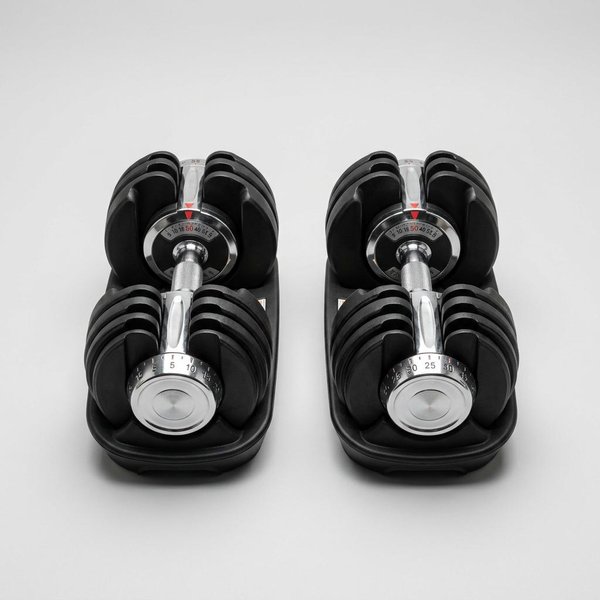
These ten movements form the foundation of efficient, full-body strength training. Most can be performed with a simple pair of adjustable dumbbells, making them ideal for apartments.
| Exercise | Primary Muscles | Equipment Needed | Apartment Notes |
|---|---|---|---|
| Squat | Quads, glutes, hamstrings, core | Dumbbells or bodyweight | Low noise; use exercise mat for floor protection |
| Deadlift | Posterior chain, back, grip | Dumbbells or kettlebell | Control the eccentric to reduce noise |
| Bench Press | Chest, shoulders, triceps | Dumbbells + bench or floor | Floor press is a quiet, space-saving alternative |
| Overhead Press | Shoulders, triceps, core | Dumbbells | Seated version reduces noise vs. standing |
| Row | Back, biceps, rear delts | Dumbbells | Single-arm rows need minimal space |
| Pull-Up | Back, biceps, core | Pull-up bar (doorway) | Doorway bars are renter-friendly with no drilling |
| Dip | Chest, triceps, shoulders | Dip station or chairs | Portable dip bars fold flat for storage |
| Lunge | Quads, glutes, hamstrings, balance | Dumbbells or bodyweight | Static lunges reduce noise vs. walking lunges |
| Hip Thrust | Glutes, hamstrings, core | Dumbbell on hips + bench | Highly effective; minimal space required |
| Farmer's Walk | Grip, core, traps, forearms | Dumbbells or kettlebells | Walk in place if space is limited |
Research published in the Journal of Strength and Conditioning Research shows that compound movements produce similar—or superior—muscle activation across multiple groups compared to performing multiple isolation exercises. A 30-minute full-body compound routine can replace 60+ minutes of isolation-focused training.
Compound lifts that engage large muscle mass—like squats and deadlifts—trigger a more significant release of anabolic hormones including testosterone and growth hormone. This hormonal cascade supports muscle growth and fat loss across the entire body, not just the muscles being worked.
These movements mirror real-world patterns: squatting to pick something up, pressing an object overhead, pulling yourself up. The strength you build translates directly to daily life, not just the gym.
Because compound exercises recruit more total muscle fiber, they demand more energy. Studies indicate that multi-joint exercises elevate heart rate and calorie expenditure significantly more than isolation work—making them efficient for both strength and conditioning goals.
You don't need a squat rack or barbell to benefit from compound training. Here's how to structure a program with just a pair of adjustable dumbbells:
Day A – Push & Legs Focus
Day B – Pull & Hinge Focus
Day C – Mixed & Bodyweight
Rest one day between each session. This structure hits every major muscle group twice per week using nothing but dumbbells and a doorway pull-up bar.
If you're new to strength training, begin with bodyweight or light dumbbells and focus on form before adding load:
| Exercise | Beginner Version | Intermediate Progression |
|---|---|---|
| Squat | Bodyweight sit-to-stand | Goblet squat with dumbbell |
| Deadlift | Hip hinge with broomstick | Dumbbell Romanian deadlift |
| Bench Press | Push-up from knees | Floor press with light dumbbells |
| Row | Inverted row under table | Single-arm dumbbell row |
| Overhead Press | Wall slide | Seated dumbbell press |
Aim to master 2–3 sets of 10–12 clean reps at each level before progressing. Add 2.5–5 lbs when you can complete all sets with good form.
Compound exercises are the cornerstone of efficient home gym training. They let you train more muscle in less time, with less equipment, and in less space—exactly what apartment dwellers need. A pair of adjustable dumbbells and a commitment to progressive overload on these ten foundational movements will deliver better results than most commercial gym routines, all without leaving your living room.
Start with the beginner progressions, follow the 3-day split, and focus on adding weight or reps each week. In a small space, simplicity and consistency win every time.