The 5 Best Ab Benches for Home Gyms in 2025: Decline & Adjustable Benches Tested
Research-backed guide to best ab benches home for small-space home gyms....
Learn how to start calisthenics at home with no equipment. Progressive exercises, 8-week program, and science-backed methods for building strength with bodyweight training.
Calisthenics — training using only your body weight as resistance — is the most accessible form of strength training ever developed. No gym membership, no equipment, no commute. Just you, gravity, and progressive movement patterns that have built physiques from ancient Greek soldiers to modern elite gymnasts.
This guide provides everything a beginner needs to start calisthenics in a small apartment, including exercise progressions, an 8-week program, and the scientific principles that make bodyweight training effective.
Calisthenics derives from the Greek words kalos (beauty) and sthenos (strength). It encompasses any strength exercise that uses body weight as the primary resistance, including:
A 2023 systematic review in Sports Medicine analyzed 28 studies on bodyweight training and found:
| Outcome | Calisthenics Effect | Comparison to Weight Training |
|---|---|---|
| Muscle strength | Significant gains | Comparable for beginners |
| Muscle hypertrophy | Significant gains | Slightly lower for advanced |
| Core stability | Superior gains | Exceeds weight training |
| Balance/proprioception | Superior gains | Exceeds weight training |
| Cardiovascular health | Significant gains | Comparable |
For beginners, bodyweight training produces strength and muscle gains equivalent to traditional weight training. The difference only emerges at advanced levels where external loading becomes necessary for continued progression.
Every calisthenics program builds on six fundamental patterns. Master these before attempting advanced variations.
Target Muscles: Chest, shoulders, triceps, core
Progression Ladder:
| Level | Exercise | Target | When to Progress |
|---|---|---|---|
| 1 | Wall push-up | 3×15 | Too easy |
| 2 | Incline push-up (hands on table) | 3×12 | Full range, easy |
| 3 | Knee push-up | 3×10 | Full range, controlled |
| 4 | Standard push-up | 3×8 | Full range, easy |
| 5 | Diamond push-up | 3×8 | Tricep emphasis mastered |
| 6 | Wide push-up | 3×10 | Chest development |
| 7 | Decline push-up | 3×8 | Feet elevated |
| 8 | Archer push-up | 3×5/side | Unilateral strength |
| 9 | One-arm push-up | 3×5/side | Elite pushing strength |
Form Checklist:
Target Muscles: Lats, biceps, rhomboids, rear deltoids
Progression Ladder:
| Level | Exercise | Target | When to Progress |
|---|---|---|---|
| 1 | Dead hang | 3×30s | Grip strength built |
| 2 | Scapular pull-up | 3×10 | Shoulder blade control |
| 3 | Negative pull-up | 3×5 (5s lower) | Eccentric strength |
| 4 | Assisted pull-up (band) | 3×8 | Full range achieved |
| 5 | Standard pull-up | 3×5 | First full rep achieved |
| 6 | Chin-up | 3×8 | Bicep emphasis |
| 7 | Wide-grip pull-up | 3×6 | Lat width focus |
| 8 | L-sit pull-up | 3×5 | Core integration |
| 9 | Muscle-up | 3×3 | Transition mastery |
Equipment Note: Pull-ups require an overhead bar. For apartment dwellers, we recommend the Iron Gym Total Upper Body Workout Bar for doorway mounting with no installation, or the ProsourceFit Multi-Grip Pull-Up Bar for multi-grip options.
See our full guide: Pull-Up Progression: Zero to First Pull-Up
Target Muscles: Quadriceps, glutes, adductors, core
Progression Ladder:
| Level | Exercise | Target | When to Progress |
|---|---|---|---|
| 1 | Box squat (to chair) | 3×15 | Depth and control |
| 2 | Air squat | 3×20 | Full depth achieved |
| 3 | Jump squat | 3×12 | Power development |
| 4 | Bulgarian split squat | 3×10/leg | Single-leg strength |
| 5 | Shrimp squat | 3×8/leg | Advanced unilateral |
| 6 | Pistol squat | 3×5/leg | Elite leg strength |
Form Checklist:
Target Muscles: Hamstrings, glutes, lower back
Progression Ladder:
| Level | Exercise | Target | When to Progress |
|---|---|---|---|
| 1 | Glute bridge | 3×15 | Glute activation |
| 2 | Single-leg glute bridge | 3×12/leg | Unilateral strength |
| 3 | Hip thrust (feet elevated) | 3×15 | Full hip extension |
| 4 | Nordic curl negative | 3×5 | Eccentric hamstring |
| 5 | Nordic curl | 3×5 | Elite hamstring strength |
Target Muscles: Rectus abdominis, obliques, transverse abdominis
Progression Ladder:
| Level | Exercise | Target | When to Progress |
|---|---|---|---|
| 1 | Dead bug | 3×10/side | Supine core control |
| 2 | Plank | 3×30s | Isometric endurance |
| 3 | Side plank | 3×20s/side | Lateral core |
| 4 | Hollow body hold | 3×20s | Gymnastics core |
| 5 | L-sit (parallettes) | 3×10s | Compression strength |
| 6 | Dragon flag negative | 3×5 | Advanced core |
Equipment Note: L-sits and advanced core work benefit from parallettes. The Amazon Basics Push-Up Bars provide an affordable entry point.
Target Muscles: Rhomboids, lats, rear deltoids, biceps
Progression Ladder:
| Level | Exercise | Target | When to Progress |
|---|---|---|---|
| 1 | Door frame row | 3×12 | Basic pulling |
| 2 | Towel row (under table) | 3×10 | Horizontal pull |
| 3 | Resistance band row | 3×12 | Variable resistance |
| 4 | Inverted row (low bar) | 3×8 | Bodyweight row |
| 5 | Feet-elevated inverted row | 3×8 | Increased load |
| 6 | Archer row | 3×6/side | Unilateral strength |
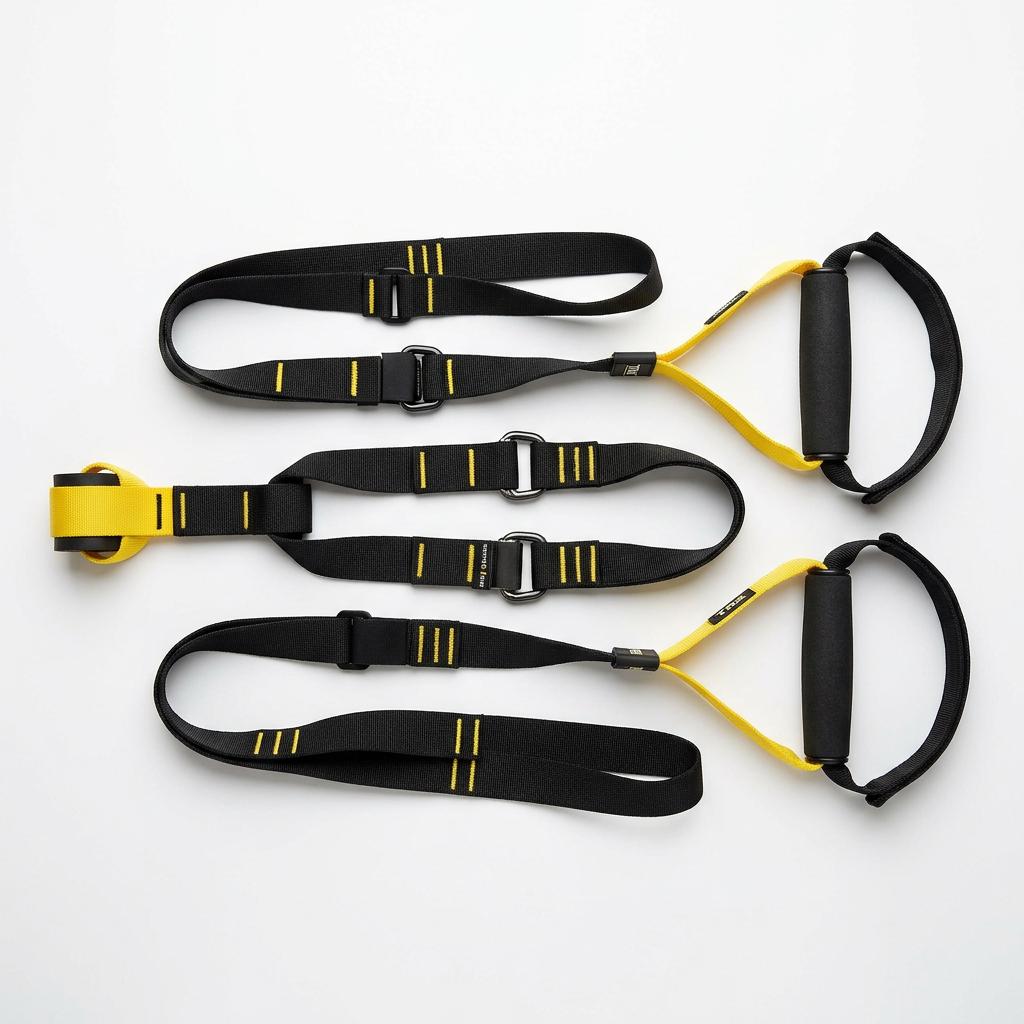
Equipment Note: Rows become significantly easier with suspension trainers. The PACEARTH Suspension Trainer enables full rowing progression at minimal cost.
| Exercise | Sets | Reps | Level |
|---|---|---|---|
| Incline push-up | 3 | 8–12 | Level 2 |
| Dead hang | 3 | 20–30s | Level 1 |
| Air squat | 3 | 15–20 | Level 2 |
| Glute bridge | 3 | 12–15 | Level 1 |
| Plank | 3 | 20–30s | Level 2 |
| Door frame row | 3 | 10–12 | Level 1 |
| Exercise | Sets | Reps | Level |
|---|---|---|---|
| Knee push-up | 3 | 8–10 | Level 3 |
| Scapular pull-up | 3 | 8–10 | Level 2 |
| Air squat | 3 | 20–25 | Level 2 |
| Single-leg glute bridge | 3 | 10/leg | Level 2 |
| Plank | 3 | 30–45s | Level 2 |
| Towel row | 3 | 10–12 | Level 2 |
| Exercise | Sets | Reps | Level |
|---|---|---|---|
| Standard push-up | 3 | 5–8 | Level 4 |
| Negative pull-up | 3 | 3–5 (5s lower) | Level 3 |
| Jump squat | 3 | 10–12 | Level 3 |
| Hip thrust | 3 | 12–15 | Level 3 |
| Side plank | 3 | 20s/side | Level 3 |
| Inverted row | 3 | 6–10 | Level 4 |
| Exercise | Sets | Reps | Level |
|---|---|---|---|
| Standard push-up | 3 | 8–12 | Level 4 |
| Assisted pull-up | 3 | 5–8 | Level 4 |
| Bulgarian split squat | 3 | 8–10/leg | Level 4 |
| Nordic curl negative | 3 | 3–5 | Level 4 |
| Hollow body hold | 3 | 15–20s | Level 4 |
| Inverted row | 3 | 8–12 | Level 4 |
While true calisthenics requires no equipment, these affordable additions dramatically accelerate progress:
| Priority | Equipment | Purpose | Budget Option |
|---|---|---|---|
| 1 | Pull-up bar | Vertical pulling | Iron Gym |
| 2 | Suspension trainer | Rows, core, legs | PACEARTH |
| 3 | Resistance bands | Assistance, added resistance | Fit Simplify Bands |
| 4 | Push-up bars | Wrist protection, depth | Amazon Basics Bars |
Total investment: Under $100 for all four items — less than one month of gym membership.
Research indicates strength-trained individuals require 1.6–2.2 g protein per kg body weight daily. For a 70 kg (154 lb) individual: 112–154 g protein daily.
| Goal | Caloric Adjustment | Expected Rate |
|---|---|---|
| Fat loss | -300 to -500 kcal/day | 0.5–1% body weight/week |
| Muscle gain | +200 to +300 kcal/day | 0.25–0.5% body weight/month |
| Maintenance | Baseline | Weight stable, strength increases |
Consume 20–40 g protein within 2 hours post-workout to maximize muscle protein synthesis. This timing window remains open longer than previously believed — total daily protein intake matters more than precise timing.
| Mistake | Why It Hurts | Solution |
|---|---|---|
| Skipping progressions | Risk of injury, plateau | Follow the ladder system |
| Neglecting pulling | Postural imbalances | 1:1 push-to-pull ratio minimum |
| Rushing reps | Reduced time under tension | 2–3 second eccentric phase |
| Ignoring core | Weak foundation for advanced moves | Core work every session |
| Inconsistent training | No adaptation stimulus | Schedule 3 fixed days weekly |
| Comparing to others | Demotivation | Track your own progress only |
Record these metrics weekly:
Expectation Setting: Visible physique changes typically require 8–12 weeks of consistent training. Strength improvements appear within 2–3 weeks (neural adaptations precede muscle growth).
Q: How long should a beginner calisthenics workout last? A: 30–45 minutes is optimal. Quality over quantity — focused work beats marathon sessions.
Q: Can I build muscle with only bodyweight? A: Absolutely. Research confirms beginners gain muscle equally from bodyweight and weight training. Advanced trainees may need to add weight or progress to harder variations.
Q: What if I cannot do a single push-up or pull-up? A: Start at Level 1 of the progression ladders. Wall push-ups and dead hangs build the foundation. Every expert was once a beginner.
Q: How is calisthenics different from TRX/suspension training? A: Suspension training is a subset of calisthenics that uses straps for support and instability. See our comparison: TRX vs. Calisthenics
Last updated: June 18, 2026. As an Amazon Associate, SnugGym earns from qualifying purchases.