321 STRONG Foam Roller Review: Textured Myofascial Release for Home Recovery
Our research-backed review of the 321 STRONG Foam Roller examines texture pattern, foam density, durability, and pain-pr...
SnugGym is an Amazon Associate. We earn from qualifying purchases at no extra cost to you. Learn more

Compare percussion massage guns and foam rollers for post-workout recovery. We analyze muscle activation, research evidence, convenience, price, and practical use cases to determine the best recovery approach.
Recovery equipment has evolved from a luxury category to a recognized component of effective training programs. Percussion massage guns and foam rollers represent the two most common self-myofascial release approaches for home gym users. While both aim to reduce muscle tension, improve range of motion, and accelerate recovery, they operate through different mechanisms and suit different use cases. Our analysis examines the research evidence, practical differences, and optimal implementation of each.
Quick Verdict: Foam rollers provide broad, cost-effective myofascial release for large muscle groups and have stronger research support for improving flexibility. Massage guns offer targeted, convenient percussion therapy for specific muscle knots and areas difficult to reach with a roller. The ideal home gym includes both — the foam roller for systematic full-body work and the massage gun for precise, on-demand spot treatment.
Foam rolling applies sustained compressive pressure to muscle and fascial tissue using body weight against a cylindrical foam surface. The mechanism involves:
Research-supported effects: Meta-analyses confirm foam rolling increases short-term range of motion (10–20% immediately post-rolling) and reduces delayed-onset muscle soreness (DOMS) when performed post-exercise. The effect on long-term flexibility is less established — benefits appear transient, lasting 10–30 minutes.
Percussion massage guns deliver rapid, vertical pulsations (1,200–3,200 percussions per minute) to muscle tissue via a rigid attachment head. The mechanism involves:
Research context: Studies on percussion therapy are emerging but less mature than foam rolling literature. Early research suggests comparable benefits to foam rolling for range of motion and perceived soreness, with the added advantage of targeting deeper tissue layers and precise trigger points.
| Feature | Foam Roller | Massage Gun |
|---|---|---|
| Mechanism | Compression + rolling shear | Percussion/vibration |
| Target area | Broad (entire muscle groups) | Precise (specific muscles or trigger points) |
| Effective depth | Superficial to moderate tissue | Moderate to deep tissue (device-dependent) |
| Body coverage | Requires floor space and body positioning | Reach any area while seated or standing |
| Learning curve | Low | Moderate (attachment selection, speed, pressure) |
| Time for full-body session | 10–15 minutes | 5–10 minutes |
| Portability | Moderate (18–36" long) | High (fits in gym bag) |
| Noise level | Silent | 40–65 dB (varies widely by model) |
| Price range | $15–$60 | $50–$600 |
| Power required | None | Battery (most models) |
| Durability | 1–3 years (foam degradation) | 3–5+ years (motor/battery dependent) |
| Research volume | Extensive (100+ peer-reviewed studies) | Growing (20+ published studies) |
Check price at Amazon — foam rollers
Check price at Amazon — percussion massage guns
Systematic reviews and meta-analyses:
| Outcome | Evidence Strength | Typical Effect Size | Key Studies |
|---|---|---|---|
| Acute range of motion increase | Strong | +10–20% (single muscle group) | Wiewelhove et al. (2019) Frontiers in Physiology |
| DOMS reduction (24–72 hr post-exercise) | Moderate | −20–30% soreness ratings | Schroeder et al. (2019) JSSM |
| Performance recovery | Weak/insignificant | No meaningful effect on strength/power output | D'Amico et al. (2021) EJSS |
| Long-term flexibility | Weak | No sustained effect without regular stretching | Konrad et al. (2022) Sports Medicine |
| Perceived recovery | Moderate | Improved subjective recovery scores | Murray et al. (2022) IJSPP |
Mechanism research: Skarabot et al. (2015) demonstrated that foam rolling increases ankle dorsiflexion range of motion through changes in stretch tolerance (neurological) rather than actual tissue lengthening (mechanical). This distinction matters — foam rolling doesn't "break up scar tissue" as commonly claimed, but rather modulates nervous system tone to permit greater range of motion.
| Outcome | Evidence Strength | Typical Effect Size | Key Studies |
|---|---|---|---|
| Acute range of motion increase | Moderate | +5–15% (comparable to foam rolling) | Konrad et al. (2020) JSSM; Garcia-Sillero et al. (2021) |
| DOMS reduction | Moderate | Similar magnitude to foam rolling | Schulz et al. (2023) Journal of Sports Rehabilitation |
| Muscle blood flow | Moderate | 20–30% increase during and immediately post-treatment | Imtiyaz et al. (2014) JCSM (vibration therapy broadly) |
| Performance recovery | Weak | No consistent effect on subsequent performance | Limited data |
| Pain reduction | Moderate | Significant reduction in musculoskeletal pain complaints | Cheatham et al. (2021) IJERPH |
Key study — Konrad et al. (2020): Directly compared vibration therapy (similar mechanism to massage guns) to foam rolling for hamstring flexibility. Both produced equivalent acute increases in ROM (~6–8°). The vibration group reported less discomfort during treatment.
| Body Area | Effectiveness | Notes |
|---|---|---|
| Quadriceps | Excellent | Easy positioning, full coverage |
| Hamstrings | Good | Requires some upper body support |
| IT band / lateral thigh | Good | High discomfort; evidence for benefit is mixed |
| Glutes | Good | Requires awkward positioning for full coverage |
| Calves | Excellent | Easy and effective |
| Upper back (thoracic) | Excellent | Most valued foam rolling application |
| Lower back | Poor/Risky | Lumbar hyperextension risk; generally avoided |
| Chest | Fair | Requires floor positioning; limited pressure |
| Shoulders/Delts | Fair | Difficult to position effectively |
| Lats | Good | Side-lying position works well |
| Feet | Fair | Small rollers or balls preferred |
| Neck | Poor/Risky | Too much pressure risk; use tennis ball instead |
| Body Area | Effectiveness | Recommended Attachment |
|---|---|---|
| Quadriceps | Excellent | Large ball or flat head |
| Hamstrings | Excellent | Large ball or flat head |
| Glutes | Excellent | Large ball (self-treatment limited reach) |
| Calves | Excellent | Small ball or bullet head |
| Upper back | Good | Large ball (avoid spine directly) |
| Lower back | Fair | Flat head, very low pressure, avoid spine |
| Chest | Excellent | Large ball or flat head |
| Shoulders/Delts | Excellent | Small ball or fork head |
| Lats | Good | Large ball (requires shoulder flexibility to reach) |
| Neck | Fair | Soft ball, lowest speed, extreme caution |
| Feet | Excellent | Bullet head or small ball |
| Forearms | Excellent | Small ball or flat head |
| Jaw/TMJ | Fair (professional guidance recommended) | Softest attachment, lowest setting |
Critical advantage of massage guns: Areas that are difficult or impossible to reach with a foam roller — the glutes, shoulders, chest, and calves in seated users — are easily accessible with a massage gun. The self-treatment capability for the entire body without floor positioning is a meaningful practical advantage.
| Session Type | Foam Roller | Massage Gun |
|---|---|---|
| Quick pre-workout activation (2–3 muscles) | 3–5 minutes | 2–3 minutes |
| Post-workout full-body routine | 10–15 minutes | 6–10 minutes |
| Targeted trouble spot treatment | 2–3 minutes (plus setup) | 1–2 minutes |
| Daily maintenance routine | 10 minutes | 5–7 minutes |
The massage gun's speed advantage is most pronounced for busy users who struggle to dedicate 10+ minutes to recovery. The reduced friction of grabbing a device versus unrolling a mat and positioning on the floor measurably increases adherence.
| Context | Foam Roller | Massage Gun |
|---|---|---|
| Gym bag | Bulky (18–24" typically) | Compact (most units 6–10" long) |
| Travel | Possible but inconvenient | Excellent (TSA-approved, battery-powered) |
| Office desk | Impractical | Easy (discreet, quick sessions) |
| Pre-competition warm-up | Common sight at events | Increasingly common |
| Tier | Price | Characteristics | Examples |
|---|---|---|---|
| Basic EPE foam | $10–$20 | Low density, soft, degrades quickly | Amazon Basics, generic EPE rollers |
| High-density EVA | $20–$40 | Moderate density, durable, adequate for most | TriggerPoint GRID, LuxFit |
| Premium textured | $40–$60 | Multi-density, varied surface patterns, maximum durability | RumbleRoller, TriggerPoint Carbon |
| Vibrating roller | $80–$150 | Added vibration mechanism, rechargeable | TriggerPoint VYPER, Hyperice Vyper |
| Tier | Price | Characteristics | Examples |
|---|---|---|---|
| Budget | $40–$80 | Single speed, limited attachments, 2–3 hr battery, higher noise | Taotronics, FitPulse, generic brands |
| Mid-range | $80–$200 | 3–5 speeds, 4–6 attachments, 3–5 hr battery, moderate noise | Ekrin B37, LifePro Sonic, Renpho R3 |
| Premium | $200–$350 | 5+ speeds, 6+ attachments, quiet operation (<50 dB), app integration | Theragun Prime, Hyperice Hypervolt 2 |
| Professional | $350–$600 | Maximum amplitude (16 mm), quietest operation, professional warranty | Theragun Pro, Hyperice Hypervolt 2 Pro, TimTam Power Massager |
Check price at Amazon — mid-range massage guns
| Step | Foam Roller Protocol | Massage Gun Protocol |
|---|---|---|
| Target muscles | Primary movers for upcoming workout | Primary movers for upcoming workout |
| Duration per muscle | 30–45 seconds | 15–30 seconds |
| Pressure/speed | Moderate, controlled rolls | Low to medium speed, light pressure |
| Goal | Increase ROM without inducing fatigue | Neuromuscular activation, not deep tissue work |
| Step | Foam Roller Protocol | Massage Gun Protocol |
|---|---|---|
| Target muscles | All muscles worked + adjacent areas | All muscles worked, focus on tender spots |
| Duration per muscle | 60–90 seconds | 1–2 minutes |
| Pressure/speed | Moderate to firm, slow rolls | Medium speed, moderate pressure |
| Goal | Reduce DOMS, restore ROM, promote relaxation | Reduce DOMS, address trigger points, increase local circulation |
Start with a foam roller if:
Add or choose a massage gun if:
The optimal home gym recovery setup: A high-density foam roller ($25–$40) for systematic full-body work plus a mid-range massage gun ($100–$200) for targeted, convenient spot treatment. This combination covers all recovery scenarios at a total investment of $125–$240 — less than a single premium massage gun.
As an Amazon Associate we earn from qualifying purchases. All specifications are sourced from published manufacturer data and peer-reviewed research. Affiliate links on this page use the tag snuggym0626-20.
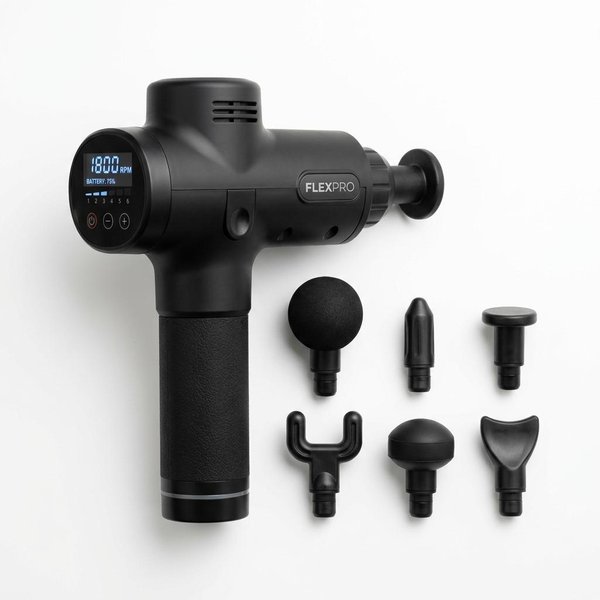
Affordable deep tissue massage gun from physical therapists, 5 speeds and 5 heads.
83/100