321 STRONG Foam Roller Review: Textured Myofascial Release for Home Recovery
Our research-backed review of the 321 STRONG Foam Roller examines texture pattern, foam density, durability, and pain-pr...
SnugGym is an Amazon Associate. We earn from qualifying purchases at no extra cost to you. Learn more
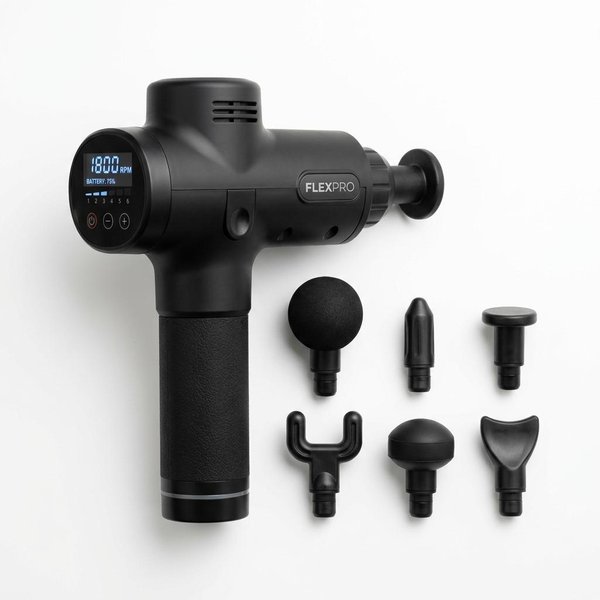
Affordable deep tissue massage gun from physical therapists, 5 speeds and 5 heads.
Foam rollers and percussive massage guns are the two most common self-myofascial release (SMR) tools in home gyms. Both aim to reduce muscle tension, improve range of motion, and accelerate recovery. They work through different mechanisms, excel at different applications, and produce different outcomes.
This guide distinguishes what each tool actually does, when to choose one over the other, and why most home gym builders eventually want both.
Mechanism: A foam roller applies sustained compressive and shear forces to muscle and fascial tissue as the user moves their body over the roller. Body weight provides the pressure. Rolling motion creates mechanical deformation of tissue.
Primary effects (based on published research):
What foam rollers do NOT do: Break up scar tissue, permanently restructure fascia, or replace dynamic warm-ups for performance preparation. The "adhesions" and "knots" framework is an oversimplification. Foam rolling works through neurological and vascular mechanisms, not mechanical breaking of tissue.
Mechanism: A percussive massage gun delivers rapid vertical impacts (typically 1,200–3,200 percussions per minute) to muscle tissue. The amplitude (depth of each strike, typically 10–16 mm) and frequency determine the stimulus intensity.
Primary effects (based on published research):
What massage guns do NOT do: They do not "break up" lactic acid (lactate clears within hours of exercise naturally). They do not permanently alter muscle architecture. They are not a substitute for professional physical therapy for injury rehabilitation.
| Feature | Foam Roller | Massage Gun |
|---|---|---|
| Primary mechanism | Compression + tissue shear | Rapid percussive impact |
| Area coverage | Broad (entire muscle group) | Targeted (specific point) |
| Pressure control | Body weight (limited adjustability) | Motor-driven (variable, precise) |
| User effort required | Moderate (must move body over roller) | Low (hold device on target) |
| Application time per muscle | 60–120 seconds | 30–90 seconds |
| Access to hard-to-reach areas | Poor (back, neck, posterior shoulder) | Excellent (long handle reaches all areas) |
| Portability | Moderate (typically 12–36" long) | Good (handheld, fits in bag) |
| Cost range | $15–60 | $50–600 |
| Noise level | Silent | 45–70 dB (varies by model/speed) |
| Learning curve | Low | Low–Moderate (attachment selection, pressure) |
| Risk of misuse | Low (minor bruising if excessive) | Moderate (avoid bone, neck, some areas) |
| Research volume | Extensive (10+ years of studies) | Moderate (emerging evidence base) |
Foam rolling before exercise increases acute range of motion without the performance decrement sometimes associated with prolonged static stretching. Our analysis of the research suggests 30–60 seconds per major muscle group as part of a dynamic warm-up routine.
Best for: Legs (quads, hamstrings, calves), hips (TFL, glutes), thoracic spine extension.
Rolling immediately after training and again 24 hours later reduces DOMS perception. The mechanism likely involves increased blood flow and neurological modulation rather than structural tissue change.
Best for: Large muscle groups that were trained heavily. Quads after squats. Hamstrings after deadlifts. Upper back after pulling exercises.
Regular foam rolling (5–10 minutes daily) maintains tissue pliability and identifies areas of increased tension before they become restrictive. This is particularly valuable for desk workers who develop thoracic kyphosis and hip flexor shortening.
Best for: Thoracic spine (extension over roller), hip flexors, calves (chronically tight in seated populations).
A quality foam roller costs $20–40 and lasts years. For users building a gym on a tight budget, the foam roller delivers 80% of the recovery benefit at 10–20% of the massage gun cost.
When a specific point in a muscle is particularly tender or restricted, a massage gun's targeted percussion reaches deeper and more precisely than a foam roller. The small attachment heads concentrate force on a 1–2 cm area.
Best for: Pec minor (chest), infraspinatus (rotator cuff), piriformis (deep glute), soleus (deep calf).
The long handle and angled head of a massage gun enable self-treatment of areas impossible to reach with a foam roller: the entire back, posterior shoulder, neck (with caution and appropriate attachment), and hamstrings without the awkward positioning foam rolling requires.
Best for: Latissimus dorsi, rhomboids, posterior deltoid, peroneals (lateral lower leg).
A 5-minute massage gun routine covering 6–8 muscle groups is faster and less physically demanding than an equivalent foam rolling session. For users who skip recovery work because foam rolling feels like a workout in itself, the massage gun removes that friction.
The portability of massage guns enables recovery work at the office, while traveling, or at times when lying on a foam roller is impractical. This accessibility may improve recovery consistency.
The tools are complementary, not competitive. An optimal recovery protocol combines them:
Example post-leg-day routine:
Example upper body routine:
| Type | Surface | Density | Best For | Cost |
|---|---|---|---|---|
| Smooth EVA foam | Smooth | Soft–Medium | Beginners, general use | $15–25 |
| Smooth EPP foam | Smooth | Firm | Deeper pressure, durability | $20–35 |
| Textured/grid pattern | Contoured bumps | Medium–Firm | Targeted pressure on trigger points | $30–60 |
| Vibrating foam roller | Smooth or textured | Adjustable | Added vibration stimulus, increased blood flow | $60–150 |
| Half-roller (flat side) | Smooth | Varies | Balance work, under-desk foot roll | $15–30 |
Our assessment: A standard firm EPP foam roller (36" × 6", smooth) is the right starting point for most users. Add a textured roller later for targeted work. Vibrating rollers offer marginal additional benefit at significant cost increase—not recommended as a first purchase.
| Specification | Budget Tier ($50–120) | Mid-Range ($120–250) | Premium ($250–600) |
|---|---|---|---|
| Stall force | 20–35 lbs | 35–50 lbs | 50–80+ lbs |
| Amplitude | 10–12 mm | 12–14 mm | 14–16 mm |
| Percussion speed | 1,800–3,000 PPM | 1,200–3,200 PPM | 1,200–3,200 PPM |
| Battery life | 2–3 hours | 3–5 hours | 4–6 hours |
| Attachments | 3–4 heads | 4–6 heads | 6–8 heads |
| Noise at max | 60–70 dB | 55–65 dB | 45–55 dB |
| Weight | 2.5–3.5 lbs | 2.0–3.0 lbs | 2.0–2.5 lbs |
Key specifications explained:
Our assessment: The mid-range tier ($120–250) offers the best value. Premium brands (Theragun, Hypervolt) justify their price through lower noise, better ergonomics, and longer warranties. Budget guns under $100 often have overstated specifications and shorter lifespans. The $50 budget massage gun may last 6–12 months; the $250 gun typically lasts 3–5 years.
Foam rollers and massage guns achieve similar outcomes—increased range of motion and reduced soreness—through different mechanisms. Foam rollers excel at broad muscle group coverage, cost less, require more user effort, and work silently. Massage guns excel at targeted deep-tissue work, hard-to-reach areas, and convenience at a higher price point.
Most dedicated home gym users eventually own both. Start with a foam roller if budget-constrained. Add a massage gun when you identify specific limitations the roller can't address. The tools complement each other; neither fully replaces the other.
As an Amazon Associate we earn from qualifying purchases.
Last updated: 2025-07-21