321 STRONG Foam Roller Review: Textured Myofascial Release for Home Recovery
Our research-backed review of the 321 STRONG Foam Roller examines texture pattern, foam density, durability, and pain-pr...
SnugGym is an Amazon Associate. We earn from qualifying purchases at no extra cost to you. Learn more
Our expert-reviewed roundup of the 5 best balance boards for stability training, featuring the Revolution 101, EveryMile Wobble Board, StrongTek, and more. Includes 8-criteria comparison table.
SnugGym is reader-supported. When you buy through links on our site, we may earn an affiliate commission at no extra cost to you. Prices and availability are current as of January 2025.
Balance training is the most underappreciated component of home gym programming. While most users prioritize strength and cardio equipment, proprioceptive training—the body's awareness of position in space—delivers benefits that transfer directly to athletic performance, injury prevention, and daily movement quality. A 2015 systematic review in the British Journal of Sports Medicine found that balance training reduces ankle sprain risk by 36% and ACL injury risk by 50% when performed consistently.
Balance boards create an unstable surface that forces continuous micro-adjustments from the stabilizer muscles of the ankles, knees, hips, and core. This constant corrective engagement builds joint stability, improves neuromuscular coordination, and develops the reactive strength that prevents injuries during unexpected movements—like stepping off a curb wrong or catching yourself on uneven ground.
This roundup evaluates five leading balance boards on an 8-criteria rubric designed for home gym use, including noise considerations for apartment training, progression potential from beginner to advanced, and durability under regular use.
| Criterion | Score (out of 10) | Notes |
|---|---|---|
| Stability Progression Range | 9.0 | Diameter-adjustable roller creates 3+ difficulty levels |
| Build Quality and Durability | 9.0 | Baltic birch deck; high-density urethane roller; 400 lb capacity |
| Deck Surface and Grip | 8.5 | Clear grip tape; barefoot-friendly; replaceable |
| Workout Versatility | 9.0 | Board sports training, standing desk, strength exercises |
| Learning Curve and Safety | 8.0 | Moderate learning curve; included workout guide helps |
| Portability and Storage | 7.5 | 30" × 12" deck; stores vertically; roller separates |
| Noise Level for Apartments | 8.0 | Quiet on carpet; rubber roller end caps reduce hard-floor noise |
| Value for Money | 8.5 | Premium construction justifies mid-premium pricing |
| TOTAL | 67.5/80 | Winner |
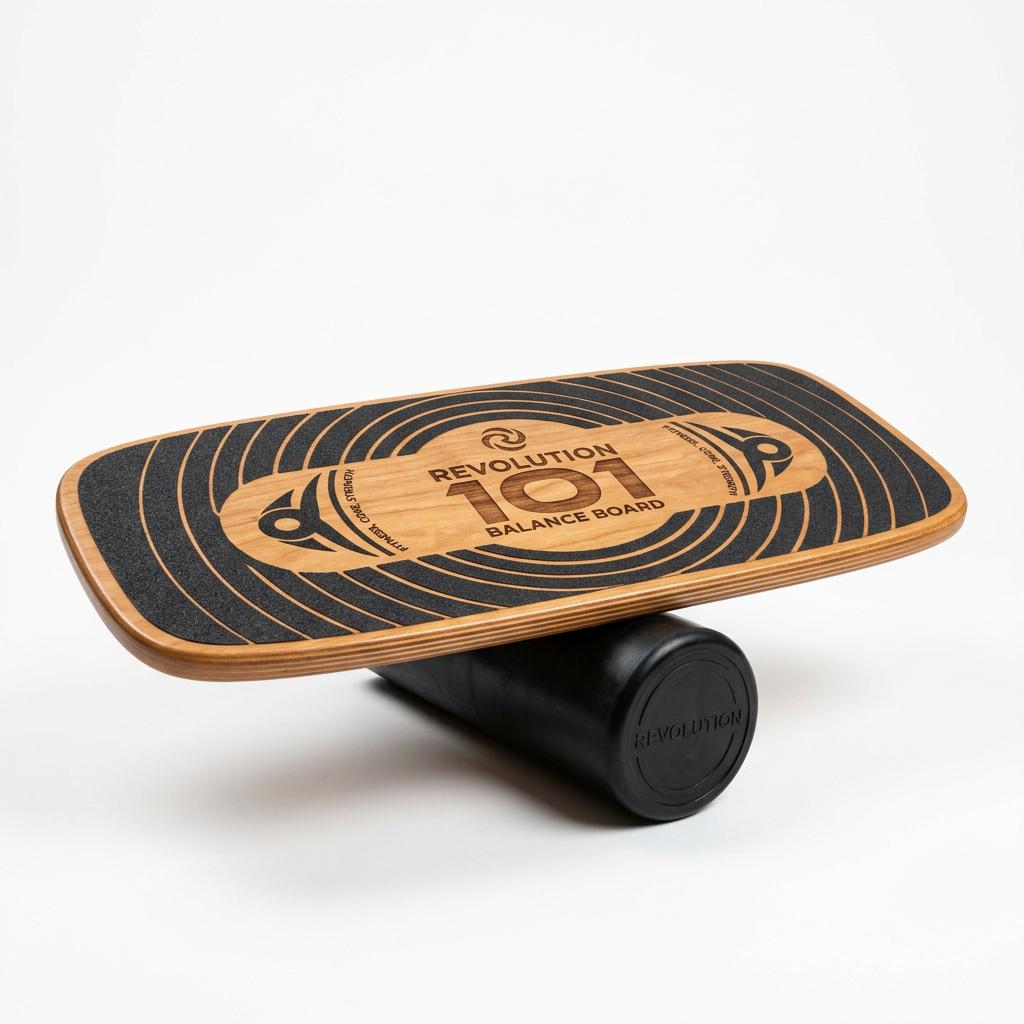
The Revolution 101 captures the top spot through intelligent design that adapts to user progression. Unlike fixed-difficulty balance boards that become obsolete as skill develops, the Revolution 101 uses a separate roller that the user positions at different points along the deck's underside tracks. Rolling near the ends creates a stable, beginner-friendly ride; centering the roller creates an advanced, highly unstable experience that challenges even trained athletes.
This progression system eliminates the need to purchase multiple boards as you advance. Beginners can start with the roller at the track ends, progress to midpoint positioning, and eventually explore full-range rolling—a progression path that provides months or years of increasing challenge from a single purchase.
The deck construction is exceptional. The Baltic birch plywood provides the right combination of flex and rigidity, while the clear grip tape offers secure footing without the aggressive texture that chews up bare feet or socks. The 400-pound weight capacity accommodates all users, and the roller end caps prevent floor damage during the inevitable dismounts and tip-overs of the learning phase.
Drawbacks: The 30-inch deck length may feel limiting for users over 6'2" attempting advanced movements. Learning to balance on a roller board has a genuine learning curve—expect several sessions of frequent step-offs before finding consistent balance. Hard floor use generates more noise than carpet; a yoga mat underneath helps for apartment settings.
| Criterion | Score (out of 10) | Notes |
|---|---|---|
| Stability Progression Range | 7.5 | Fixed 15° tilt angle; adjustable air pressure for some variation |
| Build Quality and Durability | 8.0 | ABS plastic deck; textured surface; solid construction |
| Deck Surface and Grip | 8.5 | Aggressive textured surface; excellent shoe grip |
| Workout Versatility | 7.5 | Primarily standing balance; limited movement patterns |
| Learning Curve and Safety | 9.0 | Most beginner-friendly option; low risk of falling |
| Portability and Storage | 8.5 | Compact 15.4" diameter; lightweight; easy to store |
| Noise Level for Apartments | 9.0 | Virtually silent on any surface; best for noise-sensitive spaces |
| Value for Money | 9.0 | Excellent price for the quality and durability |
| TOTAL | 67.0/80 | Runner-Up |
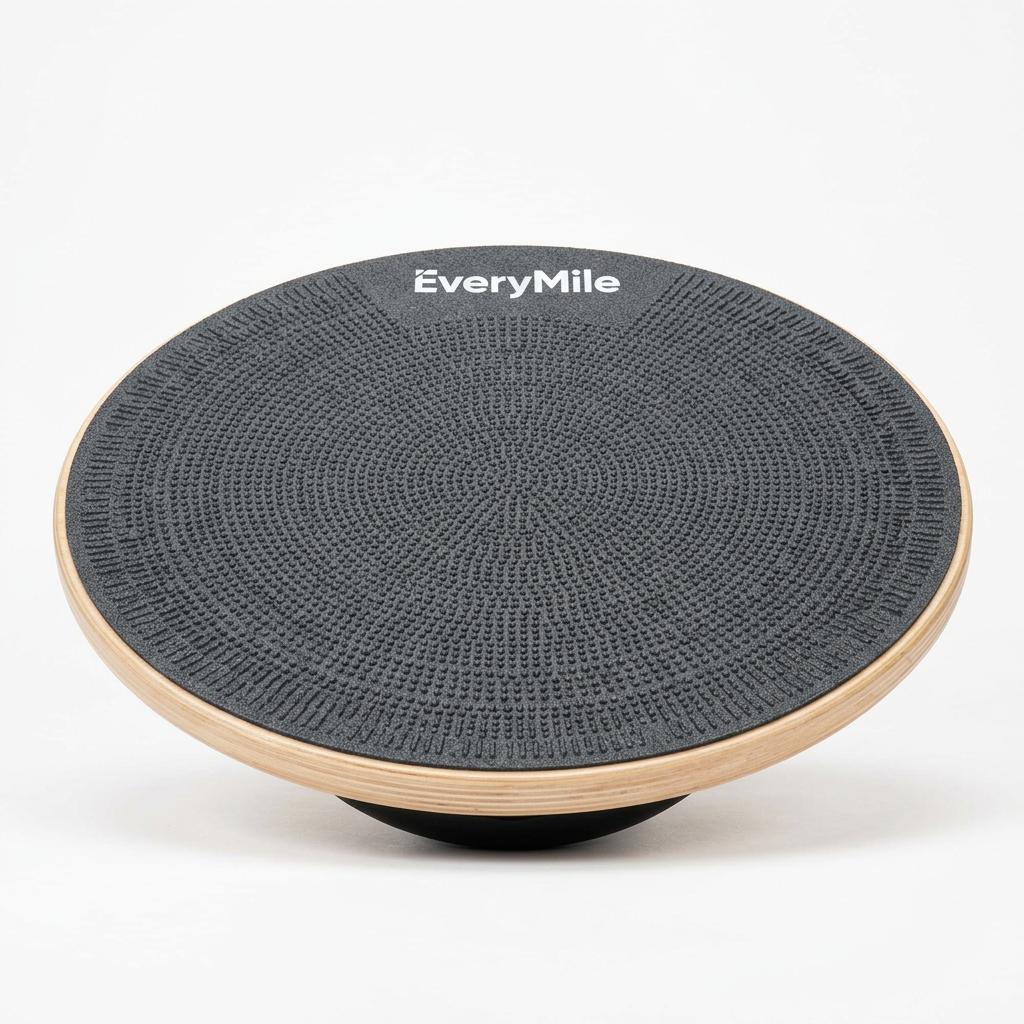
The EveryMile Wobble Board takes a fundamentally different approach from the Revolution 101. Rather than a rolling instability, the wobble board creates a tilting instability around a fixed central point. This design is significantly safer for beginners, elderly users, rehabilitation patients, and anyone training in a space where falling would be hazardous (near furniture, in small rooms, etc.).
The 15-degree tilt range prevents the dramatic edge contacts that send roller boards flying across the room. The non-slip textured surface grips shoes securely even during vigorous movement, and the adjustable air pressure in some models allows slight customization of tilt resistance. At under 3 pounds and 15.4 inches in diameter, it's the most storage-friendly option for small apartments.
For rehabilitation applications—ankle sprain recovery, knee stabilization, proprioceptive retraining after injury—the wobble board design is actually superior to roller boards. The predictable, controllable tilt allows therapists and patients to focus on specific movement patterns without the additional cognitive load of managing rolling instability.
Drawbacks: The fixed tilt angle creates a ceiling on difficulty progression. Advanced users will find the 15-degree limit insufficient within weeks of consistent training. The circular deck limits stance width for exercises like squats or lunges. The ABS plastic construction, while durable, doesn't match the premium feel of the Revolution 101's wood deck.
| Criterion | Score (out of 10) | Notes |
|---|---|---|
| Stability Progression Range | 7.0 | Fixed tilt; no progression mechanism |
| Build Quality and Durability | 7.5 | Plywood deck with PVC base; adequate for home use |
| Deck Surface and Grip | 7.5 | Sandpaper-style grip; functional but rough on bare feet |
| Workout Versatility | 7.0 | Standing balance; limited exercise variety |
| Learning Curve and Safety | 8.5 | Low learning curve; stable enough for beginners |
| Portability and Storage | 8.5 | Compact 15.75" diameter; lightweight |
| Noise Level for Apartments | 9.0 | PVC base is quiet on all floor types |
| Value for Money | 9.5 | Among the lowest-priced quality options |
| TOTAL | 64.0/80 | Best Budget |
The StrongTek Wooden Wobble Board delivers functional balance training at the lowest price point in this roundup without compromising safety or essential build quality. The plywood deck and PVC base construction is simpler than the EveryMile's engineered ABS, but functionally equivalent for basic balance training.
The sandpaper-style grip surface provides excellent traction for shoe-wearing users but is uncomfortably rough for barefoot training—sock or shoe use is essentially required. The 350-pound weight capacity accommodates most users, and the compact 15.75-inch diameter stores easily in closets or under furniture.
For users who want to experiment with balance training without significant investment, or who need a secondary balance tool for rehabilitation days, the StrongTek represents a sensible entry point.
Drawbacks: Grip surface is too aggressive for barefoot use. No progression mechanism beyond the user's own skill development. Build quality is adequate but won't match the longevity of premium options under heavy use.
| Criterion | Score (out of 10) | Notes |
|---|---|---|
| Stability Progression Range | 9.5 | Recessed rail + roller system; highly adjustable difficulty |
| Build Quality and Durability | 8.0 | Hardwood deck; steel-reinforced rails; good construction |
| Deck Surface and Grip | 8.0 | Standard grip tape; replaceable |
| Workout Versatility | 8.5 | Advanced board sports simulation; dynamic movement training |
| Learning Curve and Safety | 6.0 | Steep learning curve; not for beginners or injury rehab |
| Portability and Storage | 7.0 | 36" deck is longest in roundup; requires more storage |
| Noise Level for Apartments | 7.5 | Roller-on-rail contact is audible; mat recommended |
| Value for Money | 8.0 | Good value for the advanced capability offered |
| TOTAL | 62.5/80 | Best for Advanced |
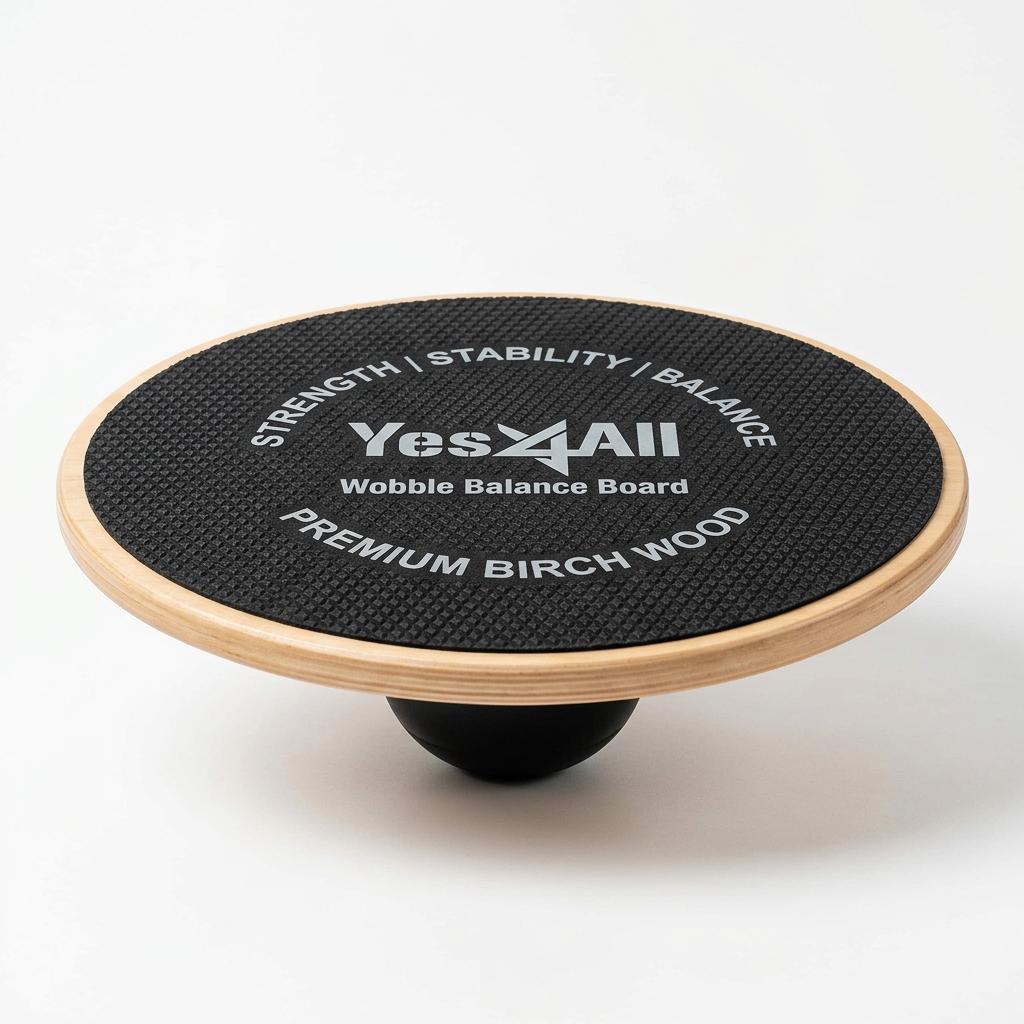
The Yes4All Wobble board (also called a rollette or rocker-roller board) is the most challenging balance trainer in this roundup. The recessed center rail guides a separate roller that moves along the board's length, creating dynamic instability that demands constant fore-aft and lateral correction. This is the training tool of choice for surfers, snowboarders, and skateboarders who want to maintain board feel during off-season months.
The difficulty progression comes from roller diameter: smaller rollers create more instability. The included roller is medium-sized; advanced users can purchase smaller-diameter rollers for exponentially greater challenge. The 36-inch deck length accommodates full stances and movement patterns that shorter boards cannot.
Drawbacks: This is explicitly not a beginner tool. The learning curve is steep, and falls are common during the first 5–10 sessions. The 36-inch deck requires significant storage space. Roller-on-rail noise is higher than wobble boards or carpet-padded roller boards. Users without board sports experience may find the challenge frustrating rather than engaging.
| Criterion | Score (out of 10) | Notes |
|---|---|---|
| Stability Progression Range | 7.0 | Moderate fixed instability; designed for sustained standing |
| Build Quality and Durability | 7.5 | Solid wood construction; 350 lb capacity |
| Deck Surface and Grip | 8.0 | Comfortable massage-point surface for barefoot use |
| Workout Versatility | 7.0 | Standing desk primary; limited active training utility |
| Learning Curve and Safety | 8.5 | Very accessible; designed for low-intensity sustained use |
| Portability and Storage | 7.5 | Moderate size; includes resistance bands for added exercises |
| Noise Level for Apartments | 9.0 | Quiet rubber base; excellent for shared spaces |
| Value for Money | 8.5 | Bundled resistance bands add value |
| TOTAL | 63.0/80 | Best for Standing Desk |
The URBNFit occupies a specific niche: the standing desk balance board. Rather than maximizing instability for challenging balance training, it provides gentle, sustained instability that keeps leg muscles engaged during computer work without demanding focused attention. The massage-point deck surface stimulates foot muscles during barefoot use, and the included resistance bands allow occasional upper body exercises during standing breaks.
For home office workers who want to add movement to sedentary workdays, this design philosophy is more practical than aggressive balance boards that would prevent typing and concentration. The rubber base grips hard floors without sliding, and the moderate instability won't send you stumbling during video calls.
Drawbacks: Too stable for meaningful balance training progression. The resistance bands are entry-level quality. Users seeking genuine balance challenges will outgrow this quickly. The massage points, while pleasant for some, irritate sensitive feet during extended use.
| Feature | Revolution 101 | EveryMile Wobble | StrongTek Wooden | Yes4All Wobble | Juoe Balance |
|---|---|---|---|---|---|
| Board Type | Roller (adjustable) | Wobble (fixed) | Wobble (fixed) | Bongo rail-roller | Wobble (moderate) |
| Max Tilt/Difficulty | High (adjustable) | 15° fixed | ~15° fixed | Very High (rail-guided) | Low-Moderate |
| Deck Size | 30" × 12" | 15.4" diameter | 15.75" diameter | 36" × 12" | 27" × 10" |
| Weight Capacity | 400 lb | 300 lb | 350 lb | 350 lb | 350 lb |
| Best For | Progressive training | Beginners/Rehab | Budget beginners | Advanced/Athletes | Standing desk users |
| Noise Level | Low (with mat) | Silent | Silent | Moderate | Silent |
| Includes Accessories | Workout guide | None | None | None | Resistance bands |
| Our Score (out of 80) | 67.5 | 67.0 | 64.0 | 62.5 | 63.0 |
How long does it take to learn balance board skills? Basic static balance on a wobble board: 1–3 sessions. Comfortable roller board balance: 1–3 weeks. Advanced dynamic movements: 2–6 months of consistent practice.
Can balance boards help with ankle sprain recovery? Yes, under professional guidance. Wobble boards are standard rehabilitation tools for ankle and knee proprioceptive retraining. Start only after acute healing is complete and with therapist approval.
Are balance boards safe for seniors? Wobble boards with wide bases and low tilt angles are appropriate for active seniors. The EveryMile and similar stable wobble boards are safer than roller designs. Use near a wall or counter for support.
How often should I train on a balance board? 10–15 minutes daily provides better results than occasional long sessions. Balance is a skill that responds to frequency. Integrate it into your warm-up routine.
Will balance board training improve my squat and deadlift? Indirectly. Ankle and hip stability developed through balance training improves force transmission and reduces energy leaks during heavy lifts. It's a valuable accessory, not a replacement for direct strength work.
SnugGym is reader-supported. When you buy through links on our site, we may earn an affiliate commission. All recommendations are independently researched and selected by our editorial team.
| Image | Product | Price | Badge | Link |
|---|---|---|---|---|
 |
Revolution 101 Balance Board Trainer | 129.99 | Best Overall | Check Price |
 |
Yes4All Wobble Balance Board | 24.99 | Best Value | Check Price |
 |
EveryMile Wobble Balance Board | 29.99 | Also Great | Check Price |
 |
RollerBone FitBone Balance Board | 89.95 | Premium Pick | Check Price |
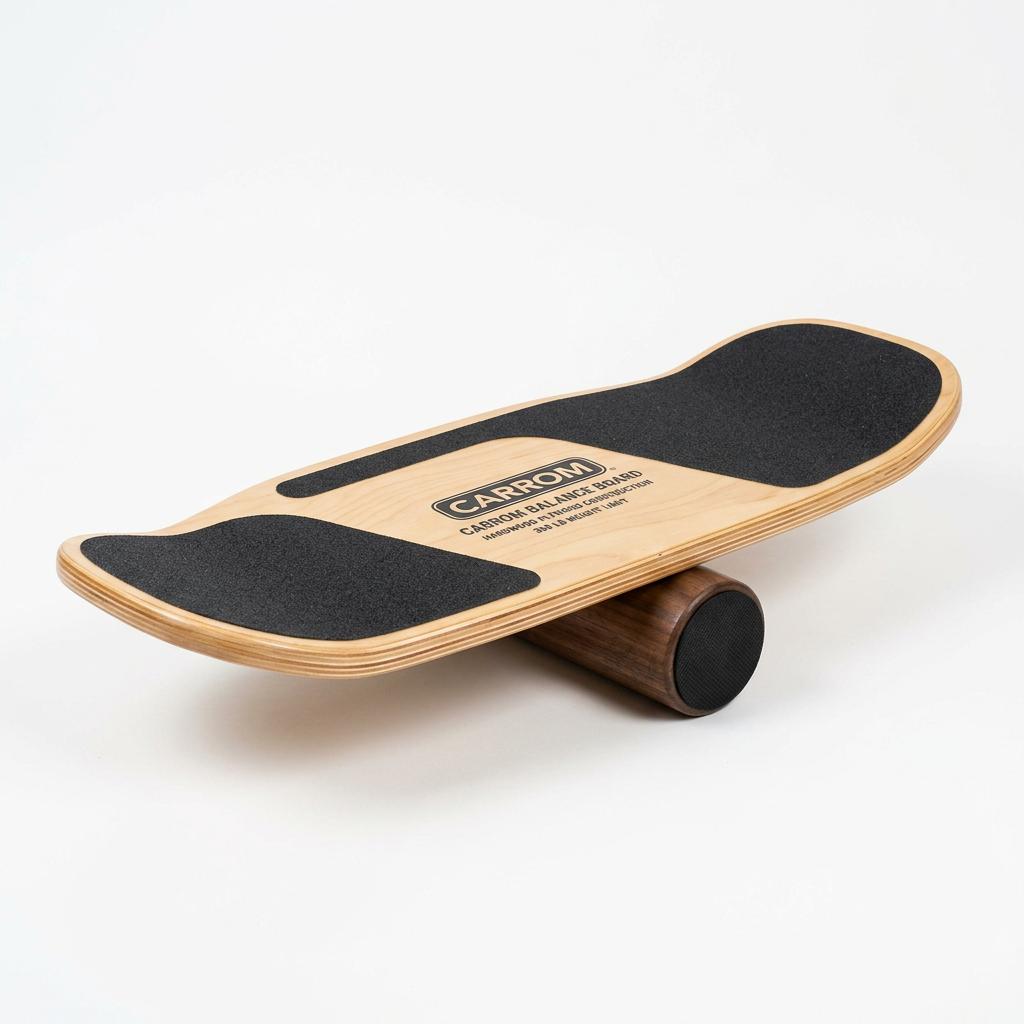 |
Carrom Balance Board | 49.99 | Best Budget | Check Price |
Premium hardwood balance board with adjustable roller stop system. Perfect for core training, skateboarding, snowboarding, and surfing cross-training.
Round wooden wobble balance board with non-slip surface. 15.75-inch diameter supports up to 300lbs. Ideal for core training, physical therapy, and balance exercises.
Upgraded balance board with TPE non-slip bump surface. 15.7-inch diameter, lightweight at 1.75kg. Perfect for standing desk, home gym, and physical therapy.
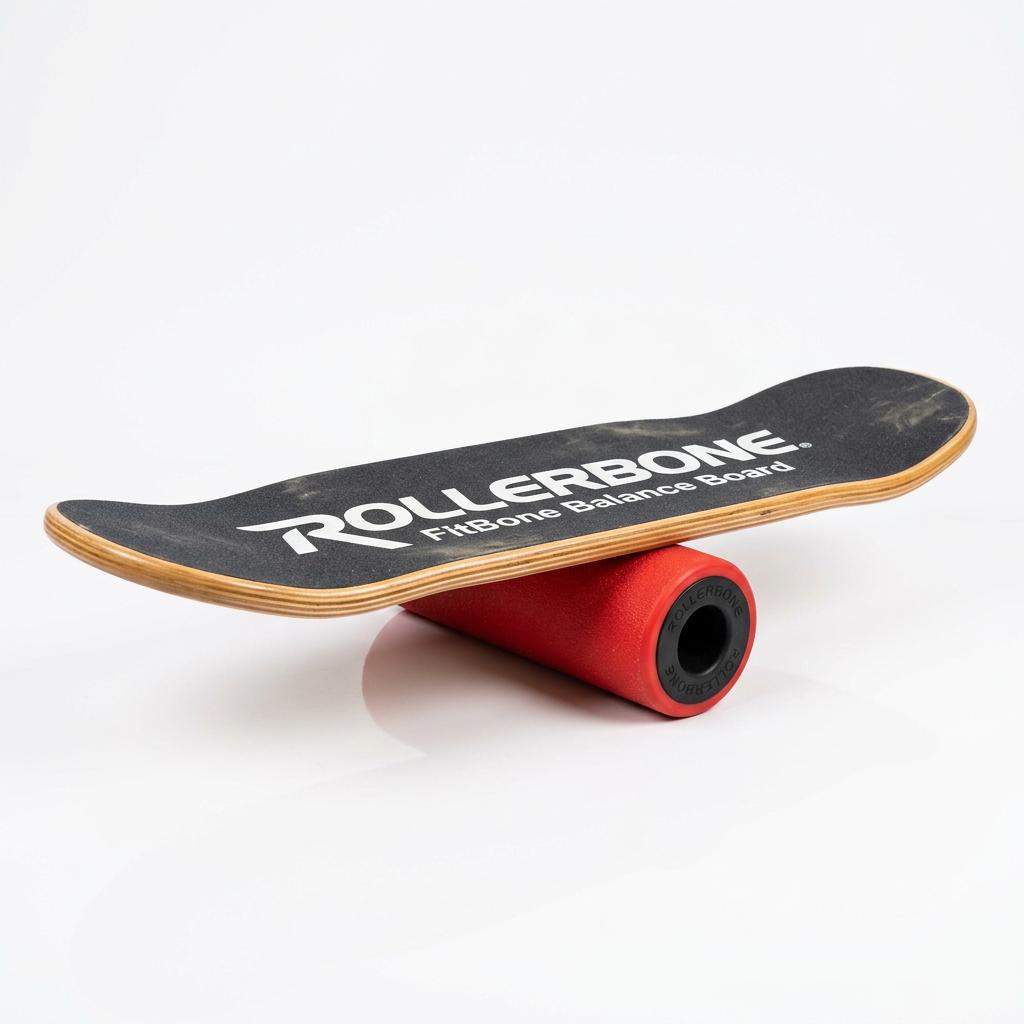
Skateboard-style balance board with grippy deck and premium roller. Perfect for board sport enthusiasts looking to improve balance, tricks, and core strength.
High-quality hardwood plywood balance board with 300-pound weight limit. Classic rocker design helps improve balance, coordination, and core strength.
Premium hardwood balance board with adjustable roller stop system. Perfect for core training, skateboarding, snowboarding, and surfing cross-training.
Check Price on Amazon
Round wooden wobble balance board with non-slip surface. 15.75-inch diameter supports up to 300lbs. Ideal for core training, physical therapy, and balance exercises.
Check Price on Amazon
Upgraded balance board with TPE non-slip bump surface. 15.7-inch diameter, lightweight at 1.75kg. Perfect for standing desk, home gym, and physical therapy.
Check Price on Amazon
Skateboard-style balance board with grippy deck and premium roller. Perfect for board sport enthusiasts looking to improve balance, tricks, and core strength.
Check Price on Amazon
High-quality hardwood plywood balance board with 300-pound weight limit. Classic rocker design helps improve balance, coordination, and core strength.
Check Price on Amazon