Best Air Bike Under $500: Top 5 Fan Bike Reviews 2024
Our expert team tested 5 air bikes under $500. Find the best fan bike for HIIT and calorie burn with our 8-criteria scor...
Expert guide to low-impact cardio options for joint issues. Learn the best machines, modifications, and programming for knee, hip, and back-friendly exercise.
By the SnugGym Editorial Team | Evidence: Research-Backed
FTC Disclosure: SnugGym.com is reader-supported. We may earn a commission through links on this page at no extra cost to you. This does not influence our independent research or recommendations.
Joint pain derails more fitness journeys than any other obstacle. A runner with emerging knee osteoarthritis, a cyclist recovering from hip replacement, a former athlete with degenerative disc disease—each faces the same frustrating reality: the exercise that once brought vitality now brings pain. The response is rarely to stop exercising entirely, but rather to find modalities that maintain cardiovascular fitness without aggravating vulnerable joints.
Low-impact cardio—exercise that elevates heart rate without subjecting joints to the pounding forces of running or jumping—provides the solution. Research consistently demonstrates that appropriate low-impact exercise not only avoids joint damage but can actually improve joint health by strengthening supporting musculature, promoting synovial fluid circulation, and maintaining healthy cartilage through controlled loading.
This guide synthesizes peer-reviewed research, clinical exercise physiology, and our extensive equipment testing to provide actionable recommendations for low-impact cardiovascular training. We cover the best machines, evidence-based modifications, programming considerations, and safety guidelines for users with joint concerns.
To select appropriate exercise, it helps to understand the relative forces different activities impose on joints:
| Activity | Peak Ground Reaction Force (body weight multiples) |
|---|---|
| Running | 2.5–3.0x body weight per footstrike |
| Jumping | 3.0–5.0x body weight at landing |
| Walking (flat) | 1.0–1.5x body weight |
| Elliptical | 0.5–1.0x body weight (guided, no impact) |
| Cycling | Minimal—no ground contact |
| Rowing | Minimal—seated, no weight-bearing |
| Swimming | Essentially zero—buoyancy eliminates joint loading |
Data from biomechanics research published in the Journal of Orthopaedic & Sports Physical Therapy.
This data clarifies why running and jumping aggravate joint conditions while cycling, rowing, and swimming typically don't. The goal is elevating heart rate while keeping joint forces within tolerable ranges.
The recumbent bike represents the gold standard for joint-friendly cardio. The reclined seating position distributes body weight across a large backrest, eliminating spinal compression. The seated position removes all impact loading from knees, hips, and ankles. The leg motion—circular pedaling through a controlled range—strengthens quadriceps that support knee joints without stressing them.
Joint Benefits:
Best For: Knee osteoarthritis, hip replacements (post-rehabilitation), chronic back pain, balance disorders, deconditioned beginners
Research Support: A 2021 systematic review in Sports Medicine found that stationary cycling produced significant improvements in pain, function, and quality of life for knee osteoarthritis patients with no reported adverse events.
Recommended Model: Sunny Health & Fitness Recumbent Bike
Programming: Start with 10–15 minutes at low resistance, 60–70 RPM. Progress by 2–3 minutes weekly. Aim for 30–45 minutes at moderate resistance as fitness develops.
Elliptical machines provide weight-bearing exercise—the loading that maintains bone density—without the impact forces of walking or running. The guided footpath keeps joints moving through safe ranges while the upper-body poles engage arms and shoulders for total-body conditioning.
Joint Benefits:
Best For: Early-stage knee osteoarthritis, hip concerns (with appropriate stride length), osteoporosis prevention, general low-impact conditioning
Research Support: Studies comparing elliptical training to walking found that ellipticals produced equivalent cardiovascular stimulus with 40–60% less knee joint stress. The Archives of Physical Medicine and Rehabilitation published findings that elliptical training improved functional capacity in knee osteoarthritis patients.
Stride Length Consideration: Users over 5'8" should select ellipticals with 18+ inch stride length. Shorter strides force a cramped gait that increases knee shear forces. Users under 5'4" should look for 16–18 inch strides.
Recommended Model: Schwinn Compact Elliptical
The seated position of rowing eliminates all weight-bearing impact while providing remarkable full-body cardiovascular conditioning. The stroke engages 86% of musculature—more than any other low-impact option—making it exceptionally time-efficient.
Joint Benefits:
Best For: General low-impact conditioning, back pain (with proper form), hip and knee conditions that tolerate controlled flexion
Caution: Users with lumbar disc herniation or spinal stenosis should receive professional form instruction before rowing. Poor form—specifically excessive forward reach with rounded back—can aggravate these conditions. With proper technique (upright torso, core engaged throughout), rowing is generally well-tolerated.
Recommended Model: Sunny Health & Fitness Magnetic Rower
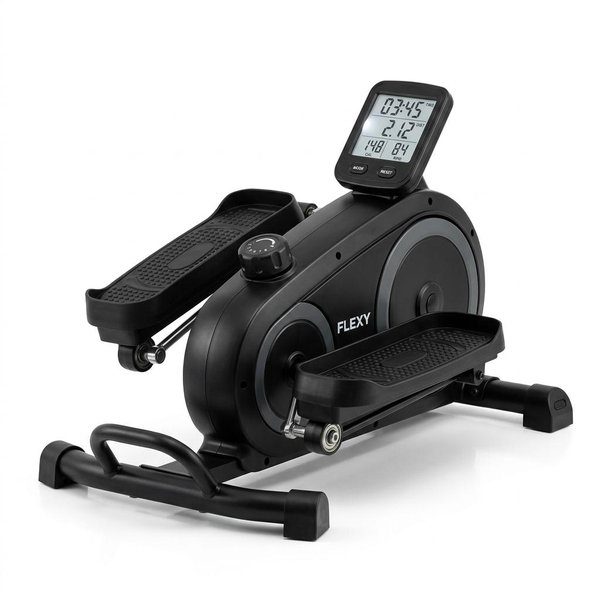
For users whose joint pain limits even standard low-impact exercise, under-desk options provide movement at the lowest possible intensity. The seated position, minimal resistance, and continuous motion promote circulation and maintain range of motion without meaningful joint stress.
Joint Benefits:
Best For: Severe joint limitations, post-surgical early mobilization, extreme deconditioning, elderly users with balance limitations
Recommended Models: DeskCycle 2 Under Desk Bike or Cubii JR1 Seated Elliptical
While not a home machine option, water exercise deserves mention as the lowest-impact cardio available. Water buoyancy reduces body weight by 80–90% when submerged to chest depth, effectively eliminating joint loading while providing natural resistance to movement.
Joint Benefits:
Best For: Severe arthritis, post-surgical rehabilitation, fibromyalgia, obesity with joint pain
Start Conservative: Begin with durations and intensities well below what you think you can handle. A successful low-impact program builds gradually from a foundation of pain-free sessions. Starting too aggressively risks joint irritation that sets progress back weeks.
Consistency Over Intensity: Three 20-minute moderate sessions weekly produce better joint outcomes than one 60-minute aggressive session. Frequent, moderate loading promotes synovial fluid circulation and cartilage nutrition without overwhelming joint tolerance.
Monitor Pain Response: Distinguish between acceptable exercise discomfort and concerning joint pain:
| Acceptable Discomfort | Stop Immediately |
|---|---|
| General muscle fatigue | Sharp, stabbing joint pain |
| Mild warmth in joints | Pain that alters your movement pattern |
| Slight stiffness that resolves within 30 minutes | Pain that persists or worsens 24 hours post-exercise |
| Heavy breathing, elevated heart rate | Swelling in or around the joint |
Knee Osteoarthritis:
Hip Conditions:
Lower Back Pain:
Rheumatoid Arthritis:
For users whose goal includes eventual return to higher-impact activities, this progression protocol provides a safe pathway:
| Phase | Duration | Focus | Criteria to Advance |
|---|---|---|---|
| Phase 1 | Weeks 1–4 | Recumbent cycling only | 30 minutes pain-free |
| Phase 2 | Weeks 5–8 | Add elliptical training | 30 minutes elliptical pain-free |
| Phase 3 | Weeks 9–12 | Add rowing or upright cycling | No pain 24 hours post-exercise |
| Phase 4 | Weeks 13–16 | Introduce walking on treadmill | 20 minutes walking pain-free |
| Phase 5 | Week 17+ | Gradual jogging introduction | No pain during or after jogging |
This is a conservative timeline. Some users may advance faster; others may need extended periods at each phase. Let pain response, not calendar dates, guide progression.
Combining multiple low-impact modalities often produces superior results to single-modality training:
The Joint-Friendly Weekly Schedule:
| Day | Activity | Duration | Notes |
|---|---|---|---|
| Monday | Recumbent cycling | 30 min | Moderate resistance, 70 RPM |
| Tuesday | Elliptical (forward) | 25 min | Low-moderate resistance |
| Wednesday | Rest or gentle stretching | — | Active recovery |
| Thursday | Rowing (if back-healthy) or cycling | 25 min | Technique focus |
| Friday | Elliptical (reverse) | 20 min | Emphasize glutes and hamstrings |
| Saturday | Recumbent cycling | 30–40 min | Longer steady-state |
| Sunday | Rest | — | Full recovery |
This schedule distributes loading across different joints and movement patterns while providing adequate recovery between similar sessions.
Consult a physician before beginning low-impact exercise if you experience:
A physician or physical therapist can provide specific guidance based on your diagnosis, imaging results, and current functional status. The recommendations in this guide apply to general cases; individual circumstances may require modifications.
Joint pain doesn't have to end your fitness journey—it simply changes the path. Low-impact cardio machines provide effective cardiovascular conditioning while respecting vulnerable joints. The recumbent bike offers the safest starting point for most users. The elliptical provides weight-bearing benefits without impact. Rowing delivers unmatched full-body efficiency for those with healthy backs. Under-desk options keep moving when standing exercise isn't possible.
Start conservatively, progress gradually, and let your body's response guide your programming. The goal isn't to find the hardest workout you can tolerate—it's to build consistent, pain-free movement habits that accumulate into meaningful fitness improvements over months and years. With appropriate machine selection and programming, joint-friendly cardio can become a sustainable, enjoyable part of your daily routine.