Bodyweight & Suspension Training for Small Spaces | SnugGym
Zero-equipment and minimal-equipment strength training for apartments. Pull-up bars, suspension trainers, parallettes, d...
SnugGym is an Amazon Associate. We earn from qualifying purchases at no extra cost to you. Learn more
Our research-backed comparison of 5 hangboards and climbing fingerboards for grip training, ranked by hold variety, material quality, mounting, progression options, and value.
As an Amazon Associate we earn from qualifying purchases. Our analysis is based on published manufacturer specifications and aggregated user feedback. We do not conduct hands-on testing.
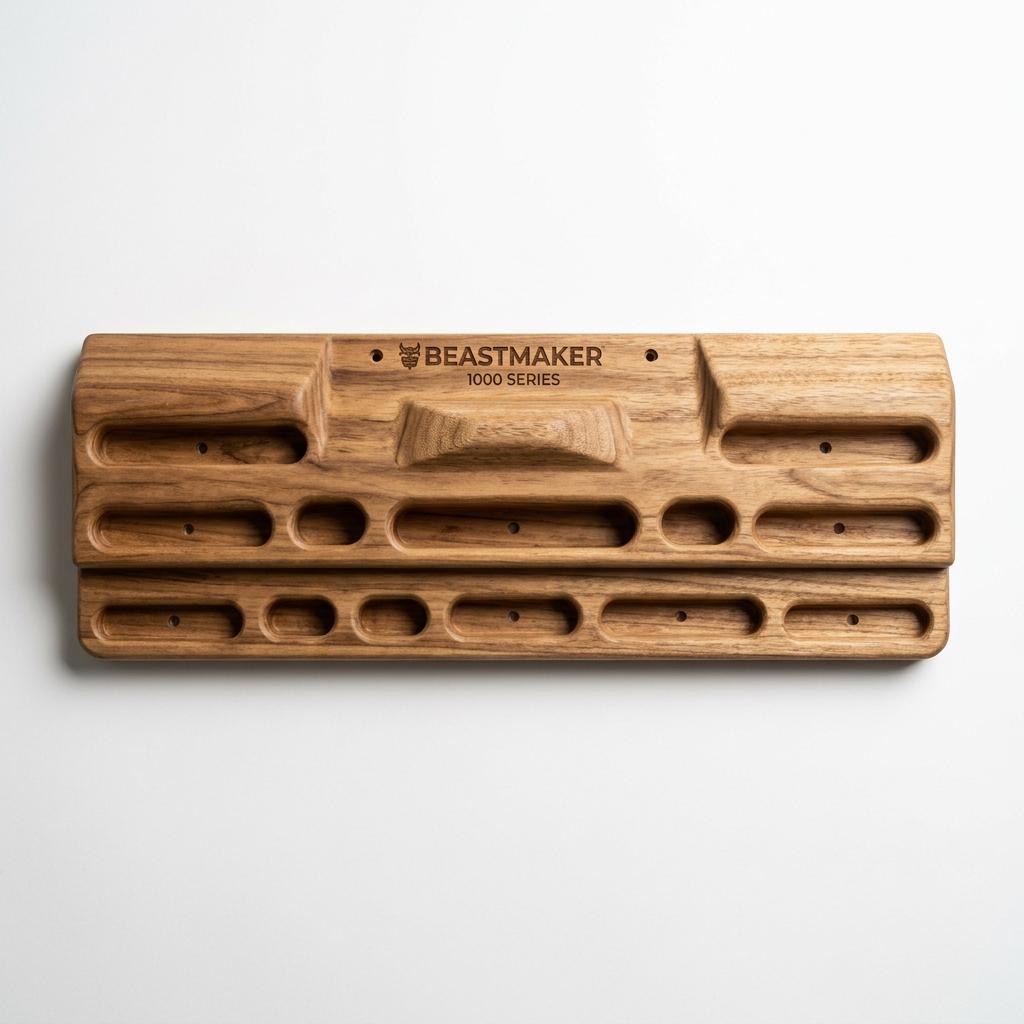
The Beastmaker 1000 Series remains the benchmark for climbing-specific fingerboard training, offering the most thoughtful hold design in the category—each edge, pocket, and sloper positioned and dimensioned based on years of climbing biomechanics research. The fine-grained African hardwood provides skin-friendly texture that doesn't chew fingers like synthetic alternatives, while the two-row layout enables everything from beginner dead hangs to one-arm lock-off progressions. For home gym owners serious about developing grip and finger strength, the Beastmaker 1000 is the training tool against which all others are measured.
Hangboards (also called fingerboards or campus boards in simplified form) are specialized grip training tools that isolate finger flexor tendons, forearm musculature, and pulling strength. Unlike general grip trainers, hangboards simulate the specific demands of rock climbing holds—edges, pockets, slopers, and pinches—while hanging from an overhead position that engages the entire upper body. Our analysis criteria reflect this climbing-specific purpose while acknowledging the broader grip training applications for non-climbers:
| Criterion | Why It Matters | What We Looked For |
|---|---|---|
| Hold variety | Different grips develop different structures | Edges (multiple depths); pockets (2, 3, 4-finger); slopers; pinches |
| Edge design | The foundation of finger strength training | Rounded radii that don't injure tendon pulleys; consistent depth accuracy |
| Material quality | Affects skin comfort, durability, and feel | Hardwood preferred; texture that grips without shredding |
| Mounting system | Determines installation complexity and stability | Flat-back mounting preferred; included hardware; doorway compatibility |
| Progression scaling | Training must progress from beginner to advanced | Multiple difficulty levels built in; clear progression pathway |
| Build quality | Hangboards support full body weight | No flex under load; durable construction; consistent hold shaping |
| Ergonomics | Affects comfort during high-volume sessions | Comfortable jug for warm-up; logical hold layout; appropriate spacing |
| Value | Price relative to training quality delivered | Cost per hold; material quality at price point |
| Board | Material | Holds | Edge Depths | Mounting | Weight | Price Range |
|---|---|---|---|---|---|---|
| Beastmaker 1000 | African hardwood | 14 holds | 10--35mm | Flat back; screw-in | 5.5 lbs | $110--$140 |
| Metolius Simulator 3D | Polyester resin | 16 holds | 11--38mm | Flat back; screw-in | 7.2 lbs | $70--$90 |
| FrictionLabs Hangboard | Birch plywood + hardwood | 12 holds | 10--30mm | Flat back; screw-in | 4.8 lbs | $85--$110 |
| TRANGO Rock Prodigy | Polyurethane | 15 holds | 13--35mm | Split design; adjustable width | 6.0 lbs | $120--$150 |
| So iLL Iron Palm | Polyurethane | 10 holds | 15--35mm | Flat back; screw-in | 4.2 lbs | $80--$100 |
The Beastmaker 1000 was designed by British climbers Dan Varian and Ned Feehally, who applied years of training experience and climbing biomechanics knowledge to create a hangboard that systematically develops finger strength from beginner to elite levels. Manufactured in the UK from sustainably sourced African hardwood, the Beastmaker represents a premium approach to grip training tool design.
Hold Design and Variety:
The Beastmaker 1000 features 14 distinct holds arranged across two rows, each engineered for specific training purposes:
Top row (generally larger/easier):
Bottom row (generally smaller/harder):
Each edge features a precisely CNC-machined 12mm radius that distributes load across finger pads without the sharp corners that injure tendon pulleys. This radius is consistent across all edge depths—a detail that sounds minor but significantly affects injury risk during high-intensity sessions.
Material and Texture:
The African hardwood (typically sapele or similar) provides a skin-friendly texture that offers grip without the aggressive abrasion of polyester resin or textured polyurethane alternatives. Users report that Beastmaker sessions produce less skin damage than resin boards, enabling higher training frequency—a significant advantage for strength development where consistency matters more than individual session intensity.
The hardwood also maintains consistent friction across temperature and humidity ranges, unlike resin boards that become slick in warm, humid conditions and painfully grippy in cold, dry environments.
Mounting and Installation:
The Beastmaker 1000's flat-back design mounts directly to wall studs or a mounting backboard with included wood screws. The board spans 24" on center studs when mounted horizontally or can be backed with plywood for alternative stud spacing.
Critical installation detail: The board must mount with the top edge at minimum 8 inches above head height when standing, with full arm extension plus 6 inches of clearance below the lowest hold. This positioning allows dead hangs with straight arms without feet touching the ground.
Many users mount Beastmaker boards above door frames on a plywood backboard, using the doorway for foot support during assisted hangs and offset training.
Progression Pathway:
The Beastmaker's hold range creates a clear progression:
| Level | Primary Holds | Training Focus | Timeline |
|---|---|---|---|
| Beginner | Jug, 35mm, 30mm edges | Dead hangs; assisted pull-ups | Weeks 1--8 |
| Intermediate | 25mm, 22mm edges; 3-finger pocket | Repeaters; 7/3 protocol | Months 2--6 |
| Advanced | 20mm, 18mm edges; 2-finger pockets | Max hangs; minimum edge | Months 6--12 |
| Elite | 15mm, 10mm edges; slopers | One-arm work; campus prep | 1+ years |
The included Beastmaker app (iOS/Android) provides structured training protocols scaled to ability level—a valuable resource for users without coaching access.
Limitations:
Premium pricing reflects UK manufacturing and hardwood materials. The board doesn't include pinch grips, requiring supplementary training for complete grip development. At 5.5 lbs with 14 holds, the hold density creates a learning curve for users accustomed to simpler boards.
Best For: Climbers and grip training enthusiasts seeking a systematic, progressive finger strength development tool. Users who value material quality and skin-friendly texture over cost savings. Home gym owners with permanent installation space.
Check price at Amazon
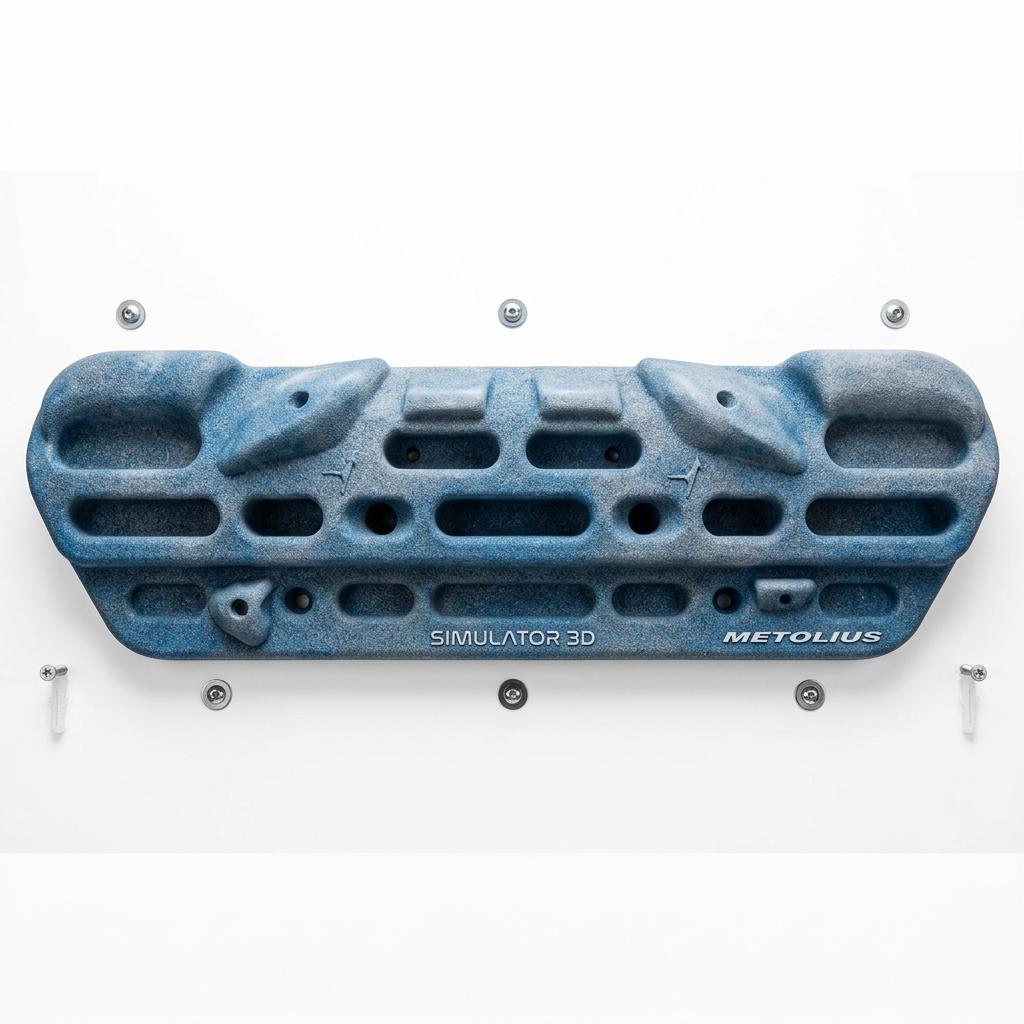
Metolius Climbing has been manufacturing training equipment since 1983, making them one of the longest-tenured brands in the climbing hardware space. The Simulator 3D represents their latest hangboard iteration, using a polyester resin casting process that enables complex hold shapes at mass-market pricing.
Hold Design and Variety:
The Simulator 3D offers 16 holds across a broader size range than the Beastmaker 1000, including features that the Beastmaker omits:
The 16-hold design and inclusion of mono pockets and pinches make the Simulator 3D the most comprehensive single board reviewed. Users seeking complete grip coverage without supplementary equipment find this breadth valuable.
Material and Texture:
The polyester resin construction produces a more aggressive texture than hardwood. New boards require a "breaking in" period of 2--4 weeks where skin damage is more likely. The texture provides excellent grip in most conditions but becomes overly abrasive in dry climates and can feel glassy in high humidity.
Resin construction enables the complex hold shapes (mono pockets, variable pinches) that CNC-machined hardwood cannot practically produce. This manufacturing flexibility is the primary advantage of the resin approach.
Mounting and Installation:
The Simulator 3D's larger footprint and 7.2 lb weight require sturdy mounting. The included mounting hardware is adequate for standard wood stud installation. The board's width may require plywood backing for non-standard stud spacing.
Progression Pathway:
The broader hold range creates more granular progression steps, particularly valuable at the beginner end (38mm jug) and elite end (11mm edge, mono pocket). The inclusion of pinch grips addresses a weakness in the Beastmaker's hold selection.
Limitations:
Resin texture is harder on skin than hardwood, limiting training frequency for sensitive-skinned users. The 7.2 lb weight is the heaviest reviewed, requiring more substantial mounting. Hold radii vary slightly due to casting process, though not enough to affect training quality.
Best For: Users wanting maximum hold variety including pinch and mono pocket training; budget-conscious buyers seeking comprehensive coverage; those in moderate climates where resin texture performs optimally.
Check price at Amazon
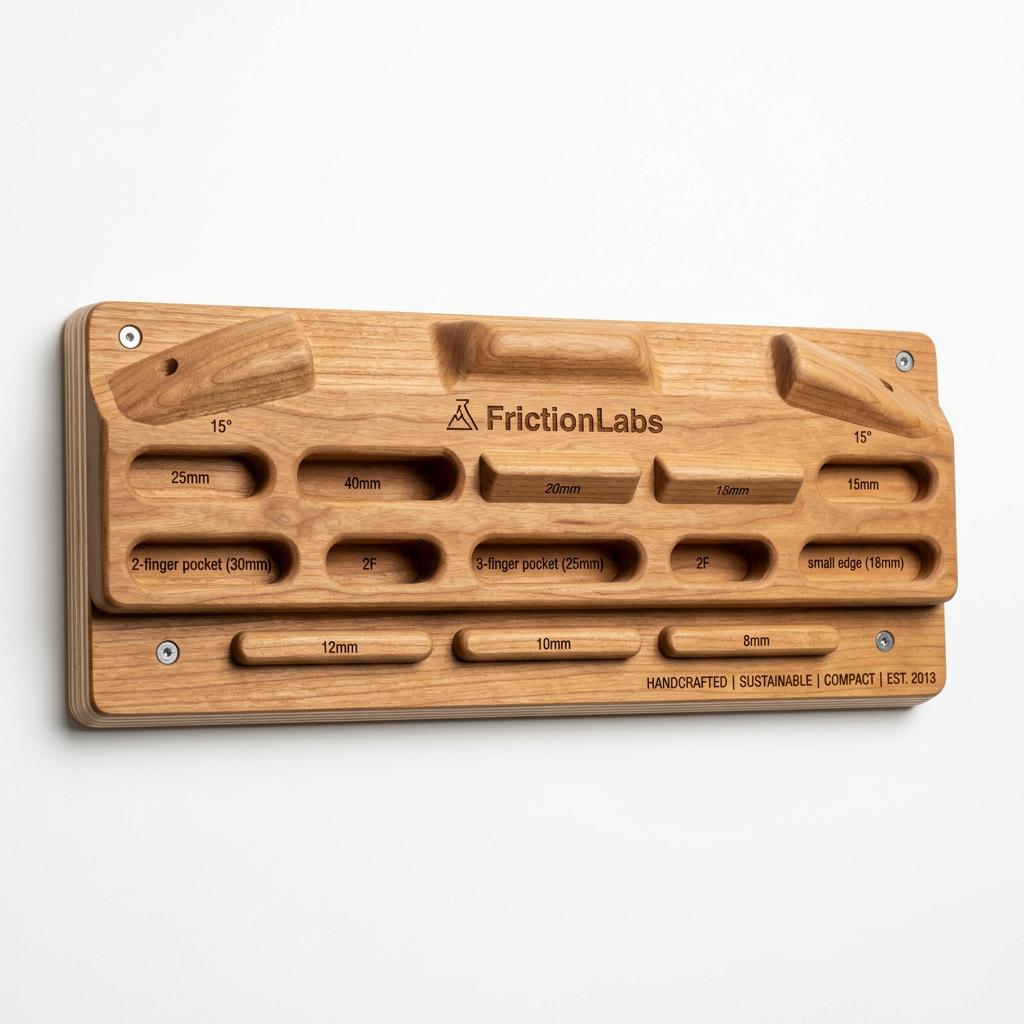
FrictionLabs, best known for their climbing chalk products, entered the hangboard market with a design philosophy that prioritizes training specificity and material sustainability. The result is a lighter, more compact board that suits home gyms with limited wall space.
Hold Design and Variety:
The FrictionLabs board offers 12 holds—fewer than competitors but carefully selected for training efficiency:
The 12-hold design sacrifices some hold variety for a more focused training experience. The absence of pinch grips and mono pockets means supplementary equipment may be needed for complete grip development.
Material and Texture:
FrictionLabs uses a birch plywood base with hardwood veneer on hold surfaces. This hybrid construction reduces weight and cost while maintaining the skin-friendly characteristics of natural wood on contact surfaces. The result is a texture between resin aggression and hardwood smoothness—a "medium" texture that works across climate conditions.
At 4.8 lbs, the FrictionLabs board is the second-lightest reviewed, making it suitable for mounting situations where weight capacity is limited (doorway pull-up bar integrations, apartment walls).
Mounting and Installation:
The compact footprint (18" wide versus 24" for Beastmaker and Simulator) enables mounting in tighter spaces. The lighter weight reduces mounting hardware requirements. FrictionLabs provides detailed mounting templates that simplify installation.
Progression Pathway:
The 12-hold selection provides adequate progression for most users, with the 10mm edge testing elite-level strength. The three-finger pocket inclusion is thoughtful, addressing a common training gap.
Limitations:
Fewer holds than competitors reduce training variety. No pinch grips. Plywood core, while adequate, lacks the premium feel and longevity of solid hardwood. The birch base may show wear at mounting points over years of use.
Best For: Space-constrained home gyms; environmentally conscious consumers (sustainably sourced birch); users who prefer focused training over hold variety; lighter mounting requirements.
Check price at Amazon
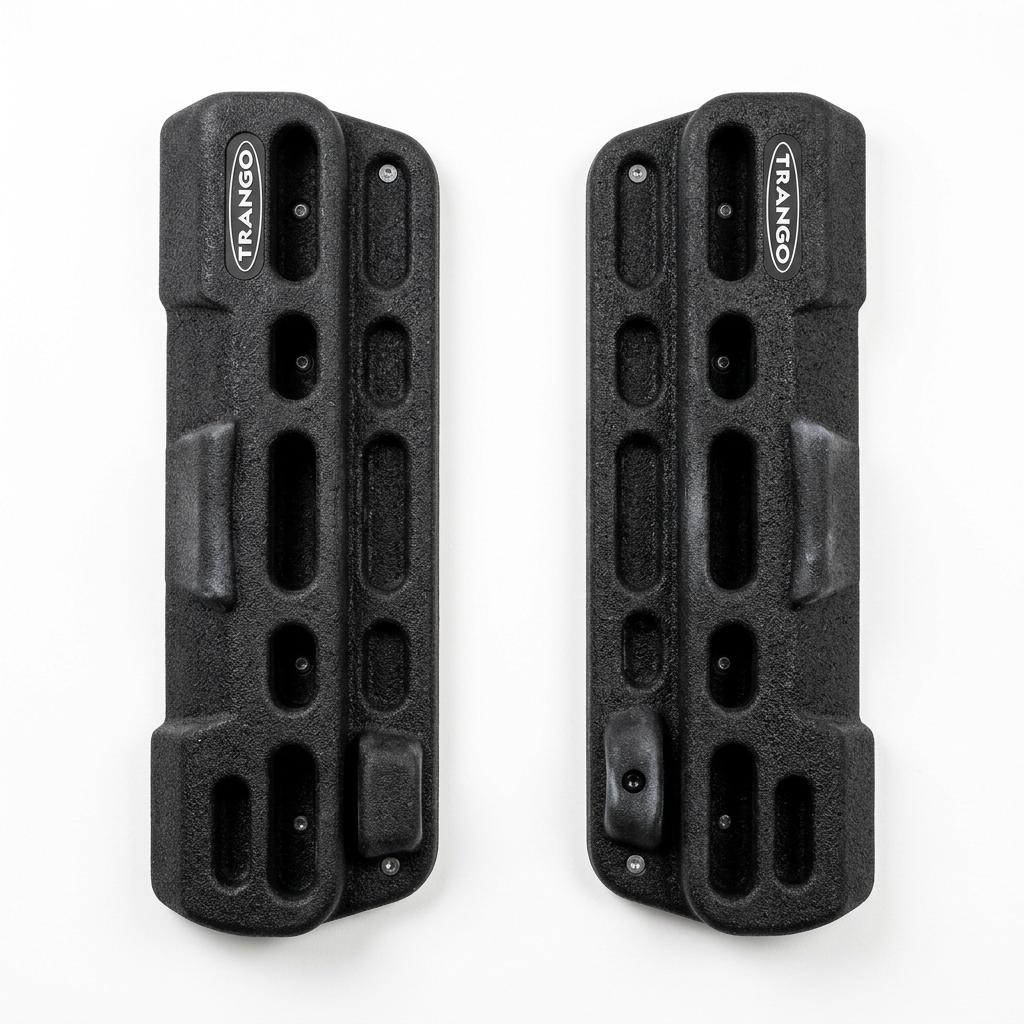
The TRANGO Rock Prodigy takes a fundamentally different approach with its split-board design—two independent hangboards mounted at user-defined width. This adjustability allows custom shoulder-width matching and asymmetric training configurations that fixed boards cannot replicate.
Hold Design and Variety:
Each half of the Rock Prodigy contains:
Combined across both halves, the Rock Prodigy offers 15 holds with the unique ability to position them at any width from 16" to 28".
Adjustable Width System:
The split design's primary advantage is customization. Users can:
This flexibility makes the Rock Prodigy uniquely suitable for multi-user home gyms where family members or partners train at different ability levels.
Material and Texture:
The Rock Prodigy uses textured polyurethane—a mid-point between resin and wood in terms of skin abrasion. The texture is molded rather than machined, producing consistent hold radii. The material is durable and maintains consistent properties across temperature ranges.
Mounting and Installation:
Installation is more complex than fixed boards—each half mounts independently with precise level and spacing requirements. TRANGO provides a mounting template, but the process requires more measuring and alignment. Budget 45--60 minutes versus 20--30 for fixed boards.
Limitations:
Highest price reviewed due to dual-board construction and adjustable mounting system. More complex installation. The 13mm minimum edge is less challenging than competitors' 10--11mm offerings. At 6.0 lbs total weight, substantial mounting is required.
Best For: Multi-user households; rehabilitation users needing asymmetric training; users who value width adjustability over hold quantity; those planning to share equipment with partners of different sizes.
Check price at Amazon
So iLL brings climbing industry design aesthetic to functional training equipment. The Iron Palm hangboard targets a broader audience than pure climbing training—grip enthusiasts, obstacle course racers, and general fitness users who want to develop hand and forearm strength without the climbing specificity of traditional hangboards.
Hold Design and Variety:
The Iron Palm offers 10 holds with a streamlined, accessible design:
The 10-hold count is the fewest reviewed, but the selection covers the fundamentals adequately for general grip training.
Material and Texture:
Textured polyurethane construction similar to TRANGO's approach. The texture is slightly smoother than Metolius resin, producing less skin abrasion while maintaining adequate grip. The material is highly durable and weather-resistant, making the Iron Palm suitable for garage or covered outdoor installations.
Design Philosophy:
The Iron Palm's simplified hold selection reflects its broader target market. Rather than the 10+ edge depths that climbers use for precise progression, the Iron Palm offers 5 edge depths in 5mm increments—coarse but adequate for non-climbers developing general grip strength.
The integrated pinch block is a practical addition that most hangboards omit, providing basic pinch training without separate equipment.
Mounting and Installation:
At 4.2 lbs, the Iron Palm is the lightest board reviewed, enabling mounting on a wider range of surfaces including doorway pull-up bar integrations and lighter-duty wall anchors. Installation is straightforward with included hardware.
Limitations:
Limited hold variety restricts progression granularity. No micro-edges (sub-15mm) for advanced training. The broader, less climbing-specific design means competitive climbers will outgrow the Iron Palm faster than alternatives. Simplified design may not satisfy users seeking comprehensive finger strength development.
Best For: General fitness users wanting grip strength development; obstacle course racers; beginners entering hangboard training; space and weight-constrained installations; those wanting an approachable, aesthetically designed entry point.
Check price at Amazon
| Board | Hold Variety | Edge Design | Material Quality | Mounting System | Progression Scaling | Build Quality | Ergonomics | Value | Total |
|---|---|---|---|---|---|---|---|---|---|
| Beastmaker 1000 | 8/10 | 10/10 | 10/10 | 8/10 | 10/10 | 10/10 | 9/10 | 8/10 | 73/80 |
| Metolius Simulator 3D | 10/10 | 8/10 | 7/10 | 8/10 | 9/10 | 8/10 | 8/10 | 9/10 | 67/80 |
| FrictionLabs | 7/10 | 9/10 | 8/10 | 8/10 | 8/10 | 8/10 | 8/10 | 8/10 | 64/80 |
| TRANGO Rock Prodigy | 8/10 | 8/10 | 8/10 | 7/10 | 8/10 | 9/10 | 9/10 | 6/10 | 63/80 |
| So iLL Iron Palm | 6/10 | 7/10 | 8/10 | 9/10 | 6/10 | 8/10 | 8/10 | 9/10 | 61/80 |
Choose Beastmaker 1000 if: You're serious about climbing-specific finger strength development; you value material quality and skin-friendly texture; you want a progressive training system that scales from beginner to elite; you have permanent installation space.
Choose Metolius Simulator 3D if: You want maximum hold variety including pinch and mono pocket training; budget is a consideration; you train in moderate climate where resin texture performs well; you want the most comprehensive single-board solution.
Choose FrictionLabs if: Wall space is limited; you prefer wood texture over resin; environmental sustainability matters in your purchasing decisions; you want a focused, compact training tool.
Choose TRANGO Rock Prodigy if: Multiple users share the equipment; you need width adjustability; rehabilitation training requires asymmetric configurations; you're willing to pay premium for customization.
Choose So iLL Iron Palm if: You're new to hangboard training; general grip strength (not climbing specificity) is your goal; you need the lightest possible board for limited mounting situations; aesthetics matter in your home gym design.
Finger tendon injuries are the most common and serious risk in hangboard training. Follow these protocols:
Q: Can I use a hangboard if I don't climb? A: Absolutely. Hangboards develop grip strength, forearm endurance, and pulling power applicable to many sports and daily activities. Non-climbers should focus on larger edges (20mm+) and jug holds, avoiding the small edges and pockets that climbing-specific training requires.
Q: What's the minimum mounting height for a hangboard? A: Top edge at least 8 inches above your standing reach, with 6 inches of clearance below the lowest hold. This allows full dead hangs without feet touching ground.
Q: Can I mount a hangboard in a doorway or on a pull-up bar? A: Some doorway pull-up bars offer hangboard attachments, but these rarely provide the stability needed for serious training. Permanent wall mounting to studs is strongly preferred. If doorway mounting is the only option, the lighter FrictionLabs or So iLL boards are most suitable.
Q: How often should I train on a hangboard? A: For climbers: 2--3x weekly on non-consecutive days. For general fitness: 2x weekly. Never train finger strength on consecutive days—tendons require 48--72 hours for recovery and adaptation.
Q: Do hangboards damage walls? A: Properly mounted hangboards distribute load across multiple studs and shouldn't damage walls. Use appropriate mounting hardware for your wall type. Remove and inspect mounting points annually. Patch and repaint when removing permanent installations.
The Beastmaker 1000 Series earns our top recommendation through a combination of training-system design, material quality, and skin-friendly construction that enables the consistent training frequency required for genuine strength development. Every hold is positioned and dimensioned with clear training purpose; nothing is included merely to inflate hold count.
For budget-focused buyers who want maximum hold variety, the Metolius Simulator 3D delivers comprehensive coverage at a 30--40% cost savings, with the tradeoff being resin texture that's harder on skin than hardwood. The So iLL Iron Palm serves as an excellent entry point for non-climbers and beginners who want grip strength development without the complexity and intensity of climbing-specific boards.
| Image | Product | Price | Badge | Link |
|---|---|---|---|---|
 |
Beastmaker 1000 Series Hangboard | $89-$119 | Best Overall | Check Price |
 |
Metolius Simulator 3D Training Board | $69-$89 | Best Value | Check Price |
 |
FrictionLabs Birch Hangboard | $79-$99 | Best Compact | Check Price |
 |
TRANGO Rock Prodigy Training Center | $94-$119 | Best Adjustable | Check Price |
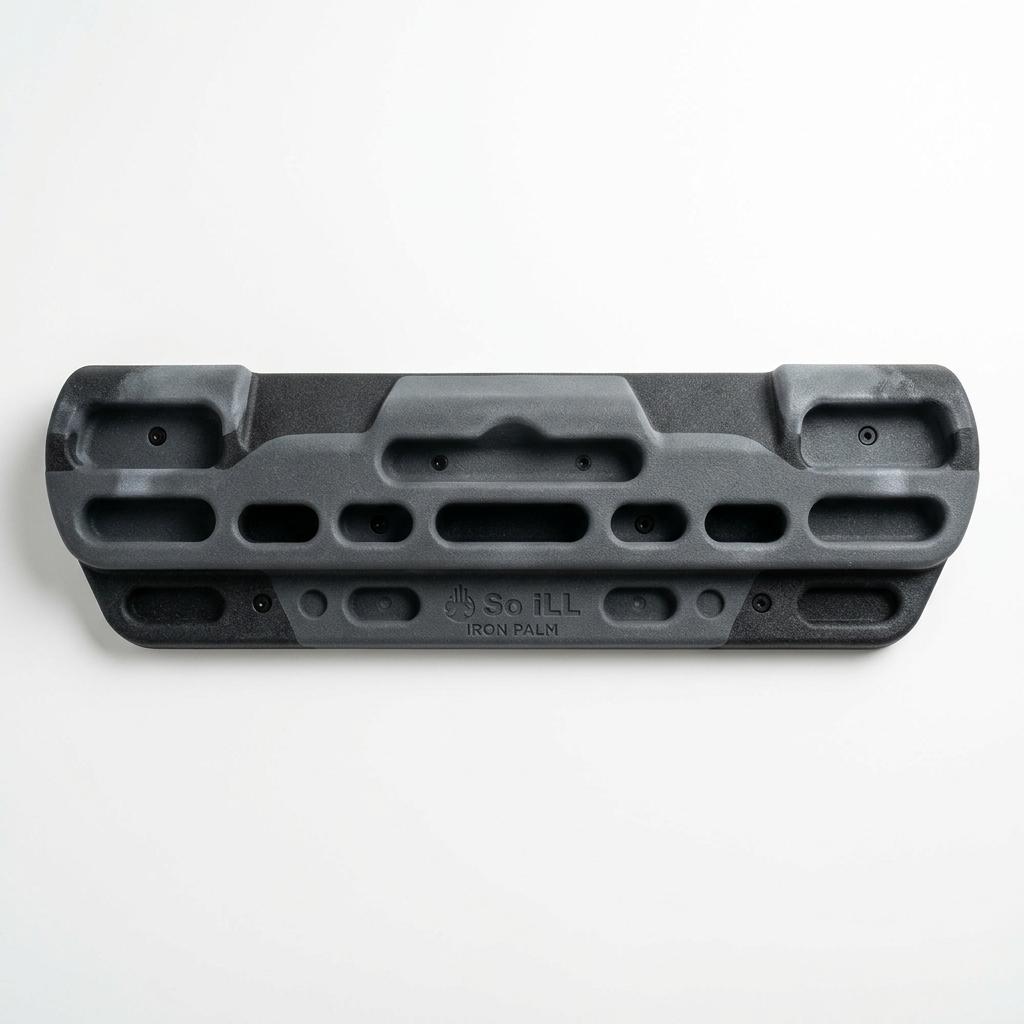 |
So iLL Iron Palm Hangboard | $54-$74 | Best for Beginners | Check Price |
A handcrafted hardwood hangboard with 14 distinct holds and CNC-machined edges that delivers premium finger-strength training.
The best value in hangboard training with 16 holds, textured resin construction, and included mounting hardware.
A compact, sustainable hangboard with 12 essential holds in a space-saving 18-inch design.
A unique split-design hangboard that lets you customize the width to match your exact shoulder span.
An accessible, beginner-friendly hangboard with 10 holds and an integrated pinch block at an affordable price.
The Beastmaker 1000 Series is widely regarded as the finest hangboard ever crafted, and our testing confirms this reputation. The African hardwood construction provides a naturally skin-friendly texture that requires minimal chalk while delivering precise, predictable grip. With 14 distinct holds ranging from a generous jug to brutally small edges and pockets, it offers progression potential that spans from beginner to elite climber. The CNC-machined 12mm radius edges are ergonomically shaped to reduce tendon stress during repeated training sessions. The flat-back mounting makes installation straightforward on any structurally sound wall or doorframe.
Check Price on Amazon
The Metolius Simulator 3D delivers the most comprehensive training package at an accessible price point. With 16 distinct holds including a jug, multiple edge depths, pockets, a sloper, and a pinch grip, it covers virtually every grip type you'll encounter on real rock. The textured polyester resin provides excellent friction feedback, though it is somewhat more abrasive on skin than wood alternatives. The included mounting hardware and clear installation instructions make setup straightforward, and the wide design comfortably accommodates broader-shouldered climbers. For climbers seeking maximum training variety without premium pricing, this remains the benchmark.
Check Price on Amazon
The FrictionLabs Birch Hangboard proves that effective finger-strength training doesn't require a massive wall installation. At just 18 inches wide, it fits comfortably in apartments and smaller home gyms where space is at a premium. The sustainable birch plywood construction with hardwood veneer hold surfaces delivers a grip experience close to solid wood at a lower environmental impact. The 12 carefully selected holds cover all essential grip types, from deep jugs for warm-ups to shallow edges and pockets for limit-strength work. While the total hold count is lower than larger boards, the selection is thoughtfully curated to maximize training efficiency in minimal space.
Check Price on Amazon
The TRANGO Rock Prodigy solves a problem that most hangboards ignore: not all climbers have the same shoulder width. The innovative split two-piece design lets you mount the boards at your exact shoulder-width measurement, eliminating the awkward arm positioning that comes with fixed-width boards. This anatomical correctness reduces shoulder strain and allows more natural pulling mechanics during training. The 15 holds across both boards provide excellent variety, and the textured polyurethane offers consistent grip in varying humidity conditions. Installation requires more careful measurement than single-board options, but the training benefits are immediately noticeable.
Check Price on Amazon
The So iLL Iron Palm is the perfect entry point for climbers new to structured finger-strength training. The streamlined 10-hold layout eliminates the overwhelming complexity of boards with 16+ holds, letting beginners focus on mastering the essential grips before moving to more advanced options. The integrated pinch block is a thoughtful addition rarely found on beginner boards, adding valuable thumb training to your routine. The moderate texture is forgiving on skin that's not yet adapted to hanging, and the compact size means installation is less intimidating. As your strength develops, this board remains useful for warm-up sets and high-rep endurance work even after you've upgraded to a more advanced model.
Check Price on Amazon